
Vendor routing guide compliance changes how manufacturers and distributors manage inbound freight. It brings structure to how materials, components, and finished goods move into their facilities. Many transportation teams focus only on outbound shipments, the freight leaving the warehouse. Inbound logistics is just as important and often represents a large percentage of the total freight spend.1 When vendors control carrier selection without shipper oversight, costs rise quickly. Suppliers choose familiar carriers, not the most efficient ones. Transportation charges increase and visibility drops. The result is higher freight spend, limited performance insight, and fewer opportunities to improve the supply chain. A routing guide restores control and brings inbound freight back into a measurable, manageable process.
Effective vendor routing guide compliance programs set clear rules for how suppliers should handle inbound shipments. They state which carriers must be used, what service levels apply, and how freight costs get tied back to purchase orders. These rules give structure where it did not exist before. Inbound freight differs from outbound shipping, where your own traffic or logistics team chooses carriers and manages load tendering. In inbound shipping, suppliers traditionally made their own decisions, without your visibility or direction.
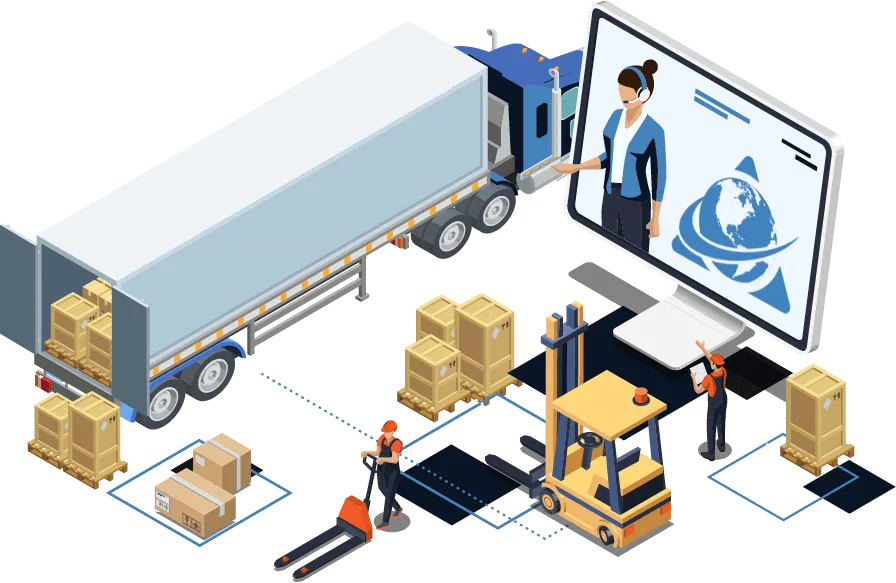
The real difference between unmanaged vendor shipping and a strategic routing guide compliance program comes down to control, visibility, and cost. When suppliers are left on their own, they often select carriers they already know. They negotiate rates individually without pulling in your total freight volume. This weakens your leverage and usually leads to higher costs built into product pricing. In practice, suppliers will add transportation costs and markup that procurement teams do not directly see or manage, creating hidden expense and inefficiency. Research on freight and supplier selection highlights the complexity of transportation decision-making and the value of structured guidance in aligning supplier decisions with network flows and cost goals.2
Modern vendor routing guide compliance programs leverage transportation management system (TMS) technology, specifically inbound vendor portals, enabling suppliers to access your pre-negotiated carrier rates, book shipments electronically, and transmit critical shipment data that purchasing and procurement teams use for proactive supply chain management. This visibility transforms inbound logistics from an uncontrolled variable into a managed, optimized function supporting broader business objectives.
What Is Inbound Logistics? A Comprehensive Definition
Inbound logistics encompasses all activities involved in receiving, unloading, and managing the flow of materials, components, and finished goods coming into your facilities from suppliers, vendors, and manufacturing partners. According to the Council of Supply Chain Management Professionals (CSCMP), effective logistics management requires coordinating the efficient and effective movement of goods throughout the supply chain, which includes both inbound and outbound flows.3
The scope of inbound logistics extends beyond simple transportation to include:
- Purchase order management: Tracking which materials ship when, from which suppliers, and confirming expected delivery dates align with production schedules.
- Carrier selection and routing: Determining which transportation providers move inbound freight, what service levels apply, and how shipments route through your distribution network.
- Shipment visibility and tracking: Monitoring inbound freight in transit, identifying delays proactively, and communicating with internal teams about arrival times.
- Receiving operations: Coordinating dock scheduling, labor planning, and warehouse processes that handle incoming shipments efficiently.
- Invoice reconciliation: Matching freight charges back to specific purchase orders, validating rates against contracts, and processing payments accurately.
- Vendor performance management: Measuring supplier compliance with routing instructions, on-time shipping performance, documentation accuracy, and packaging standards.
While outbound logistics receives significant attention because it directly impacts customer delivery experience, inbound logistics performance dramatically affects manufacturing efficiency, inventory levels, and total landed cost. Late inbound shipments stop production lines. Poor inbound visibility creates inventory uncertainty. Uncontrolled inbound costs erode product margins.
The Critical Role of Dynamic TMS-Based Vendor Routing Guides

Traditional vendor routing guides consist of static documents, spreadsheets or PDF files listing carrier names and contact information with instructions like “always use Carrier X for LTL shipments” or “call Carrier Y for truckload moves.” This approach fundamentally fails for less-than-truckload (LTL) shipping because it ignores the dynamic nature of LTL pricing and the reality that the least cost provider (LCP) changes based on multiple variables.
Why Static Routing Guides Fail for LTL Freight
LTL carrier rates depend on intricate calculations considering:
Hundredweight (CWT) breaks: Carriers provide progressively better per-pound pricing as shipment weight increases. A 500-pound shipment receives one rate structure; a 1,500-pound shipment qualifies for lower CWT pricing from the same carrier. The optimal carrier at 500 pounds may not be optimal at 1,500 pounds. Professional logistics training materials explain that carrier rate books use weight-break categories. The shipment pricing is quoted on a cost-per-hundredweight (CWT) basis. That is why it is important to use a TMS rating engine as it automatically makes the calculations. As shipment weight moves into higher weight breaks (for example, under 500 lbs, 500–999 lbs, and 1,000–1,999 lbs), the applicable CWT rate typically declines. When the CWT declines it is reducing the per-unit transportation cost of heavier shipments.4
Density and freight class: The National Motor Freight Classification® (NMFC)™ system assigns commodities to freight classes based primarily on density (pounds per cubic foot).5 Rate differences between Class 55 and Class 100 can exceed 30-40%. Carriers specialize in different freight classes; the best provider for high-density freight may not compete effectively on low-density shipments.
Accessorial charges: Liftgate service, residential delivery, limited access fees, inside delivery, and other accessorial charges vary dramatically by carrier. One carrier might charge $75 for liftgate while another charges $125. When accessorials apply, they can shift which carrier offers the true least cost.
Origin and destination geography: LTL carriers maintain terminal networks with varying geographic coverage. A carrier with strong presence in the Southeast may offer excellent rates from Georgia to Florida. However, that same motor carrier cannot compete on lanes from California to Oregon. The optimal carrier changes based on specific origin-destination pairings.
Service requirements and transit time: Some shipments require transit time specific accessorials, like guaranteed delivery within specific time windows. However other carriers might only accept standard service. Guaranteed LTL service commands premium pricing. The least cost provider differs based on service level requirements.
Drop-shipping amplification: When vendors drop-ship directly to your customers rather than your facilities, the complexity multiplies. Now origin points vary based on each vendor’s location, destination points scatter across customer addresses, and shipment characteristics differ based on customer order profiles. Static routing guides cannot possibly account for this variability.
How Dynamic TMS-Based Routing Delivers LCP Every Time
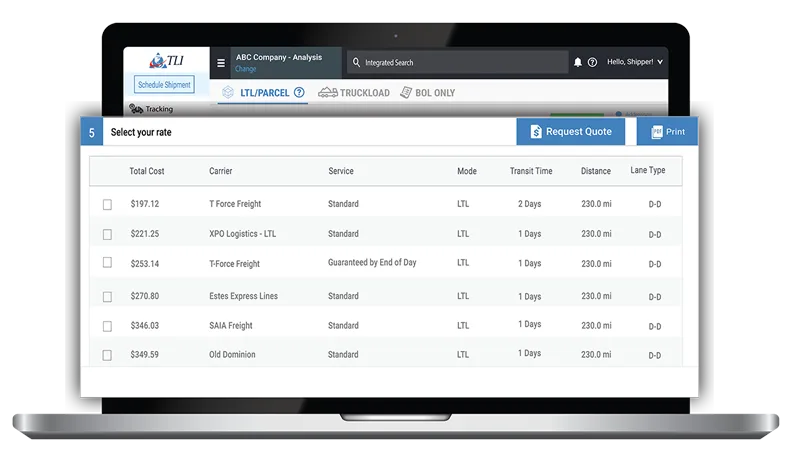
TLI’s ViewPoint TMS solves this fundamental problem through its integrated vendor portal that performs real-time carrier rating and selection. This helps because when suppliers access the portal to book inbound shipments, the system:
- Captures complete shipment details: Origin address, destination facility, total weight, dimensions, freight class, commodity description, and any required accessorial services.
- Rates across all contracted carriers: The TMS queries rates from every LTL carrier you’ve negotiated contracts with. The rating engine applies your specific discount levels, fuel surcharge formulas, and accessorial schedules.
- Calculates total delivered cost: The TMS system accounts for base freight charges, fuel surcharges, and applicable accessorial fees. The rating engine is computing the true all-in cost for each carrier option.
- Selects the least cost provider dynamically: Based on this specific shipment’s characteristics, the TMS automatically selects whichever carrier offers the lowest total cost. So you also see the transit time to ensure the carrier is meeting your service requirements.
- Books and confirms immediately: The vendor receives instant booking confirmation with pro number, pickup details, and expected delivery date. ViewPoint TMS is integrated with the motor carrier to auto schedule the pickup.
This automated approach ensures every inbound shipment moves on the most cost-effective carrier. The rating engine in the TMS accounts for specific combinations of weight, density, distance, and service requirements. According to CSCMP research on supply chain management best practices, technology-enabled optimization drives significant cost improvements in logistics operations.6 ViewPoint TMS offers technology driven same day load consolidation prompts, along with mode optimization.
- Council of Supply Chain Management Professionals (CSCMP). (2024). Research on Strategic Sourcing and Inbound Logistics. Auburn University Center for Supply Chain Innovation. https://cscmp.org/CSCMP/Develop/CSCMP_Research.aspx ↩︎
- Abdelrahman Ismael and Taner Cokyasar, Modeling and Calibration of Supplier Selection Problem in Freight Agent-Based Simulations, arXiv, 2025, https://arxiv.org/abs/2511.17875 ↩︎
- Council of Supply Chain Management Professionals (CSCMP). (2024). CSCMP Supply Chain Management Definitions and Glossary. https://cscmp.org/ ↩︎
- LTL Module 1. (2011). Less-Than-Truckload Training Manual, Georgia Institute of Technology. ↩︎
- National Motor Freight Traffic Association (NMFTA): https://www.nmfta.org/ ↩︎
- Council of Supply Chain Management Professionals (CSCMP). (2024). State of Logistics Report®: Transportation and Supply Chain Trends. Reports and Surveys. https://cscmp.org/CSCMP/Develop/Reports_and_Surveys/Reports_and_Surveys.aspx ↩︎
