
If your freight bill grows faster than your shipment count, the problem usually isn’t the market. It’s leakage: small, repeatable costs that hide between the rate you negotiated and the invoice you paid.
Growing manufacturers and distributors feel this first. More facilities, more vendors, and more carriers mean more ways for spend to drift. Here are the six drivers we see most often, and what it takes to keep each one in check.
1. Stale base rates
A freight invoice is typically made up of three components: line-haul charges, fuel surcharge (FSC), and accessorials. Line-haul is the base cost of transporting the shipment, the FSC accounts for changes in diesel prices and should be pegged to the U.S. Department of Energy’s Energy Information Administration (EIA) diesel price index, and accessorials cover additional services such as liftgate delivery, limited-access locations, or appointment scheduling.
At TLI, we help shippers optimize all three components by analyzing base rates, hundredweight pricing, freight class breaks, and pounds per cubic foot (PCF) density to identify the most competitive rate structure for their freight profile. We also tailor accessorial schedules to each shipper’s operating requirements and ensure fuel surcharges follow a clearly defined EIA-based methodology. Our proprietary rating engine brings these variables together to evaluate pricing accurately and consistently, helping shippers reduce avoidable costs, improve rate transparency, and maintain greater control over their total transportation spend.
Lanes that haven’t been bid in two years or more almost always cost more than they should. Your volume, lanes, and freight profile changed; your rates didn’t.
A structured, data-driven transportation RFP resets the baseline. TLI’s RFPs typically deliver 8–15% savings on base rates, built from your actual shipment history rather than estimates. That matters because a rate sheet built on guesses gets re-rated at the dock and drifts back up by month three.
2. Freight that ignores the routing guide
A great contract rate only saves money if shipments actually move on it. When a busy shipping clerk books the familiar carrier, or a vendor routes inbound freight their own way, you pay off-contract prices without knowing it.
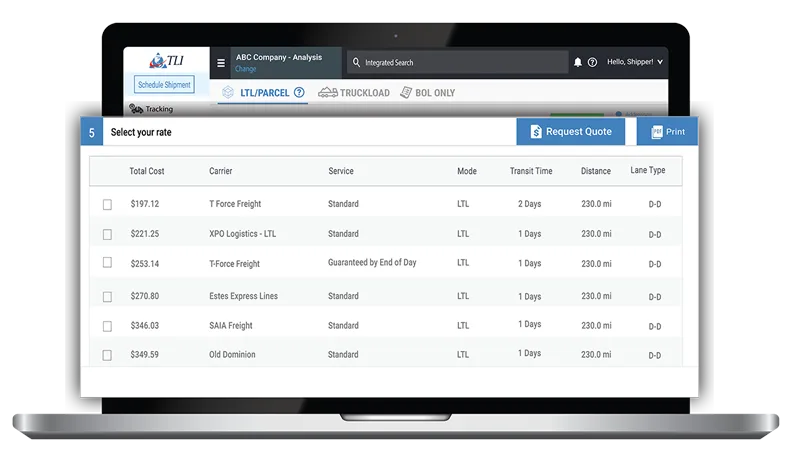
The fix is a dynamic routing guide with someone accountable for compliance. In TLI’s ViewPoint TMS, routing guides and contract rates are configured per lane, and exceptions reporting flags every shipment where the least-cost carrier wasn’t selected. Inbound vendors get clear instructions through a vendor routing portal, so supplier freight stops leaking cost too.
3. Too many small shipments
Shipping several LTL orders to the same region on the same day costs more than one consolidated move. Every extra shipment adds a minimum charge, extra handling, and more damage exposure.
During an RFP, TLI models hundredweight breaks and consolidation opportunities lane by lane. Day to day, that analysis turns into practical choices: combining orders, shifting to volume LTL or partial truckload, or using multi-stop truckload where it pencils out.

4. Invoices nobody checks
Carrier billing errors are routine, not rare. TLI’s shipment data shows 2–3% of freight invoices contain overcharges, and industry data puts the range as high as 3–8%. Common culprits:
- General tariff rates applied instead of your contract rate
- Wrong fuel surcharge percentage, or FSC applied to the wrong base
- Duplicate invoices for the same shipment
- Liftgate, residential, or detention fees with no contractual basis
- LTL reclasses and reweighs without documentation
Without a pre-payment freight bill audit, these errors become permanent costs baked into your baseline. TLI identified $634,608 in overcharges for shippers in 2025 by auditing invoices against contracts before payment.
5. Damage and loss you never recover
Lost, damaged, and short shipments cost you twice: once for the product and again for the replacement freight. Many shippers never recover either, because filing a claim correctly takes documentation, deadlines, and carrier follow-up that small teams don’t have time for.
Disciplined claims management turns that loss back into cash. In 2025, TLI managed 914 claims and recovered more than $1.2 million for shippers. Tracking claim rates by carrier also feeds the next RFP, so chronic offenders lose lanes.

6. No single view of spend
When carrier data lives across portals, inboxes, and spreadsheets, nobody can see cost per pound, on-time performance, or which facility is drifting. You can’t control what you can’t measure.
A single TMS with scorecards and quarterly business reviews turns freight from a monthly surprise into a managed budget line.
What predictable freight spend looks like
The RFP lowers the base rate. Everything else protects it. Here’s how the levers stack for a hypothetical $1.5M freight program, using the ranges TLI publishes:
| LEVER | CONTROL | IMPACT | EST. ANNUAL VALUE |
|---|---|---|---|
| RFP & contract management | Base rate | 8–15% | $120K–$225K |
| Routing guide compliance + consolidation | Whether freight moves on the right carrier, rate, and mode | Protects RFP savings | Varies by network |
| Freight bill audit | Billing errors before payment | 2–3% | $30K–$45K |
| Claims management | Recovery on loss and damage | ~1% | ~$15K |
Illustrative only. Actual results depend on your lanes, modes, and current rates.
The bottom line
Rising freight spend isn’t one problem, so one fix won’t solve it. A new rate sheet without routing accountability, consolidation, audit, and claims recovery simply leaks back to where it started.
TLI’s managed transportation program covers all of it: RFP, execution, audit, claims, and reporting with a dedicated team and ViewPoint TMS included.
Want to see where your freight dollars are going? Request a free freight assessment and we’ll review your lanes, rates, and invoices. No commitment.