
Freight Claims Management that recovers your money from carriers.
TLI files and manages freight claims on your behalf across visible damage, concealed damage, lost freight, and shortages. In 2025, TLI recovered over $1.2 million across 914 claims for shippers who did not want to chase carriers themselves.
1994
Managing Claims for Decades
914
Cases Managed in 2025
$1.2M+
Total Recovered in 2025
what is a freight claim?
A freight claim is a formal request filed by a shipper or receiver asking a carrier to compensate for goods that were lost, damaged, or short-delivered during transportation. Carriers are legally required to respond to freight claims under the Carmack Amendment.
Filing a freight claim correctly takes time, documentation, and carrier follow-up that most shipping teams do not have capacity for. Missed deadlines, incomplete documentation, or incorrect claim types can result in a carrier denying a claim that should have been paid.
TLI manages the entire freight claims process on your behalf. Your team identifies the damage or shortage, notifies TLI, and we handle everything from document collection to carrier dispute and resolution. You track the status in ViewPoint TMS.
four types of freight claims
Each claim type has different filing requirements and deadlines. Filing under the wrong type or missing a deadline gives carriers grounds to deny the claim.
Visible Damage
Damage to packaging or product visible at delivery. Note on the proof of delivery before the driver leaves.
Concealed damage
Damage found inside the packaging after delivery. Product looks fine on the outside but is damaged inside.
Lost Freight
Freight that does not arrive and cannot be located after a carrier dock search. Common in LTL networks.
Shortages
A shipment arrives with fewer units than were shipped. Note the shortage on the proof of delivery at receipt.
How TLI manages your freight claims
TLI handles the freight claims process from first notification to carrier resolution. Your team does the first step. We do the rest.
Identify, Notate, and Notify TLI
Your receiver notes visible damage or a shortage on the proof of delivery before the driver leaves. For concealed damage, document what you find within 5 days of delivery. Then notify TLI right away and we take it from there.
Provide documentation and photos
Send TLI the original commercial invoice, photos of the damaged freight or packaging, and any other documentation required. That is all we need from your side.
TLI files with the carrier
TLI confirms the claim type, checks the filing deadline, and confirms all documentations is ready to go. We file the claim directly with the carrier under the correct claim type and within the required deadline.
Resolution and recovery
TLI tracks the claim, follows up with the carrier, and sends the recovery to your company once settled. You can check the status of every open claim in ViewPoint TMS at any time.
Claim Reporting
Track open and resolved claims, recovery totals, and carrier claim rates across your freight program.
Reporting available for Advanced / Enterprise customers only.
track your freight claims in viewpoint tMS
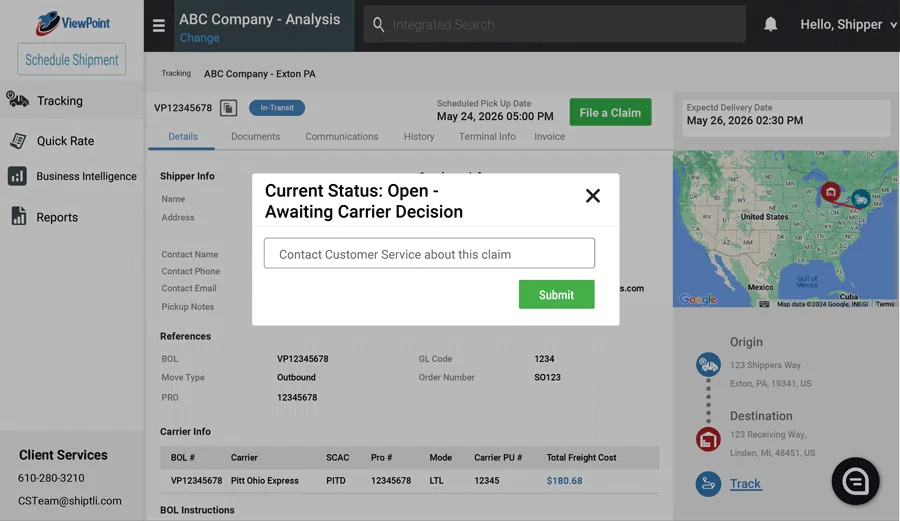
File and track claims in one place
Every claim is visible in ViewPoint TMS. You can see the claim status, carrier response, and recovery amount without calling anyone or waiting on email.
TLI uses dedicated freight claims software to file and track claims with carriers. Your team sees a clean status view in ViewPoint without needing carrier portal access.
See how TLI manages freight claims for your program
Most shippers underestimate how much time their team spends chasing carriers on damaged and lost freight. TLI will review your current claims volume, show you where your carriers are falling short, and walk you through what a managed claims program looks like.
TLI files directly with the carrier on your behalf
Track your claim status in ViewPoint TMS
We follow up with the carrier until the claim is resolved
Recovery sent directly to your company
Request your free freight services review
Tell us about your freight program and we’ll get back to you within one business day.
Other services from TLI
Freight claims is one part of TLI’s managed freight program. See all TLI freight services to understand how our services work alongside each other.
Freight Audit
TLI audits every freight bill before payment goes out. Shippers recover an average of 2 to 3 percent of annual freight spend in billing errors caught before invoices are paid.
TLI Advantage+
Carrier claims requires proof of negligence. TLI Advantage+ pays the full declared value without requiring proof of fault.
ViewPoint TMS
Your team submits and tracks claim status directly in ViewPoint while TLI works the claim with the carrier in the background.
Common Questions About Freight Claims
A freight claim is a formal request to a carrier for compensation for goods that were damaged, lost, or short-delivered during transportation. Under the Carmack Amendment, carriers are legally required to respond.
You need the original commercial invoice, photos of the damaged freight and packaging, and the proof of delivery with damage or shortage noted. TLI gathers the bill of lading and carrier documents on your behalf.
A freight claim covers physical loss or damage to a shipment. A freight dispute covers billing disagreements such as invoice errors or unauthorized accessorial charges. TLI handles both through freight claims management and freight audit services.
Yes. TLI manages freight claims across LTL, truckload, partial truckload, and other modes it manages. Claim requirements vary by carrier and mode.