
Automotive Industry Shipping
Shipping solutions for the Automotive Industry
Meet the challenges of shipping various auto-parts from suppliers to customers with solutions in the automotive industry.

Automotive Freight Management for Manufacturers, Suppliers, and Distributors
Automotive supply chains depend on reliable transportation. A late shipment of a component, replacement part, production material, or aftermarket product can create downstream delays for manufacturers, distributors, repair facilities, and customers.
TLI provides automotive freight management and transportation services for companies shipping automotive parts and related products throughout the United States. Our team manages recurring LTL, truckload, partial truckload, expedited, and multimodal shipments while providing the technology and operational support needed to keep freight moving.
Ship Auto Parts
Rather than treating every shipment as an isolated transaction, TLI can build a transportation program around your lanes, shipment history, carrier requirements, delivery locations, and service expectations. Our managed transportation approach combines carrier sourcing, freight execution, tracking, vendor routing, freight invoice auditing, claims management, and transportation reporting through our proprietary ViewPoint TMS.
Automotive Products TLI Can Help Transport
For larger or recurring freight programs, TLI can analyze your historical shipments and manage a competitive carrier RFP to build a transportation network around your actual lanes and requirements. The result is more than a freight quote. It is a transportation program designed around how your business actually ships. TLI provides commercial freight transportation for a wide range of automotive products and components, including:
- Automotive parts
- Replacement parts
- Auto body parts
- Automotive components
- Manufacturing components
- Aftermarket automotive products
- Vehicle accessories
- Automotive equipment
- Palletized parts
- Production materials
- Warehouse and distribution freight
- Supplier shipments
- Finished automotive products
Need to improve your automotive freight program?
What automotive shipping services does TLI provide?
| Automotive shipping service | How TLI supports auto part shippers |
|---|---|
| LTL freight | Ship palletized automotive parts and recurring less-than-truckload shipments through regional and national LTL carriers. |
| Truckload freight | Manage full truckload shipments for larger quantities of automotive parts, production materials, and distribution freight. |
| Partial truckload | Evaluate partial-load opportunities when a shipment does not require a full truck but is too large or costly for standard LTL. |
| Expedited freight | Arrange time-sensitive transportation when production schedules, customer commitments, or service requirements require accelerated delivery. |
| Intermodal transportation | Evaluate intermodal options when rail and truck combinations can provide an alternative for appropriate lanes. |
| Vendor routing | Give vendors routing instructions and visibility while allowing them to schedule shipments through TLI’s transportation system. |
| Freight invoice audit | Review freight bills for billing discrepancies, incorrect classifications, duplicate charges, and unauthorized accessorials. |
| Freight claims management | Help manage documentation, carrier communication, and claim resolution when automotive freight is damaged or lost. |
| Transportation RFPs | Analyze historical shipment data and run competitive carrier RFPs for recurring automotive freight lanes. |
| Transportation management | Operate an ongoing freight program with carrier management, shipment execution, tracking, reporting, audit, and claims support. |
| TMS technology | Provide ViewPoint TMS for quoting, booking, tracking, claims, reporting, and transportation visibility. |
Inbound Automotive Freight and Vendor Routing
Inbound Vendor Routing Portal
Inbound transportation can become difficult when suppliers arrange freight independently, use different carriers, or provide limited shipment visibility.
Track Inbound Shipments
TLI’s vendor routing capabilities help automotive manufacturers and distributors establish greater control over inbound transportation. Vendors can receive routing requirements and schedule shipments through the transportation management system while the shipper maintains visibility into the shipment and transportation activity.
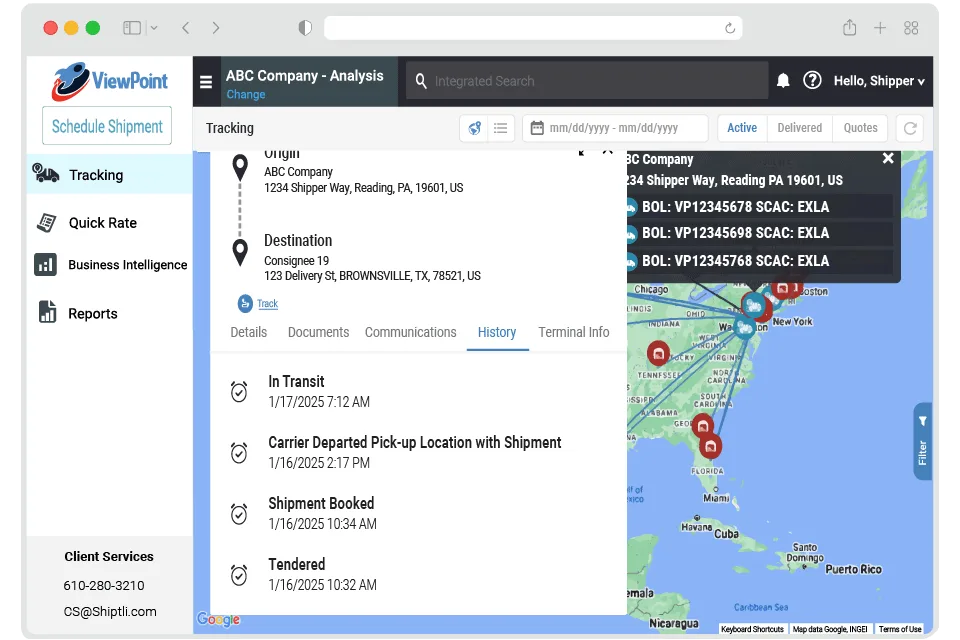
Common inbound freight challenges for automotive shippers
| Challenge | TLI approach |
|---|---|
| Vendors use different carriers | Establish routing requirements and preferred carrier options |
| Limited inbound visibility | Centralize shipment information and tracking |
| Uncontrolled transportation costs | Establish transportation rules and monitor freight costs |
| Manual vendor communication | Provide a structured routing process |
| Difficult inbound reporting | Consolidate transportation data for analysis |
| Inconsistent shipping practices | Create standardized routing procedures |
Why automotive companies use TLI
Automotive transportation is not simply about finding a truck for the next shipment. Recurring freight programs require the right combination of cost, capacity, service, visibility, and carrier accountability.
Get a free Freight AssessmentVetted Carriers
Annual Miles
Industries
Automotive Freight Brokerage vs Managed Transportation
TLI combines a 30,000+ vetted-carrier network with transportation technology and a dedicated logistics team. For companies with recurring freight volume, our managed transportation approach can extend an internal logistics department without requiring the shipper to manage every carrier relationship, shipment exception, invoice discrepancy, or freight claim internally.
| Transactional freight broker | Managed transportation |
|---|---|
| Shipment-by-shipment approach | Ongoing transportation program |
| Focuses primarily on the immediate load | Considers the broader freight network |
| Carrier selected for individual shipment | Carrier strategy built around recurring lanes |
| Limited historical analysis | Uses shipment data to analyze transportation patterns |
| Shipper manages much of the transportation process | TLI manages daily freight execution |
| Separate processes for tracking and reporting | ViewPoint centralizes freight information |
| Freight problems handled individually | Ongoing carrier and exception management |
| Limited involvement beyond the shipment | Freight audit, claims, reporting, and optimization |
How TLI Manages Automotive Freight
01
Analyze your freight
TLI reviews your shipment history, lanes, origins, destinations, modes, accessorials, carriers, and transportation spend to understand how your freight is actually moving.
02
Identify transportation opportunities
Our logistics team evaluates carrier coverage, pricing, shipment characteristics, consolidation opportunities, mode selection, and recurring freight patterns.
03
Build the carrier strategy
For recurring freight volume, TLI can use a structured carrier RFP to obtain lane-specific pricing and establish a carrier network around your transportation requirements. Existing carrier relationships can remain part of the program where appropriate.
04
Execute shipment tendering
Once the program is established, TLI manages daily freight execution including quoting, booking, tendering, tracking, carrier communication, and shipment exceptions.
05
Audit and manage exceptions
TLI reviews freight invoices, manages claims, monitors transportation performance, and works with carriers when problems occur.
06
Report on performance
Transportation data can be surfaced through ViewPoint and reporting tools so shipping teams can monitor freight activity and identify opportunities for improvement.
Automotive Shipping and Freight Management FAQ
Common questions about managed transportation.
Can’t find what you’re looking for?
Contact us at 610.280.3210 or Quotes@shiptli.com
Automotive freight management is the process of coordinating transportation for automotive manufacturers, suppliers, distributors, and other companies moving automotive parts and related products. It can include carrier sourcing, freight booking, tracking, vendor routing, transportation optimization, freight auditing, claims management, and reporting.
TLI routes automotive parts in the LTL and FTL networks. TLI provides transportation services for companies shipping palletized automotive parts and other commercial freight. Depending on the shipment, TLI can arrange LTL, truckload, partial truckload, expedited, intermodal, and other transportation services.
TLI can manage inbound shipments. TLI provides vendor routing capabilities that allow shippers to establish inbound transportation requirements while vendors schedule shipments through the transportation system. This gives the shipper greater control and visibility over inbound freight.
TLI manages LTL transportation for recurring commercial freight and provides access to regional and national LTL carriers. ViewPoint allows shippers to quote, book, track, and manage LTL shipments through one platform.
TLI manages truckload transportation as part of its broader freight service offering. Truckload can be used for higher-volume shipments, dedicated capacity requirements, and recurring lanes where a full trailer is appropriate.
TLI can analyze historical transportation data, compare carrier pricing, identify lane opportunities, evaluate mode options, and manage competitive carrier RFPs. TLI reports that its RFP customers typically see 8–15% base-rate savings, although actual results vary by shipper, freight profile, lanes, and market conditions.
Yes, clients of TLI can keep their existing carrier direct pricing. TLI’s managed transportation programs can be built around a shipper’s existing preferred carriers, with TLI’s carrier network used to supplement coverage and identify additional opportunities where appropriate. Competitive contracts that were negotiated directly by your pricing department can be uploaded into the TMS to be rated side-by-side custom contracts and sorted by least cost carrier.
TLI primarily works with mid-market and enterprise shippers with recurring freight volume across multiple lanes and modes. TLI’s managed transportation offering is particularly relevant to companies spending approximately $1 million or more annually on freight, while TLI also works with growing shippers with annual freight spend starting around $150,000.