
Managed transportation improves freight reliability and visibility by giving one dedicated team ownership of carrier sourcing, load execution, tracking, freight audit, and reporting. A single transportation management system (TMS) brings every shipment, carrier update, and performance metric together, eliminating the need to juggle separate portals, inboxes, and spreadsheets. The team monitors shipments, resolves exceptions, and addresses delays before they become missed deliveries.
At TLI, that means a dedicated account team running your freight through ViewPoint TMS, TLI’s proprietary transportation management system. ViewPoint connects to carriers through EDI and API, so rates, tenders, and tracking updates move automatically. It also connects to the ERP or WMS you already run, so freight data lives alongside the rest of your business.
Most in-house programs don’t fail all at once. They erode as volume grows: one more facility, one more carrier, one more spreadsheet. This article shows where that erosion starts, what to watch for early, and how a managed program fixes it before cost and delay compound.
Where in-house transportation logistics breaks down
In-house freight management usually breaks in three places at once: the processes people run by hand, the systems that don’t talk to each other, and the carrier relationships no one has time to manage. Each one holds at low volume. Each one cracks as shipments, facilities, and modes multiply.
1. Processes: manual work that scales with every order
The most common setup we see is freight managed part-time by someone who already has a full-time job. Every order is re-keyed from the ERP into a carrier portal or TMS, a carrier is picked from memory, and a pickup is tendered by phone or email.
That works at 20 shipments a week. At 200, the same routine consumes the day. Building-products manufacturer Benjamin Obdyke ran its entire shipping operation with two people doing double entry on every order, leaving no time for analytics, forecasting, or sales support (case study).

What breaks as volume grows:
- Booking and tendering become a queue, and late tenders cost capacity on tight lanes.
- Exception handling turns reactive: a missed pickup is found when the customer calls.
- Invoice review gets skipped, so reclasses, duplicate charges, and unapproved accessorials get paid.
- Claims stall because no one owns the follow-up with the carrier.
2. Systems: data spread across portals, inboxes, and spreadsheets
Most growing shippers don’t have one view of their freight. Rates live in carrier contracts, tracking lives in carrier portals, PODs and BOLs live in email, and spend lives in accounts payable. Nobody can answer “what did we pay to ship to that customer last quarter, and did it arrive on time?” without a week of spreadsheet work.
Chemical manufacturer Misco Products managed all logistics manually, with transportation reaching 10% of total overhead and no visibility into where it went (case study). Without a single system of record, you can’t benchmark carriers, can’t prove overcharges, and can’t plan loads across facilities.
3. Carrier coordination: stale rates and a thin network
In-house teams bid freight “when there is time,” which often means lanes go two years or more without a rate review. Meanwhile the market moves, accessorial terms drift, and the carrier list shrinks to whoever answered last time.
As a business adds facilities, vendors, and customer locations, that thin network shows up as:
- Spot pricing on lanes that should be contracted
- No backup carrier when a primary carrier rejects a tender
- Inbound vendor freight booked on the vendor’s terms, outside your routing rules
- Multi-location freight moving as separate LTL shipments that could have been consolidated
Early warning signs, and why freight costs spiral
Freight costs spiral for growing businesses because volume grows faster than the process, data, and carrier strategy behind it. No single shipment, or lane is the problem. The cost compounds quietly across stale rates, unchecked invoices, poor mode choices, and staff time.
Use this checklist to spot the breaking point before it shows up in your P&L:
| WARNING SIGN | MEANING | COSTS |
|---|---|---|
| Freight is managed part-time by someone with another full-time job | No one owns carrier strategy or exceptions | Missed pickups, reactive firefighting, burnout |
| Lanes haven’t been bid in two years or more | Rates and accessorial terms no longer match the market | Overpaying on contracted lanes; TLI’s first RFP cycle typically finds 8–15% on contracted rates |
| Carrier data lives across portals, inboxes, and spreadsheets | No single source of truth for spend or service | Decisions made on habit, not performance |
| Invoices are paid without review | Reclasses, duplicates, and accessorials slip through | Leakage that audits recover; one TLI LTL audit found 3.5% in overcharges |
| Orders are re-keyed from the ERP into carrier tools | Double entry on every shipment | Hours lost and avoidable booking errors |
| Each facility ships on its own carriers and rates | No network view across locations | Missed consolidation and multi-stop savings, inconsistent service |
| Everything ships LTL by default | Mode isn’t being optimized | Cubic-capacity charges and extra terminal handling on freight that fits Volume LTL or partial truckload better |
| You suspect you’re overpaying but can’t prove it | Visibility gap, not a rate gap | The cost keeps compounding until someone measures it |
If three or more of these warning signs sound familiar, your freight program has outgrown its current setup. The longer it runs that way, the more each new facility, customer, or product line adds to the cost.
How TLI’s managed transportation fixes each breaking point
TLI’s managed transportation program replaces the in-house patchwork with a dedicated account team, a vetted carrier network of 30,000+ motor carriers, and ViewPoint TMS, included at no separate charge. TLI has run managed freight programs since 1994 and builds each one around your existing carrier relationships first, filling gaps from its network only where needed.
Carrier sourcing and rate strategy
TLI analyzes your lanes, rates, and invoices, then benchmarks carrier proposals against your historical data and current market conditions. A data-driven carrier RFP typically takes 4–6 weeks from kickoff. TLI handles lane analysis, carrier outreach, negotiation, and award recommendations, so rates stop going stale.
Load optimization and execution, together
Most providers either plan freight or move it. TLI does both in the same program. Share your shipment data, and TLI runs it through its system to build:
- Optimized load plans that match each shipment to the right mode, comparing LTL, Volume LTL, partial truckload, Load-to-Ride, and full truckload on weight, pallet count, linear feet, lane, and transit needs
- Consolidation of orders that would otherwise move as separate LTL shipments
- Multi-stop truckloads that serve several pickups or deliveries on one route, on dry van or flatbed
Then the same TLI team executes the plan: tendering, booking, carrier communication, tracking, POD archiving, and exception management. Because planning and execution sit with one team, the plan that saves money is the plan that actually ships.
Visibility in one system
ViewPoint TMS gives your team 24/7 access to quotes, booking, tracking, claims, and reporting across parcel, LTL, partial truckload, truckload, and intermodal. Carrier updates flow in automatically through EDI and API. Scheduled tracking reports and Power BI dashboards turn shipment data into carrier scorecards and spend analysis, reviewed with you in quarterly business reviews.
Audit and claims built in
Every invoice is audited against contracted rates and shipment records before payment, catching billing errors, duplicate charges, incorrect fuel surcharges, and unauthorized accessorials. TLI recovered $634,608 in freight bill audit recoveries for shippers in 2025. Claims are filed, tracked, and worked with the carrier by TLI’s team while you monitor status in ViewPoint.
Integration with the software you already run
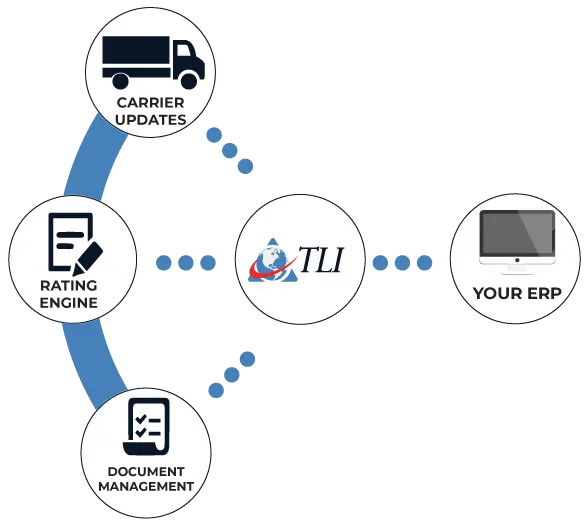
The managed transportation solution that works best with existing logistics software is one whose TMS connects directly to your ERP or WMS, rather than asking your team to re-key orders.
ViewPoint is TLI’s proprietary platform, not a white-labeled tool, so TLI can configure it around your processes and connect it to the systems you already use.
ERP Integration Benefits
- ERP and WMS integration: ViewPoint connects using standard API webhooks, so orders flow into the TMS and can book automatically. TLI’s software team works directly with your developers or IT partner.
- Carrier connectivity: EDI and API connections automate rates, tenders, and tracking updates.
- Vendor routing portal: Vendors book inbound freight under your routing rules, so inbound stays inside your program.
- Business intelligence: Freight data connects to Microsoft Power BI (requires your own Power BI subscription).
The result: Benjamin Obdyke now auto-books about 48% of its LTL freight straight from its ERP, with least-cost carrier selection from an approved network, saving 156–208 hours a year and cutting shipment errors an estimated 3–5%, without adding headcount.
How fast you can go live
A typical managed program goes live 5–6 weeks after you share historical shipping data: about 3–4 weeks for carrier RFP pricing responses, then about a week to review results and implement ViewPoint. ERP integrations run on their own timeline alongside the initial TMS rollout.

Fit for use: industrial and multi-location shippers
TLI is built for manufacturers and distributors spending $1M–$15M a year on freight, especially those shipping heavy, bulky, or mixed freight from multiple facilities. TLI runs freight programs across 50+ industries, with dedicated programs for manufacturing, building materials, industrial machinery, fabrication, automotive, paper and packaging, construction, and mining and materials. In 2025, TLI managed 85M+ miles and 535M+ pounds of freight.
| SHIPPER NEEDS | TLI SERVICE |
|---|---|
| Heavy, oversized, or mixed industrial freight | Mode comparison across LTL, Volume LTL, partial truckload, Load-to-Ride, and truckload; dry van, flatbed, and temperature-controlled equipment |
| Multiple plants, warehouses, or branches | One program and one TMS across all locations, with routing guides and carrier rules set centrally |
| Orders that could ship together | Load planning, consolidation, and multi-stop truckload builds from your shipment data |
| Inbound vendor freight | Vendor routing portal so suppliers book under your rules and rates |
| Lean logistics team | Dedicated TLI team tenders, tracks, and works exceptions; no added headcount |
| Order data in an ERP | ViewPoint integration so orders flow into the TMS and can auto-book |
| Spend and service visibility | Power BI dashboards, carrier scorecards, and quarterly business reviews |
| Billing errors and damage | Invoice audit on every shipment; claims filed and worked by TLI |
What it looks like in practice
- Building-products manufacturer: Benjamin Obdyke connected its ERP to ViewPoint, auto-booking ~48% of LTL and saving 156–208 operations hours a year for a two-person team (case study).
- Chemical manufacturer: Misco Products moved 7,000+ shipments through ViewPoint, cut freight bill retrieval time by 6 weeks, and avoided 50% in added customer-service personnel costs as it grew (case study).
- LTL-heavy shipper: A TLI freight invoice audit identified 3.5% in overcharges (case study).
What to look for in a managed transportation provider
The best managed transportation provider for a mid-market shipper combines a dedicated team, its own TMS, and audit and claims in one program, with incentives tied to lowering your total cost rather than margin per load. Use these questions when you compare options:
- Who runs my freight day to day?
Look for a named, dedicated team, not whoever picks up the phone.
- Do you plan loads and execute them?
Load optimization, consolidation, and multi-stop planning should sit with the same team that tenders and tracks.
- Does the TMS connect to my ERP or WMS?
Ask how orders get in, how long integration takes, and who does the work.
- Can I keep my current carriers?
A good program starts with your existing relationships and fills gaps. TLI includes incumbent carriers in RFP launches.
- How often are lanes bid?
Routine, data-driven RFPs outperform reactive spot pricing and sourcing freight only when time allows. That said, TLI takes a data-driven approach to both. When spot market pricing beats contracted rates and reliable capacity is readily available, we leverage the spot OTR market to capture the savings.
- Are audit and claims included?
If not, overcharges and damage costs stay on your books.
- How will you report results?
Expect carrier scorecards, KPI dashboards, and recurring business reviews.
Managed Transportation vs In-House Traffic Dept Comparison Table
| RESPONSIBILITY | MANAGED TRANSPORTATION | TRANSACTIONAL BROKERAGE | STANDALONE TMS | IN-HOUSE TEAM |
|---|---|---|---|---|
| Who plans your freight | Dedicated TLI team | Whoever picks up | You run the software | Your staff |
| Technology | ViewPoint TMS included | Load-level portal | Software only | Often spreadsheets |
| Carrier RFPs | Data-driven, routinely | Spot pricing | Not included | When there is time |
| Load planning and execution | Both, by one team | Execution only | Tools only | Manual |
| Freight audit and claims | Included | Rarely | Not included | Manual |
| Reporting | Dashboards + quarterly business reviews | Load-level only | Self-service dashboards | Spreadsheets |
| Incentive | Lower your total cost + improved service | Margin per load | License fee | Payroll |
Managed Transportation Q&A
Managed transportation improves reliability by giving one dedicated team ownership of carrier sourcing, tendering, tracking, and exception management, helping resolve issues before they cause missed deliveries. It also improves visibility by managing shipments through one TMS. TLI’s proprietary ViewPoint TMS automatically receives carrier updates via EDI and API, while dashboards and quarterly business reviews provide clear insight into freight spend and carrier performance.
The best managed transportation programs connect directly to your ERP, allowing orders to flow into the transportation management system (TMS) without manual data entry. TLI’s ViewPoint TMS integrates with existing ERP systems through APIs and webhooks, with TLI’s software team working directly with your developers. Once integrated, recurring shipments can be booked automatically, with the system selecting the lowest-cost carrier from your approved network.
TLI specializes in industrial freight for manufacturers and distributors, with dedicated programs for manufacturing, building materials, industrial machinery, fabrication, automotive, paper and packaging, construction, and mining. TLI handles heavy and oversized freight across LTL, Volume LTL, partial truckload, flatbed, dry van, and truckload, through a network of 30,000+ vetted carriers.
Freight costs spiral when volume grows faster than the process behind it. The usual causes are lanes not bid in two years or more, invoices paid without audit, unvetted carriers, orders re-keyed by hand, each facility using its own carriers, and freight defaulting to LTL when consolidation or partial truckload would cost less. Each adds a small cost per shipment that compounds with volume.
Mid-market shippers do best with a provider that adds a full logistics team and TMS without adding headcount or enterprise software overhead. TLI’s core clients spend $1M–$15M a year on freight, and shippers with $150,000+ in annual spend can start on TLI’s general rates. ViewPoint TMS is included in every TLI program, and a managed program typically goes live in 5–6 weeks.
TLI handles both. Shippers share their shipment data, and TLI runs it through its system to build optimized load plans, consolidations, and multi-stop truckloads. The same TLI team then tenders, books, tracks, and manages exceptions on those loads, so the optimized plan is the plan that ships.
Multi-location businesses benefit from one managed transportation program, one TMS, and one consistent carrier strategy across all plants, warehouses, and vendors. TLI centralizes routing guides and carrier rules in ViewPoint TMS, consolidates shipments into multi-stop loads, and gives vendors a routing portal to book inbound freight according to your requirements. TLI’s managed transportation program helps shippers coordinate freight across multiple facilities, improve visibility, and manage growing shipment volumes more efficiently.
When partnered together with TLI a managed transportation program typically goes live in 5–6 weeks after you provide historical shipping data. Carrier RFPs take approximately 3–4 weeks, followed by about one week to implement ViewPoint TMS and prepare your program for launch.
Yes. TLI builds programs around your preferred carriers first and adds carriers from its network only where there are gaps.
Fix the breaking points before they compound
Every new facility, customer, and product line makes an in-house freight program harder to run and more expensive to fix. The earlier you get a single view of your lanes, rates, and invoices, the less cost and delay you carry into next year.
Start with a free freight assessment. TLI will analyze your lanes, rates, and invoices, identify savings and service gaps, and show what a managed program would change. Prefer to talk? Call 610.280.3210 or email Quotes@shiptli.com.