
Integrating your ERP with ViewPoint TMS brings tracking and quoting together in one seamless process. This connection eliminates manual data entry, improves shipment accuracy, and provides a complete view of your logistics. With increased access to data you can scale and make data-driven decisions. With TMS integration, your team can manage shipments with less effort and more control. Let’s look at how ERP to TMS integrated shipment tracking and quoting works and why it gives you a competitive advantage.
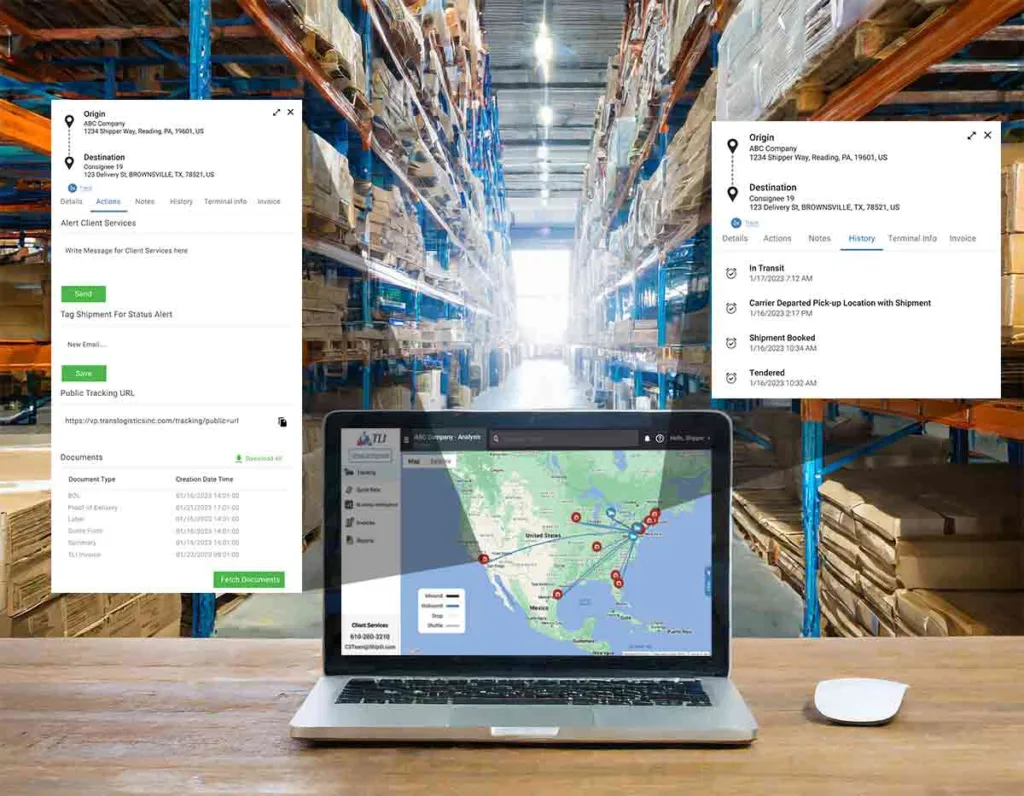
Why integrate my ERP with a TMS?
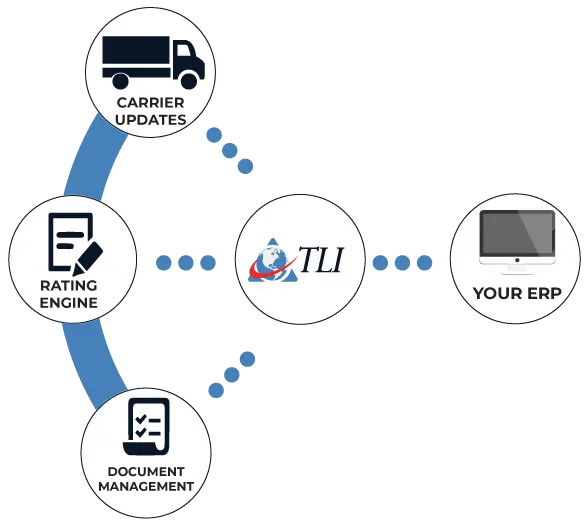
When your ERP (Enterprise Resource Planning) system connects with your TMS (Transportation Management System), it creates a powerful, all-in-one platform. This integration allows you to track shipments in real-time and get instant, accurate quotes. It automates many steps, reduces data errors, and keeps your information current across all systems. You get a streamlined way to manage shipments and a single source of truth for logistics information.
Beyond improving day-to-day efficiency, ERP and TMS integration gives your team greater visibility and control over transportation spending.
By connecting shipment data to your ERP you can make more informed decisions about carrier selection, routing, and freight costs before shipments move. This helps reduce manual administrative work, automate accounting references like cost center codes and GL codes. In addition, through integration you minimize costly shipping discrepancies, improve coordination between departments, and identify opportunities to consolidate shipments or negotiate better transportation rates. With more reliable data flowing between systems, your team can spend less time managing logistics transactions and more time focusing on operational efficiency, customer service, and strategic supply chain improvements.
How ERP-to-TMS Integration Works
Brief System Integration Overview
- ERP Order Creation
An order is created in your existing business system with shipping information and order details.
- API, EDI, Flat File Transfer
Connected shipment information is processed within TLI’s transportation management platform.
- Freight Execution
Your team can access freight quotes, book shipments, generate shipping documents, and coordinate transportation directly within your ERP system.
- Shipment Visibility and Reporting
Shipment tracking, delivery information, and transportation reporting provide greater operational visibility.
Unlike standalone transportation software that requires your employees to manage another disconnected platform, ViewPoint is designed to work alongside your existing business systems. TLI coordinates the transportation technology and carrier connections, helping your logistics team spend less time transferring information between systems and more time managing freight performance.
ERP and TMS integration methods supported by TLI:
| INTEGRATION METHOD | HOW IT WORKS | BENEFIT TO SHIPPING OPERAITONS |
|---|---|---|
| API Integration | Application Programming Interfaces allow your ERP and ViewPoint TMS to exchange information programmatically. API webhooks can facilitate automated data transfers when defined events occur. | Reduces manual data entry, automates order transfers, and keeps connected systems synchronized. |
| EDI Integration | Electronic Data Interchange enables standardized business documents and shipment information to be exchanged between connected systems. | Supports automated shipment processing, carrier communication, tendering, and shipment status updates. |
| Flat-File Integration | Structured data files are exchanged between systems using an agreed-upon format and transfer process. | Provides an integration option for businesses whose existing systems do not support the required API or EDI connectivity. |
| Power BI Integration | Transportation data can be made available for reporting and analysis through Microsoft Power BI. | Helps procurement, finance, and transportation teams evaluate freight spend, carrier performance, shipping trends, and operational KPIs. |
Flexible Integration Without Replacing Your Existing ERP
TLI does not require businesses to abandon their existing ERP or warehouse management systems to benefit from transportation automation. Through ViewPoint TMS, we work with your existing technology environment to establish appropriate API, EDI, or flat-file connections. Our team can coordinate the integration requirements, data mapping, and workflow configuration to help ensure transportation information moves between systems accurately and efficiently. This allows your organization to retain its existing business infrastructure while improving how freight is quoted, booked, tracked, and managed.
Integrating TMS with Microsoft Power BI and other systems
Many shippers choose to integrate their TMS with additional systems, like Microsoft Power BI, for enhanced data insights. Power BI offers dashboards that track key performance indicators (KPIs) across shipments, giving procurement and purchasing teams the ability to monitor inbound logistics in real-time. This integration supports effective decision-making by providing a full view of metrics that impact supply chain efficiency, such as cost per shipment, delivery timelines, and carrier performance. By seeing these insights on a single dashboard, companies can drive more accurate, data-based improvements.
For publicly traded companies and large enterprises, this kind of integration goes further. TLI can support reporting for specific needs, including shuttles, drops, and cross-trade shipments. With data readily available in Power BI or your preferred system, the traffic department can manage outbound shipments more effectively, while procurement and purchasing teams stay informed on inbound progress.
Purchasing teams can also give core vendors access to the TMS vendor portal. This is a critical ask that benefits the procurement teams as they can begin tracking and have access to shipment information prior to delivery. Perhaps you are a distributor and would like to track freight from the point of manufacturing, or you are sourcing raw material, this visibility is critical if you are running lean processes. These insights make it easier to streamline both inbound and outbound logistics, cut costs, and respond proactively to any disruptions in the supply chain.
What data can be exchanged between an ERP and a TMS?
An ERP-to-TMS integration can automate the movement of important shipping and order information between business systems. Depending on the integration configuration, ViewPoint can receive shipment details from your ERP and make transportation information available to connected systems.
| DATA CATEGORY | INFORMATION EXCHANGE | OPERATIONAL BENEFIT |
|---|---|---|
| Order Information | Sales orders, purchase orders, order numbers, cost center codes, accounting and other shipment references | Eliminates duplicate order entry and improves order visibility. |
| Shipping Addresses | Origin, destination, ship-to, and delivery location information | Reduces address errors and improves shipment accuracy. |
| Shipment Details | Commodity descriptions, quantities, weights, dimensions, and handling requirements | Provides the information needed for accurate freight rating and booking. |
| Carrier Selection | Available carrier options, routing instructions, and transportation requirements | Helps standardize carrier selection and routing decisions. |
| Freight Rates | Available transportation rates, applicable charges, and quote information | Improves freight cost visibility and supports transportation budgeting. |
| Shipment Status | Pickup confirmation, tracking updates, estimated delivery, and shipment milestones | Gives your operations teams better visibility into shipments in transit. |
| Shipping Documents | Bills of lading, shipping labels, and proof of delivery | Reduces document handling and improves record accessibility. |
| Reporting Data | Freight spend, shipment volume, carrier performance, and transportation KPIs | Supports financial analysis, procurement decisions, and continuous improvement. |
Can I get shipment quotes directly out of my ERP?
Integrated freight quoting means faster, more precise shipping estimates. This accuracy helps prevent costly errors, whether from incorrect rates or overlooked fees. By having all shipment quotes in one system, you reduce delays and improve planning. Quoting accuracy makes your pricing more competitive and helps you keep costs under control.
Worried about reclasses and reweighs? Within the TMS portal you have access to a built in freight class calculator. The transportation software will automatically populate the PCF on the shipment through the shipment density calculator while retrieving a list of the commodities that correspond to your specific product. Likewise, shippers can gather multi-modal quotes, with Parcel and Volume integrated rates available as well.
TLI is the right partner for your integrated software solution

At TLI, we bring all the essential tools under one roof. With our ERP to TMS integrated shipment tracking and quoting, you’ll streamline processes, save time, and reduce errors. Our dedicated team keeps all shipment data active and accessible. With TLI as your partner, you’ll stay compliant, improve customer service, and gain a competitive edge.
Integrated ERP to TMS shipment tracking and quoting is a great investment for business concerned with scaling swiftly yet maintaining control of all the touch points of their supply chain data. With TLI’s support, you’ll create a seamless, efficient workflow that sets you apart from competitors. Embrace this integration opportunity to take your logistics to the next level.
API Integration: Connecting Your ERP Directly to ViewPoint TMS
Application Programming Interfaces (APIs) allow different software applications to communicate and exchange information without requiring employees to manually transfer data between platforms.
TLI supports API-based connectivity with existing ERP and warehouse management systems, allowing businesses to connect their internal order management processes with ViewPoint TMS. Through standard API endpoints and webhook-based workflows, connected systems can exchange transportation information to support automated shipment creation, order processing, and freight management.
For manufacturers and distributors, this means orders created within an existing ERP can feed into the transportation workflow without requiring employees to repeatedly enter the same information. Depending on the integration requirements, shipment details can be transferred into ViewPoint, where transportation teams can access carrier rates, arrange bookings, generate shipping documentation, and monitor shipment progress.
TLI can meet together with your technical team to evaluate and explain the appropriate data exchange workflows. The objective is to improve connectivity without requiring your organization to replace its existing ERP or fundamentally change its internal business processes.
Dynamic Rule Sets
At TLI, we frequently hear from shippers with specific questions about our services. The first question we get is: “Can you do something custom for us?” The answer is yes! We can design custom tools like Dynamic Rule Sets (DRSs) and more, based on your exact needs. Whether you’re looking for unique software configurations or a custom approach to rate benchmarking, we work closely with you to build a solution that supports your business goals.
Another question we hear often is: “I think my freight rates are excellent—can you upload them, or do I have to use your pricing?” At TLI, we offer flexible solutions for rate management. We specialize in custom transportation RFP carrier sourcing to create proposals that align with your unique shipping profile. The shipment profile is created utilizing historical shipment data to optimize your rates. Some shippers want cost savings, others prioritize service, and many seek a healthy blend of both.
At TLI, we’re also happy to upload your existing motor carrier contracts—whether linear feet, point-to-point, density-based, or a mix of all contract types. This diversification of transportation contract types is a benefit, as we can create hybrid solutions using our rates combined with yours, always keeping your best interest in mind.
Finally, shippers often ask us: “What does TLI stand for?” TLI represents Trust, Loyalty, and Integrity, values that define our approach to business. Our relationships with clients are built for the long term, and we believe in delivering on promises, just as we would for a close friend. As my grandfather always said, “Be nice to everyone because you never know who could become your closest friend.” That’s how we approach our work—with respect, integrity, and a commitment to exceed expectations. Give us a chance, and we’ll show you the TLI difference!
ERP and TMS Integration: Frequently Asked Questions
A transportation management system can integrate with many ERP platforms through APIs, EDI, or flat-file data exchanges. TLI’s ViewPoint TMS supports these integration methods, allowing businesses to connect existing ERP and warehouse management systems without replacing their current software. Integration feasibility depends on the source system’s connectivity, available data, and technical requirements.
TLI supports ERP integration through API, EDI, and flat-file connectivity. This allows ViewPoint TMS to work with ERP platforms, subject to the available interfaces and integration requirements. TLI evaluates each customer’s technical environment to help determine the appropriate integration method.
ViewPoint TMS supports API-based connectivity, including standard API webhooks, to facilitate data exchange between connected business systems. This allows TLI to integrate transportation workflows with existing ERP environments, reducing manual data entry and improving shipment processing.
API integration allows software applications to communicate programmatically, often supporting event-driven data exchange and near-real-time updates. EDI uses standardized electronic business documents to exchange information between organizations, including shipment and carrier transactions.
ERP integration with ViewPoint TMS can automatically create and book freight shipments. Depending on the integration configuration, order information from an ERP can be transferred into ViewPoint TMS to initiate shipment creation, generate a Bill of Lading, and automate portions of the booking process such as load tendering to the motor carriers. This reduces duplicate data entry and allows logistics teams to process recurring shipments more efficiently.
Two-way integrations can be configured to exchange shipment status information between connected systems. Depending on the integration, businesses can make pickup confirmations, tracking milestones, delivery updates, and other transportation information available within their existing ERP environment.
The timeline depends on the complexity of the ERP environment, data mapping requirements, available APIs, and the workflows being automated.