
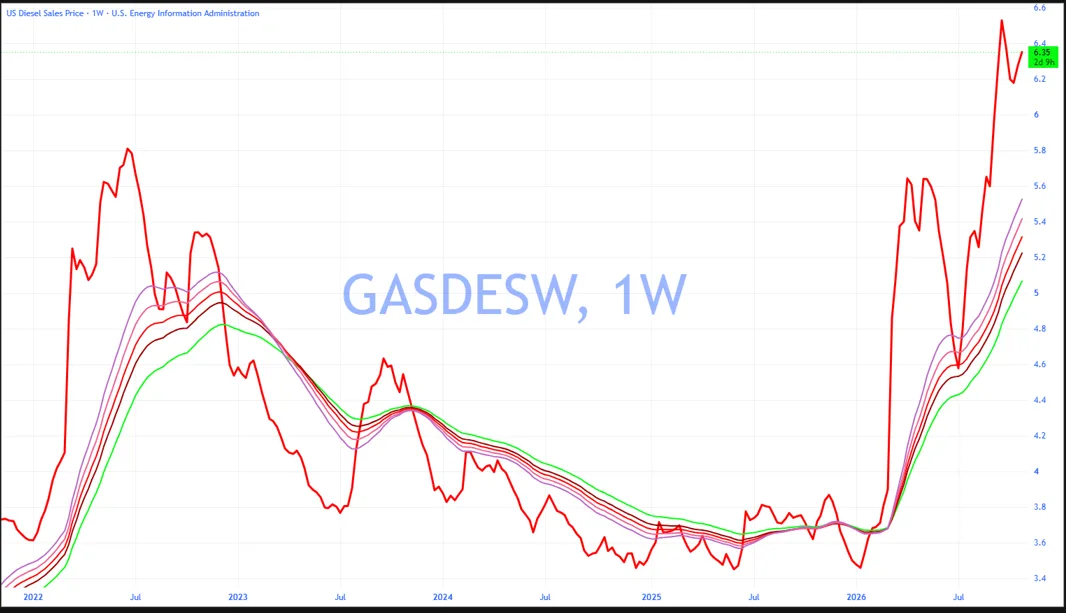
The U.S. Energy Information Administration (EIA) forecasts that retail diesel will average $4.49 per gallon in 2027, roughly 29% below the $6.352 national average recorded on October 26, 2026. That is encouraging news for every shipper with a fuel surcharge line on their freight invoices. However the forecast is an annual average, not a promise that prices will fall by January, and the global supply picture behind it remains fragile. Just because the average price was lower in prior years, does not indicate diesel prices are likely to drop lower.
This article walks through what the government forecast actually says, where the market stands today, the supply risks that could speed up or delay relief, and how shippers can plan around the uncertainty rather than bet on a single number.
What the EIA is forecasting
The EIA’s October 2026 Short-Term Energy Outlook (STEO), released October 6, projects lower petroleum prices across the board in 2027. The agency expects Brent crude to fall from a projected $105 per barrel in the fourth quarter of 2026 to an annual average of $84 in 2027, with retail diesel following it down.
| MEASURE | 2024 ACTUAL | 2025 ACTUAL | 2026 ACTUAL* | 2027 EIA FORECAST | CHANGE STEO (2027) |
|---|---|---|---|---|---|
| Brent crude oil ($/barrel) | $81 | $69 | $112.25 | $84 | +$10 (was $74) |
| U.S. retail diesel ($/gallon) | $3.76 | $3.66 | $6.352 | $4.49 | +$0.09 (was $4.40) |
| U.S. retail gasoline ($/gallon) | $3.31 | $3.10 | $4.269 | $3.56 | +$0.21 (was $3.35) |
| U.S. crude oil production (million barrels/day) | 13.3 | 13.7 | 13.9 | 14.3 | – |
*Source: EIA, Short-Term Energy Outlook, October 2026, forecast and notable forecast changes tables. Annual averages.

The outlook for diesel prices remains elevated. The EIA has raised its 2027 Brent crude forecast by 14% and its diesel forecast by 2% compared with September, citing geopolitical disruptions and exceptionally tight diesel supplies. East Coast distillate inventories were already 32% below their five-year seasonal average in September, and the EIA expects inventories to remain roughly 20% below historical averages through the winter. A meaningful recovery in inventories is not expected until the second half of 2027. While forecasts can change, current fundamentals do not yet point to significant near-term relief at the pump.
Current market conditions do not yet indicate meaningful near-term relief in diesel prices.
Where the market stands today
The weekly numbers do not yet show a sustained decline. The U.S. average on-highway diesel price was $6.352 per gallon on October 26, up from $6.276 the week before and $2.63 higher than a year earlier, according to the EIA’s Gasoline and Diesel Fuel Update. Prices have eased from the September 21 peak of $6.529, but only modestly.
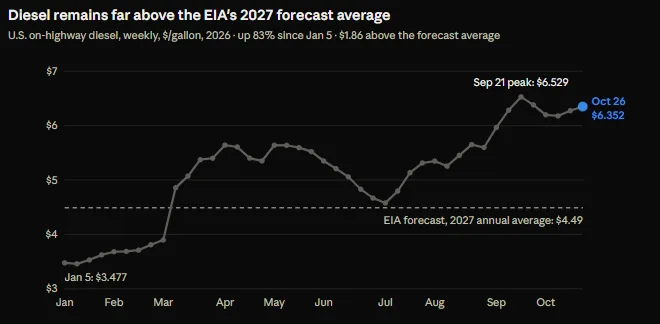
The March jump, from $3.90 to $4.86 in a single week, marks the onset of Middle East supply disruptions. Since then, diesel has not returned to $4.50, the level the EIA expects to average next year. Diesel prices also vary widely by region, which matters for any lane-level budget:
| REGION | OCTOBER 27, 2026 ($/Gal) | YEAR EARLIER ($/GAL) | CHANGE vs PRIOR YEAR |
|---|---|---|---|
| U.S. average | 6.352 | 3.718 | +71% |
| California | 8.155 | 4.934 | +65% |
| West Coast (PADD 5) | 7.329 | 4.485 | +63% |
| West Coast less California | 6.614 | 4.095 | +62% |
| Rocky Mountain (PADD 4) | 6.521 | 3.686 | +77% |
| Central Atlantic (PADD 1B) | 6.496 | 3.881 | +67% |
| Midwest (PADD 2) | 6.480 | 3.715 | +74% |
| New England (PADD 1A) | 6.421 | 3.933 | +63% |
| East Coast (PADD 1) | 6.079 | 3.723 | +63% |
| Gulf Coast (PADD 3) | 5.951 | 3.350 | +78% |
| Lower Atlantic (PADD 1C) | 5.890 | 3.642 | +62% |
Source: EIA, Gasoline and Diesel Fuel Update, release of October 27, 2026. Year-earlier prices derived from EIA’s published year-over-year change. Prices include all taxes.
The global supply picture
Today’s diesel prices are driven far more by global supply than by U.S. demand. U.S. refineries are already running hard, at 95% utilization on average in the third quarter, the most crude processed in a third quarter since 2019, according to the EIA. The constraint is abroad.
| SUPPLY FACTOR | LATEST DATA | DIESEL PRICE IMPACT |
|---|---|---|
| Strait of Hormuz | About 20 million barrels/day passed through in 2024, roughly 20% of global petroleum consumption; only about 2.6 million barrels/day of pipeline bypass capacity exists (EIA) | The largest single swing factor. Middle East production shut-ins peaked at 10.9 million barrels/day in May and were 4.8 million in September (EIA STEO). |
| Saudi East-West pipeline | Attacks in September temporarily halted a bypass route moving more than 5 million barrels/day; partial flows resumed September 22 (EIA STEO) | Shows how quickly workarounds can be disrupted. Brent spot prices reached $131 on September 15. |
| Russian refining | EIA cites reduced refining activity in Russia, China and the Middle East as the main cause of tight global distillate supply (EIA) | Russia has been a major diesel exporter. Lost output pulls U.S. diesel overseas and raises import costs for the East Coast. |
| Venezuelan crude | U.S. imports reached 701,000 barrels/day in July 2026, up from 200,000 in January (EIA) | Helpful, but equal to about 3.5% of pre-conflict Hormuz flows. It cannot offset a Middle East disruption. |
| U.S. Strategic Petroleum Reserve | 282.7 million barrels as of October 16 (EIA), versus authorized capacity of 714 million (DOE) | About 40% full, not empty. A 40-million-barrel exchange was announced September 29, but releases slowed in September. |
| U.S. distillate inventories | 104.3 million barrels as of October 16 (EIA); 13% below the five-year average in late September (EIA) | Thin commercial stocks, not the SPR, are the binding constraint. The SPR holds crude oil, not diesel. |
The EIA’s base case assumes that convoys, bypass routes and ship-to-ship transfers gradually restore Middle East exports, with most regional production back to pre-conflict levels by the end of the second quarter of 2027. On that path, Brent falls from $105 in late 2026 to $87 by the second quarter of 2027 and $74 by the fourth quarter. The agency also cautions that short-term price swings will likely be larger than its forecast shows.
Why winter makes Q1 relief harder
The first quarter of the year is seasonally the hardest time for diesel prices to fall, especially in the East. Diesel and heating oil are nearly the same product, so freight competes with home heating for the same barrels.
- The East Coast depends on outside supply. The region consumes more distillate than it refines. In 2025 it imported 124,000 barrels per day, about 10% of consumption, rising to about 15% from December through February (EIA STEO).
- Inventories bottom out in spring. The EIA expects East Coast distillate stocks to stay 20% to 30% below the five-year average this winter and to hit their 2027 low in April, at 22.6 million barrels.
- Heating oil is already expensive. Heating oil prices are up more than 30% from last winter, according to the EIA’s 2026–27 Winter Fuels Outlook.
- Retail lags wholesale. Retail and distribution margins were squeezed in 2026 as wholesale prices surged. The EIA expects those margins to widen back above average in 2027, so wholesale declines will not reach the pump dollar for dollar.
Rising U.S. electricity demand from data centers and industry is often cited in energy coverage. It matters for the broader energy system, but it is not a direct driver of diesel prices and should not be read as a signal for freight fuel costs.
Separating energy facts from speculation
Fuel markets generate a lot of armchair commentary, and not all of it holds up. Here is how common claims compare with the published data.
| CLAIM YOU MAY HEAR | WHAT THE EVIDENCE SUPPORTS |
|---|---|
| “Diesel will be cheaper in 2027.” | Supported, as a forecast. The EIA projects a $4.49 average in 2027, down from $5.19 in 2026. It is an annual average, not a date-specific prediction. |
| “Diesel will be back near $4.50 by January.” | Not supported. The EIA expects diesel above $6 in October and a gradual decline after that, with Brent still near $105 in the fourth quarter. |
| “Cheaper crude means cheaper diesel right away.” | Only partly true. Diesel crack spreads are expected to stay elevated, and retail margins are expected to widen as wholesale prices fall. |
| “U.S. emergency oil reserves are exhausted.” | Incorrect. The SPR held 282.7 million barrels on October 16, about 40% of its 714-million-barrel capacity. |
| “Venezuelan oil can replace Middle East supply.” | Incorrect. U.S. imports from Venezuela, 701,000 barrels/day in July, equal about 3.5% of pre-conflict Hormuz flows. |
| “Russian refinery outages are affecting diesel.” | Supported. The EIA identifies reduced refining in Russia as a cause of tight global distillate supply. |
| Social media posts about specific future military operations (Operation: FORTRESS) | Unverified. Plan around official data and credible reporting, not rumors that cannot be independently confirmed. |
| “America is Energy Independent” | True. America’s energy independence strengthens our national security and reduces our reliance on foreign suppliers, however this does not guarantee lower domestic fuel prices because the U.S. producers sell into a global market where prices are driven by worldwide supply and demand. |
Sources: EIA STEO, October 2026; EIA weekly stocks; DOE SPR Quick Facts; EIA Venezuela imports; EIA, What goes into diesel prices?
What could change the 2027 forecast on energy costs
The EIA forecast is a base case, not a guarantee. These are the developments most likely to move diesel faster or slower than expected.
| FACTOR | INCREASING RELIEF | DECREASING RELIEF |
|---|---|---|
| Middle East | A durable de-escalation lets Hormuz traffic and regional production normalize ahead of the EIA’s mid-2027 assumption | New attacks on tankers, pipelines or export terminals interrupt flows again |
| Russia and Ukraine | A negotiated settlement allows refinery repairs and diesel exports to recover, though repairs take months | Further strikes on refining and export infrastructure remove more diesel from world markets |
| Inventories | Distillate stocks rebuild faster than expected, narrowing crack spreads | A cold winter in the Northeast drains stocks further and pulls heating oil and diesel prices up |
| Policy supply measures | Additional coordinated releases, such as those signaled by the G7 on October 2, add barrels not yet in the EIA forecast | Releases slow or are not sustained |
If the first three move in the favorable direction together, diesel could fall faster than the EIA projects. If they move the other way, prices could stay elevated well into 2027. The next STEO, due November 10, will be the first to reflect events after October 1.
Additionally, the rapid expansion of data centers, particularly those supporting AI and cloud computing, is increasing domestic electricity demand. As these facilities require substantial amounts of power to operate and cool, the added demand can strain existing energy infrastructure, require new generation capacity, and ultimately put upward pressure on electricity and energy costs for businesses and consumers.
What this means for shippers
The most reliable way to manage fuel risk is to let a published index drive your costs, rather than a forecast. Many shippers and carriers already do this, as do TLI and our clients. The EIA notes that its weekly on-highway diesel price, released every Tuesday, is widely used in fuel surcharge formulas, although the EIA itself does not set or regulate surcharges (EIA FAQ).
At TLI, our custom carrier fuel schedules are tied to the weekly EIA diesel index. When diesel prices fall, our customers’ fuel costs decrease accordingly. When prices rise, costs adjust as well. We want to see lower fuel prices just as much as our customers do, but we believe in being transparent about market conditions rather than promising savings on a timeline we cannot guarantee. By tying our fuel tables to the EIA index, we help ensure fuel remains a pass-through cost rather than a profit center for carriers, while also protecting them from absorbing losses caused by fuel price volatility.
For example, if fuel surcharges are negotiated too low, carriers may offset the shortfall by building additional cost into their linehaul rates to protect their overall margins. In some cases, they may also hedge against future fuel increases by pricing in a risk premium, meaning the shipper could end up paying more in the base transportation rate even if fuel prices later decline.
Diesel Pricing Scenario FSC Examples:
To see why the forecast matters for budgets, consider the fuel cost of a 1,000-mile truckload move at the three price points discussed above:
| DIESEL PRICE SCENARIO | PRICE ($/GAL) | FUEL COST PER 1,000 MILES | DIFFERENCE vs TODAY |
|---|---|---|---|
| Today (EIA weekly, Oct 26, 2026) | $6.352 | $977 | – |
| EIA 2026 annual average forecast | $5.19 | $798 | −$179 (−18%) |
| EIA 2027 annual average forecast | $4.49 | $691 | −$286 (−29%) |
*Illustrative only. Assumes 6.5 miles per gallon; actual fuel economy varies by equipment, load and route. Prices from the EIA and EIA STEO.
Practical takeaway:
- Tie fuel costs to the weekly EIA diesel index. An index-based fuel schedule automatically passes price decreases and increases through as they occur, without requiring renegotiation. This is how TLI structures fuel surcharge agreements with motor carriers, promoting transparency, consistency, and fairness for both shippers and carriers.
- Budget in ranges, not a single number. Plan around today’s price for Q1, the EIA’s 2026 average as a midpoint, and the 2027 average as a second-half target.
- Treat $4.49 as a possible direction, not a deadline. It is a full-year average that assumes gradual relief in pricing, with prices higher early in the year and lower later. Averages are helpful but there are many factors that impact the volatility of energy.
- Watch the next data points. The EIA’s weekly update and the November 10 Short-Term Energy Outlook will show whether the forecast is holding.
At TLI, our custom carrier fuel schedules are directly tied to the weekly EIA diesel index, ensuring fuel costs move in line with the market. When diesel prices decline, those savings are passed along to our customers automatically. When prices rise, costs adjust accordingly. We want to see lower fuel prices just as much as our customers do, but we believe in transparency over speculation. Rather than promise savings based on market predictions, we let the data guide our approach and ensure our customers benefit when fuel prices move in their favor. This article is for general informational purposes and reflects data available as of October 30, 2026. Forecasts are subject to change.
Sources:
- U.S. Energy Information Administration, Short-Term Energy Outlook: Forecast Overview, October 6, 2026.
- EIA, Short-Term Energy Outlook: Global Oil Markets, October 6, 2026.
- EIA, Short-Term Energy Outlook: U.S. Petroleum Products, October 6, 2026.
- EIA, 2026–27 Winter Fuels Outlook, October 2026.
- EIA, Gasoline and Diesel Fuel Update, release of October 27, 2026.
- EIA, Weekly U.S. No. 2 Diesel Retail Prices, 1994–2026.
- EIA, Weekly U.S. Stocks of Crude Oil and Petroleum Products, week ending October 16, 2026.
- EIA, U.S. Imports from Venezuela of Crude Oil, monthly, through July 2026.
- EIA, Amid regional conflict, the Strait of Hormuz remains critical oil chokepoint, Today in Energy.
- EIA, What goes into diesel prices?, Today in Energy, September 18, 2026.
- EIA, Crude oil prices and refinery margins generally increased throughout the third quarter, Today in Energy, October 5, 2026.
- EIA, How do I calculate diesel fuel surcharges?, FAQ.
- U.S. Department of Energy, SPR Quick Facts.