
If you ship pallets with more than one product on them, the NMFC® mixed pallet rule matters to you. NMFTA™ wants to change how carriers class mixed shipments, and a new proposal lands on November 6. Here is what you need to know.
The National Motor Freight Traffic Association™ (NMFTA™) runs the National Motor Freight Classification® (NMFC®). Carriers use the NMFC® to set the freight class on LTL shipments. NMFTA™ calls its mixed pallet rule Item 640.
What happened to Item 640 in Docket 2026-2
This fall, NMFTA™ proposed a new Item 640 in Docket 2026-2. On September 29, the board voted it down. For now, today’s rule stays in place. (We covered the first version of this proposal earlier this year.)
But NMFTA™ is not giving up on the change. It will post a new version on November 6 in Docket 2026-3.
How the mixed shipment rule works today
Mixed Boxes: the highest class sets the price
When products in different classes share one box, carriers bill the whole box at the highest class inside it.
Mixed pallets: each product keeps its own class
When products share a pallet, carriers can bill each product at its own class and weight. To get this, list each product and its weight on the bill of lading and attach a packing slip.
The Proposed Mixed Pallet Rule >
What NMFTA™ proposed for mixed pallets
The proposal the board voted down would have changed three things:
- Carriers would give each pallet one class based on its density. Products would lose their own class.
- If a pallet held a hazmat item, carriers could bill the whole pallet at the highest class on it.
- Carriers could check your weights and sizes. If you left them off, the carrier could choose how to measure.
Why shippers pushed back on the Item 640 proposal
Two companies sent in comments: Betco Corporation and American Truck & Rail Audits.
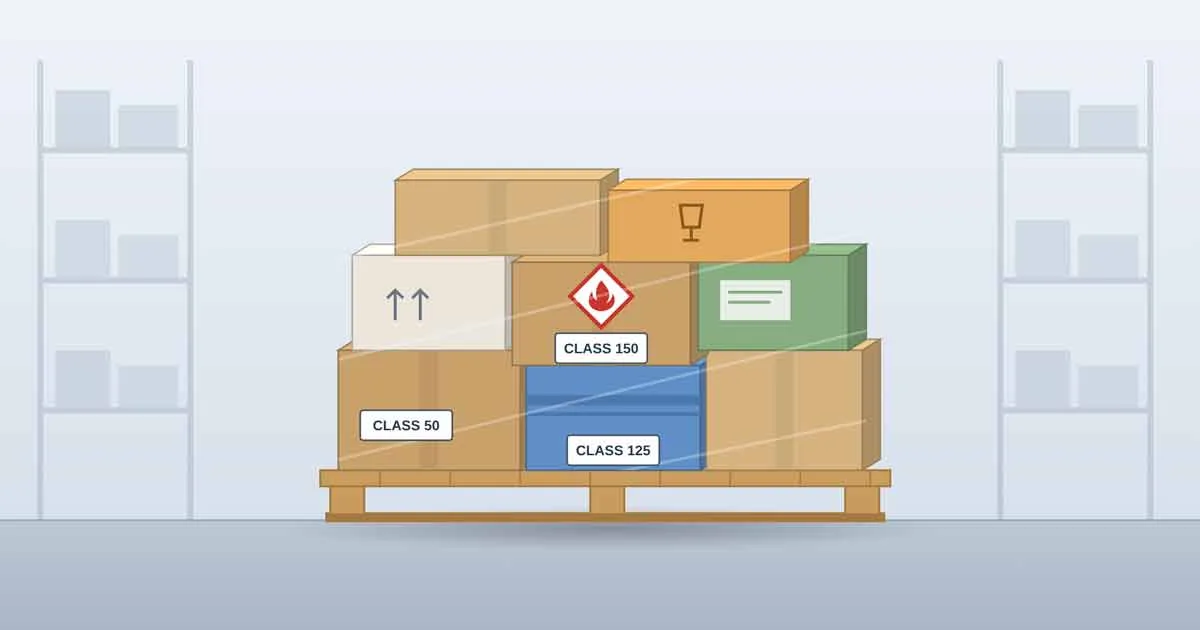
American Truck & Rail Audits showed how a Class 50 product could jump to Class 125 just by sharing a light pallet. Add a hazmat item, and it could jump to Class 150. Nothing about the product itself would change.
Betco warned that shippers might stop mixing products on one pallet. That means more pallets, more handling and emptier trucks.
Both companies asked NMFTA™ to let each product keep its own class when the bill of lading lists it.
What to expect from Docket 2026-3
NMFTA™ says it wrote Item 640 before mixed pallets, multi-SKU orders and online orders became common. It also says carriers and shippers read some terms in different ways. So NMFTA™ chose to fix the wording instead of dropping the idea.
NMFTA™ says the new version is simpler and clearer but keeps the main ideas. We will know the details once NMFTA™ posts it on November 6.
| Date | What happens |
| November 6, 2026 | New rule posted; 30-day comment period starts |
| December 15, 2026 | Online public meeting |
| December 16, 2026 | Final vote posted |
| January 23, 2027 | Rule takes effect, if approved |
How the mixed pallet rule could affect your freight costs
If you ship mixed pallets, this rule could change how carriers bill each one. A product that ships at a low class today could cost more just because of what sits next to it.
That is where ShipTLI comes in. We track every NMFC® change so you don’t have to. We can:
- Review your mixed pallets against the new rule
- Show you how it could change your costs
- Help you measure and record your freight’s density
- Help you send feedback backed by real numbers
How Should Shippers Prepare for the Proposed Item 640 Changes?
Businesses that regularly ship mixed-commodity pallets should consider reviewing the proposed changes and submitting feedback if they have concerns about documentation requirements, consolidation practices, classification treatment, or transportation costs. Preparing operationally can help identify potential gaps before any adopted changes become effective.
Although the proposal has not yet been finalized, businesses shipping mixed LTL freight should consider reviewing their existing documentation and warehouse procedures. We recommend focusing on the following areas.
- Record Individual Pallet Weights
Avoid relying exclusively on the total shipment weight when individual handling-unit weights are available. So record the weight of each pallet, skid, rack, or other handling unit. Accurate weight information is important for density calculations and for supporting the itemization alternative under proposed Section 3.
- Measure Every Handling Unit
Record the length, width, and height of each handling unit. Do not assume every pallet has identical dimensions simply because the same pallet footprint is used throughout the warehouse. Different products, packaging configurations, and stacking arrangements can change the overall dimensions.
- Identify Individual Commodities
Use specific commodity descriptions rather than generic descriptions such as “mixed merchandise” or “general freight.” When multiple products are consolidated onto one handling unit, maintain records showing which products are included and their respective weights.
- Maintain Accurate Packing Slips
f your organization intends to use proposed Section 3, packing slips will be particularly important. Each handling unit must have an attached packing slip identifying the separate articles and their respective weights. Consider whether your warehouse management system can generate these documents automatically.
- Properly Account for Pallet and Packaging Weight
The proposed Section 3 specifically addresses the weight of pallets, platforms, racks, skids, and unitizing materials. Your shipping procedures should account for these materials separately so that the required information can be accurately reflected in shipping documentation.
- Update Your Bill of Lading Procedures
The proposed provisions introduce specific notations corresponding to the classification approach being used. Your shipping department should understand when each notation applies and ensure that contractual shipping documents are completed consistently.
- Learn More About Contracts and Rating Procedures
Classification changes can have implications for negotiated transportation rates and carrier rating procedures. Review and get clarification on your current LTL carrier agreements, tariffs, and billing processes to understand how classification adjustments could affect your transportation expenses.
How to share feedback on Item 640
You will have 30 days after November 6 to comment on the new rule. NMFTA™ says the board reviewed feedback before its September vote, so your input counts.
Share your feedback with NMFTA™
You can also email FCDC@nmfta.org or call 703-838-1810. Mention Docket 2026-3 and Item 640. Include real numbers, like your pallet weights and sizes.
Having trouble with NMFC® updates?
TLI helps companies with freight management that includes helping with NMFC® codes. Whether it’s managing your freight routing guides or a billing dispute with a carrier, our team is ready to help with expert knowledge.
Get a Free Freight AnalysisFrequently asked questions on the NMFC® mixed pallet rule
Item 640 is the NMFC® rule for shipments that hold products in more than one freight class. It tells carriers how to class a mixed box or a mixed pallet.
No. The board voted it down on September 29, 2026. Today’s rule still applies.
NMFTA™ plans to post it in Docket 2026-3 on November 6, 2026. If the board approves it, the new rule takes effect January 23, 2027.
Use NMFTA™’s feedback page, or email FCDC@nmfta.org within 30 days of November 6.
National Motor Freight Classification® and NMFC® are registered trademarks of the National Motor Freight Traffic Association™ (NMFTA™). Docket content ©2026 National Motor Freight Traffic Association, Inc. Translogistics, Inc (TLI) is not affiliated with NMFTA™. This post summarizes public NMFTA™ documents for information only. For full details, see the Item 640 decision and NMFTA™’s Docket 2026-3 notice.