

TLI’s November 2025 freight update shows a market that’s steady on the surface but shifting underneath. Manufacturing continues to cool, freight rates are holding flat, and trucking capacity keeps tightening. It’s a mix that leaves both shippers and carriers watching the months ahead closely as the industry looks for signs of what’s next.
Manufacturing Continues to Contract
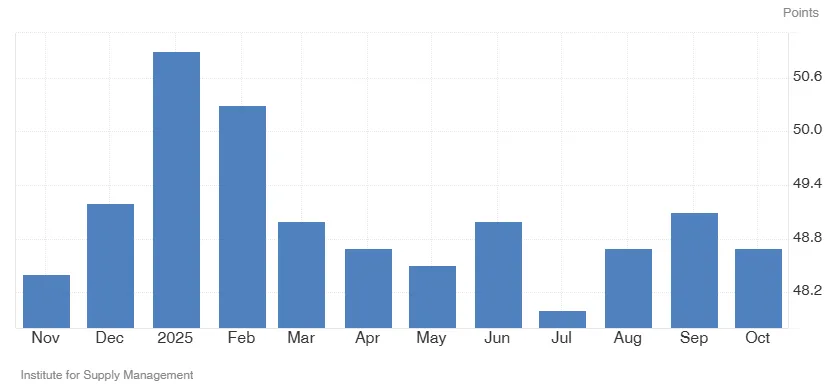
The latest ISM Manufacturing PMI shows continued weakness across U.S. manufacturing. October’s PMI registered at 48.7%, marking the eighth consecutive month below 50, the level that separates expansion from contraction.
New orders declined again for the second month in a row, signaling softer demand moving into the winter months. The ISM Prices Index eased to 58.0%, down from 61.9% in September, showing that prices are still rising but at a slower rate.
On the policy front, Federal Reserve Chair Jerome Powell noted that a December rate cut is not guaranteed, citing recent government disruptions that delayed key economic data.
What this means:
Manufacturing weakness points to reduced near-term freight demand, while persistent inflation keeps pressure on input and operating costs. Overall, the freight market remains mixed, with cooling demand and sticky prices shaping the outlook.
Freight Market: Stable but Uneven
According to DAT Trendlines, full truckload dry van spot rates are holding mostly flat compared with last year, with flatbed rates up just 1.2% and reefer rates up 1.3%. For shippers, this steady pricing creates a window to review contracts or lock in rates before any market rebound. Carriers, on the other hand, face limited rate upside in the spot market, making efficiency and equipment utilization more important than ever.
Capacity: The Supply Side Tightens
Trucking capacity is continuing to shrink. ACT Research, via FreightWaves, reports that lower tractor production, regulatory pressures, and rising insurance costs are pushing smaller fleets out of the market. Even as freight demand softens, this tightening supply helps stabilize rates and could create more challenging conditions if demand rebounds unexpectedly.
Key Takeaway:
The freight market could shift faster than expected. Maintaining strong carrier partnerships and flexible routing strategies will be crucial heading into 2026.
November 2025 Freight Market Summary
The November 2025 freight update paints a picture of a market that’s steady but cautious. U.S. manufacturing continues to contract, with new orders down for the second month in a row, while prices are still rising, just at a slower pace. Freight rates remain mostly flat year-over-year, offering stability for shippers, while shrinking trucking capacity could tighten conditions if demand picks up. The Federal Reserve remains cautious, with no rate cuts confirmed for the rest of the year.
Overall, the market is balanced but sensitive. Manufacturing weakness keeps demand in check, while limited capacity helps support pricing. In this environment, flexibility and strong carrier relationships will be the key for both shippers and carriers as they navigate the months ahead.
TLI uses trusted industry sources to create these market summaries. This update references the ISM Report on Business® – Manufacturing (October 2025), DAT Trendlines, and FreightWaves.
For more questions or more information, please contact marketing@shiptli.com.
