
Diesel prices have surged sharply, up more than 40% in under five weeks, as the Iran conflict disrupts global oil supply and drives up fuel costs across the transportation sector. Published carrier fuel surcharges are now ranging from roughly 44% to 51% of the base freight rate.
TLI customers, however, are insulated from the full impact, benefiting from a more competitive, pre-negotiated fuel surcharge structure that keeps FSC rates lower than the broader market.
$5.38
National avg. diesel/gal (Effective 3/24/2026)
+41%
Diesel price increase since Feb 23
44-51%
Published carrier FSC range
How TLI protects you from FSC volatility:
I want to be straightforward with you: fuel is genuinely expensive right now, and that cost does flow through to freight. Underlying freight charges will rise because of the rise in fuel. We also are seeing tighter capacity as supply shrinks and demand increases. What I can tell you though, that is a major relief for shippers partnered with TLI, is that our esteemed customers are not paying published tariff FSC rates because we made sure to protect from from fuel volatility many years ago before this crisis began. When we launch custom RFP sourcing events for clients, we place the motor carriers on a fuel table that ensures it is not a profit center for them.

The market pays materially more for fuel than TLI clients do, and at $5.38 per gallon for diesel, that gap translates into real savings on every shipment booked. TLI designs its custom fuel surcharge program with intention and treats fuel as a primary negotiation lever when building carrier agreements on behalf of shippers. The team develops a proprietary FSC table and requires carriers to apply it to all shipments under TLI-managed contracts. That table serves a single purpose: to recover actual fuel costs, nothing more.
Negotiating Fuel Surcharge in the RFP Process
During the RFP process, we negotiate FSC as a standalone line item rather than defaulting to a carrier’s published tariff. We benchmark our custom table against real EIA diesel data to ensure it reflects true cost recovery, not margin expansion. The structure removes FSC as a carrier profit center and instead positions it as a transparent pass-through mechanism.
Because of the freight volume TLI represents, we’re able to apply meaningful leverage that most individual shippers simply can’t achieve on their own. While your rates still reset weekly based on DOE pricing, just like the broader market, they do so off a significantly lower base percentage.
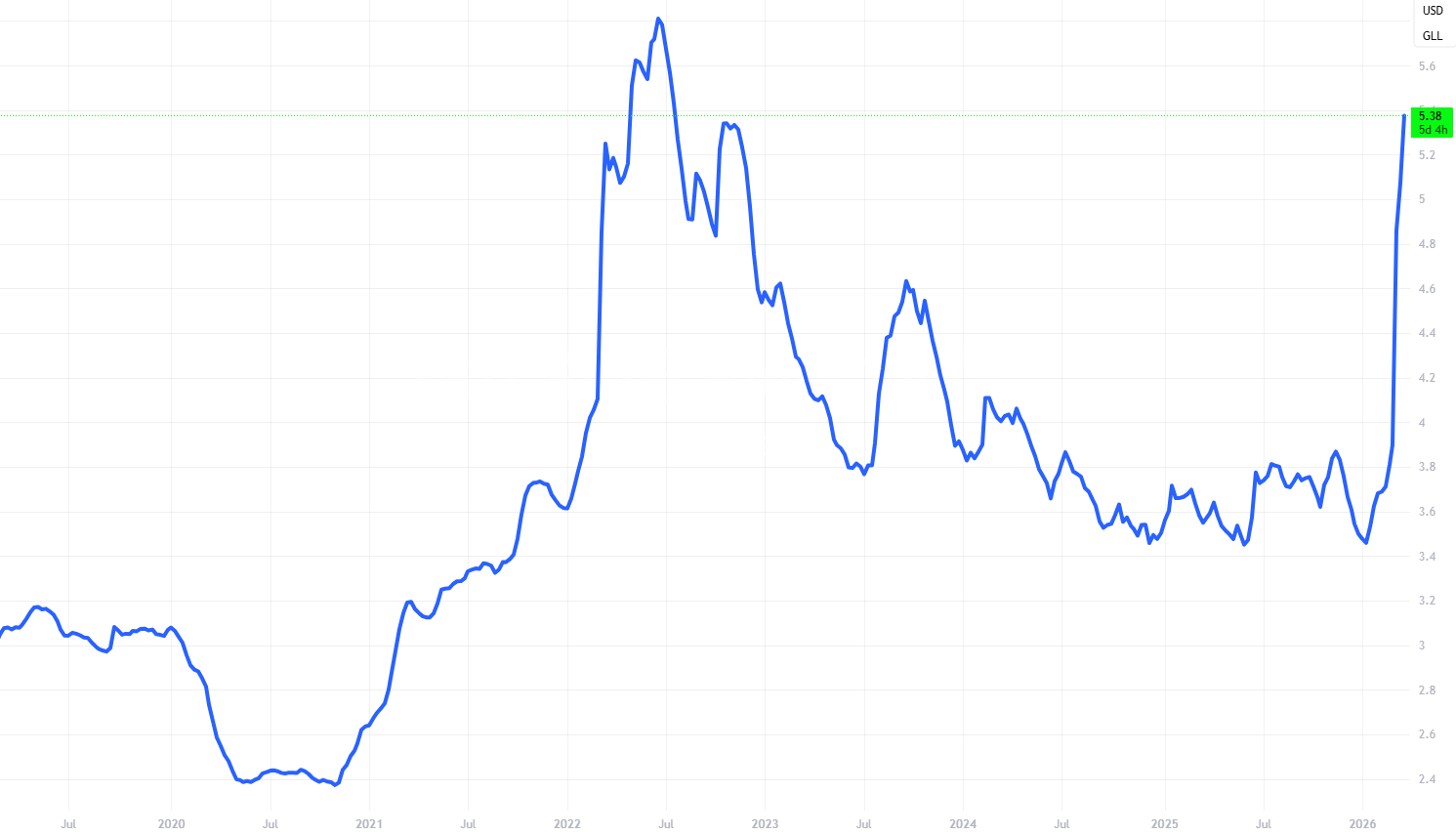
US Diesel Sales Price: U.S. Energy Information Administration
What’s happening in the market
On February 28, 2026, the U.S.-Israeli military campaign known as Operation Epic Fury triggered Iranian retaliation in the Strait of Hormuz, the world’s most critical energy chokepoint, through which roughly 20% of all global oil flows. The consequences for fuel prices were immediate. Brent crude surged from roughly $70 per barrel to over $100, and U.S. diesel crossed $5.38 per gallon nationally, the highest level since December 2022.
Unlike past oil shocks that markets could partially absorb by rerouting supply, this disruption involves a physical bottleneck that cannot simply be worked around. The International Energy Agency has called it the greatest global energy security challenge in history. That means elevated fuel costs are not a short-term blip, they are the new operating environment, at least for the foreseeable future.
What carriers are charging right now
Every major LTL and truckload carrier publishes a fuel surcharge table that ties a percentage to the weekly Department of Energy diesel price. That percentage recalculates every Tuesday. Here is where the major carriers stand as of the week of March 24, 2026:
| Motor Carrier | Service Type | Published FSC % at $5.38/gal | FSC Basis | Update Frequency | Resource Link |
|---|---|---|---|---|---|
| A Duie Pyle | LTL | 45.20% | DOE Central Atlantic Fuel Index | Weekly | Pyle FSC |
| Old Dominion Freight Line | LTL | 44.32% | DOE National Average Fuel Index | Weekly | ODFL FSC |
| XPO Logistics | LTL | 46.75% | DOE National Average Fuel Index | Weekly | XPO FSC |
| ABF Freight | LTL | 44.80% | DOE National Average Fuel Index | Weekly | ABF FSC |
| Estes Express | LTL | 51.10% | DOE National Average Fuel Index | Weekly | ESTES FSC |
| Saia Freight | LTL/TL | 48.12% LTL / 96.24% TL | DOE National Average Fuel Index | Weekly | SAIA FSC |
| TForce Freight | LTL | 43.7% | DOE National Average Index | Weekly | TFORCE FSC |
| R&L Carriers | LTL/TL | 47.8% LTL / 95.60% TL | DOE National Average Index | Weekly | RNLO FSC |
| Forward Air | LTL/TL | 48.5% LTL / 82.40% TL | DOE National Average Index | Weekly | FORWARD AIR FSC |
These are the rates any shipper not operating under a negotiated fuel agreement will pay. Carriers apply them as a percentage of the baseline linehaul charge and reset them weekly based on the regional or national DOE index.
What this means for your freight bills going forward

Diesel prices at this level are expected to remain elevated as long as the Strait of Hormuz remains restricted. Unlike the 2022 energy shock, there is no simple rerouting solution to this one. Every shipper in North America is navigating higher fuel costs right now. The difference is how much of that cost you absorb. Shippers paying published carrier FSC rates are absorbing all of it, and then some. TLI clients are protected from the volatility as the fuel table prevents FSC from being a motor carrier profit center. That is the distinction we have built into our program, and it matters more right now than it has in years.
So, if you have questions or concerns about your current FSC rates, want to understand the gap between your invoices and TLI’s negotiated table, or are a new shipper that wants to get your freight program into our transportation RFP process, reach out to your TLI account team. We are here to help you manage through this.