
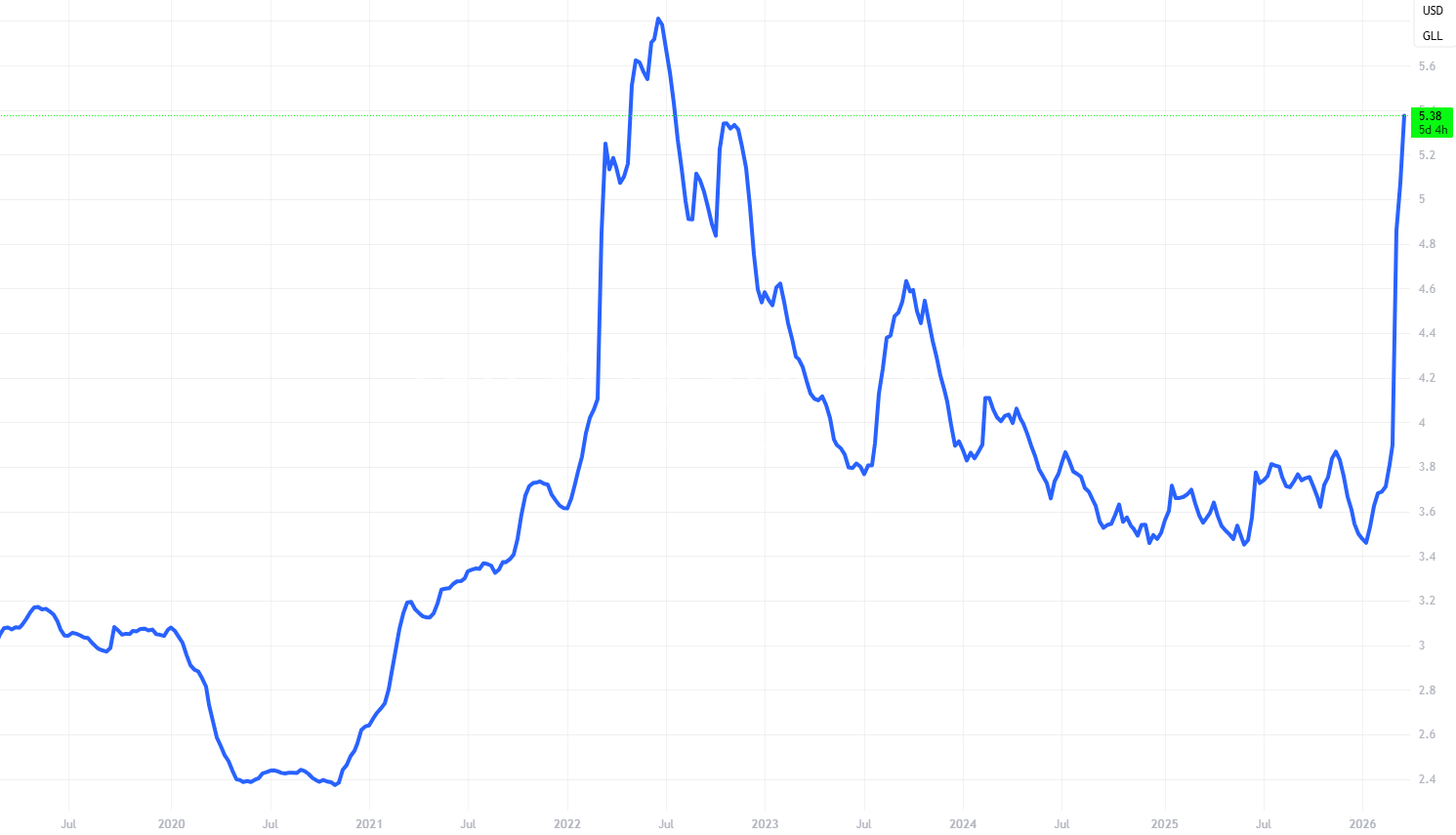
The Iran war has sent diesel past $5 per gallon, triggering the fastest fuel surcharge spike since 2022. Motor carriers are responding immediately. In many cases, FSC has quietly become a profit center rather than a cost recovery tool. Here’s the full picture, and how TLI helps shippers fight back.
$5.38
AVG. DIESEL/GAL (Mar 2026)
+41.13%
DIESEL INCREASE (since Feb 23)
20%
OIL THROUGH HORMUZ STRAIT
What is a fuel surcharge?
A fuel surcharge (FSC) is an additional fee that motor carriers apply on top of the base freight rate to help offset the cost of diesel fuel. Unlike the base rate, which is negotiated and relatively stable, FSC is a floating charge tied directly to the weekly U.S. Department of Energy (DOE) national average on-highway diesel price.1 It is assessed as a percentage of your net transportation charge, and it recalculates every single Tuesday.
That means when diesel spikes, as it has done dramatically in early 2026 due to the Iranian war, your freight bill spikes automatically, even if you have a long-standing carrier contract. The FSC mechanism was originally designed as a transparent cost-recovery tool: a way for carriers to pass along legitimate, documented fuel cost increases without constantly renegotiating rates. That was the theory. The reality, as many shippers are now discovering, is far more complicated.
How Is FSC Calculated?
Each major motor carrier publishes its own FSC table, a lookup chart that pairs a range of diesel prices (in cents-per-gallon bands) with a corresponding surcharge percentage. Every Monday or Tuesday, the DOE releases the updated national average diesel price. The carrier uses that number to set the FSC percentage for the following week. Most carriers apply this surcharge to every LTL and TL shipment moving through their network.
How FSC Works: A Quick Example
If your base freight charge is $800 and the carrier’s published FSC at current diesel prices is 34%, your actual fuel surcharge line item is $272, bringing your effective freight total to $1,072 before any other accessorials. At last weeks national average of $5.07/gal, many carriers are in the 32–36% FSC range on published tariff tables.
The Iran War: Why Fuel Costs Exploded in 2026

On February 28, 2026, joint U.S.-Israeli airstrikes launched what became known as Operation Epic Fury, a major military campaign targeting Iranian military infrastructure.2
Iran responded by striking commercial shipping in the Strait of Hormuz, the world’s single most critical energy chokepoint. The consequences for global diesel prices were immediate and severe.3
“The IEA has described the situation caused by the war as the ‘greatest global energy security challenge in history.’ Flows through the Strait of Hormuz have collapsed from 20 million barrels per day to a trickle.” – International Energy Agency, March 20264
In the weeks that followed, the ripple effects moved through the global energy system at unprecedented speed:
- Brent crude surged from roughly $70/bbl in early 2026 to over $100/bbl within days of the conflict starting, with spikes approaching $120/bbl recorded in the first two weeks
- U.S. diesel prices crossed $5.38 per gallon nationally, the highest level since December 2022, representing a 41.13% increase in under five weeks
- Tanker attacks and shipping suspensions stranded hundreds of vessels and removed approximately 20 million barrels per day of OPEC production from the export market
- Iran is demanding a $2,000,000 charge for container ships to cross the strait of Hormuz
- Trucking and rail companies began increasing fuel surcharges, passing the full cost increase through to shippers
- The IEA released the largest-ever draw from strategic petroleum reserves, including over 172 million barrels from the U.S. Strategic Petroleum Reserve, in an attempt to calm markets
Unlike the Russia-Ukraine energy shock of 2022, which the market was able to absorb through rerouting and substitution, the Strait of Hormuz closure represents a physical chokepoint that cannot simply be worked around. That makes this price shock structurally more persistent, and makes proactive FSC management a strategic priority for every shipper in North America.

Published Motor Carrier Fuel Surcharge Rates: Current (Week of March 24, 2026)
| Motor Carrier | Service Type | Published FSC % at $5.38/gal | FSC Basis | Update Frequency | Resource Link |
|---|---|---|---|---|---|
| A Duie Pyle | LTL | 45.20% | DOE Central Atlantic Fuel Index | Weekly | Pyle FSC |
| Old Dominion Freight Line | LTL | 44.32% | DOE National Average Fuel Index | Weekly | ODFL FSC |
| XPO Logistics | LTL | 46.75% | DOE National Average Fuel Index | Weekly | XPO FSC |
| ABF Freight | LTL | 44.80% | DOE National Average Fuel Index | Weekly | ABF FSC |
| Estes Express | LTL | 51.10% | DOE National Average Fuel Index | Weekly | ESTES FSC |
| Saia Freight | LTL/TL | 48.12% LTL / 96.24% TL | DOE National Average Fuel Index | Weekly | SAIA FSC |
| TForce Freight | LTL | 43.7% | DOE National Average Index | Weekly | TFORCE FSC |
| R&L Carriers | LTL/TL | 47.8% LTL / 95.60% TL | DOE National Average Index | Weekly | RNLO FSC |
| Forward Air | LTL/TL | 48.5% LTL / 82.40% TL | DOE National Average Index | Weekly | FORWARD AIR FSC |
*Rates reflect approximate published FSC percentages at the DOE national average diesel price of ~$5.38/gal (week of March 24, 2026). Actual carrier invoicing may vary based on regional pricing or individual tariff amendments. FSC percentages will continue to adjust weekly with diesel prices. Sources: Carrier published tariff tables; DOE EIA weekly diesel price report.
Why FSC Has Quietly Become a Carrier Profit Center
Here’s a fact that many shippers don’t realize: fuel surcharges were not designed to be a 1-for-1 cost pass-through. by default. When diesel prices were around $3.50/gallon a few years ago, carriers established their FSC tables with specific cost-recovery assumptions. Today, at $5.38/gallon, carriers are applying surcharge percentages that in many cases exceed their actual incremental fuel costs, generating additional margin on top of what’s needed to cover the fuel expense itself.
A 2024 TD Cowen analysis found that a 4.7% year-over-year increase in diesel prices corresponded with a 26% increase in carrier fuel surcharge rates.5 That asymmetry is not accidental, it reflects how FSC tables are constructed and how carriers have adjusted their table tiers over time. The result is that FSC has evolved from a pass-through mechanism into a meaningful profit center for well-run carriers, particularly in high-diesel environments like today’s.
How TLI Delivers Significantly Lower Fuel Surcharges Through Our Custom RFP Process
At TLI, we believe fuel surcharges should cover actual fuel costs, not serve as a secondary revenue stream for carriers at shippers’ expense.
Through our proprietary RFP and carrier negotiation process, we have built a freight program where FSC is managed transparently, tied to real cost data, and negotiated as a core component of the carrier relationship, not an afterthought buried in a tariff appendix. This results in fuel being a pass-through for the motor carriers.
What Makes TLI’s Approach Different
Our custom transportation RFP process goes well beyond standard freight bidding. When we source carrier agreements on behalf of our clients, fuel surcharge structure is a primary negotiation variable, not a default acceptance of whatever a carrier publishes. The result: TLI’s custom contract clients consistently access FSC percentages that are significantly lower than published tariff rates, even in high-diesel environments like today’s.
- FSC is negotiated as a standalone line item during the RFP, not accepted as a tariff default
- We benchmark carrier FSC against actual EIA data, ensuring cost-recovery alignment rather than margin extraction
- Our carrier relationships and freight volume provide genuine leverage that individual shippers rarely achieve on their own
- Motor carriers use TLI’s proprietary FSC table to calculate surcharges.
We Cannot Publish Our FSC Table, But You Can Access It Through Our Custom RFP Program
Due to the competitive and proprietary nature of our carrier agreements, TLI does not publish our negotiated FSC rates publicly. What we can tell you is that the difference between published carrier tariff FSC and what TLI clients pay through our program is material, and at $5+/gallon diesel, that gap translates into significantly higher dollar savings on every single shipment.
The only way to tap into TLI’s negotiated FSC program is through a properly sourced RFP. Take the strategic supply chain management approach and have TLI use their tools to launch an RFP on your behalf.

When we run a freight RFP on your behalf, your lanes are enrolled into our carrier pricing structure, including the negotiated fuel surcharge rates. There’s no shortcut, but the savings are real and ongoing.
Ready to stop overpaying on fuel surcharges?
Let TLI source an RFP for your freight program. You’ll then get access to our negotiated FSC rates, full carrier performance benchmarking, and a clear picture of what you’re currently leaving on the table.
Beyond FSC: Additional Cost Saving Programs
Fuel surcharges are a major cost lever, but they are not the only one. TLI offers shippers a comprehensive savings methodology that examines every component of the freight bill. Two of the most impactful additional programs are our CWT Hundredweight Study and our Accessorial Charge Audit.
⚖️
CWT Hundredweight Study
Many shippers are paying LTL rates when a hundredweight (CWT) pricing model, rated per 100 lbs. TLI conducts a full CWT analysis against your actual shipment profile: weights, lanes, frequency, and commodity mix. For shippers with consistent mid-weight shipments, the savings from migrating to CWT pricing can be dramatic, and the FSC calculation methodology under CWT programs is often more favorable as well.
🔍
Accessorial Charge Study
Accessorial fees can easily add +15–25% to a freight bill above and beyond base rates and FSC. Most shippers accept these charges without dispute. TLI performs a detailed accessorial audit of your freight invoices, benchmarks each charge against carrier tariff and market norms, identifies billing errors and overcharges, and renegotiates accessorial schedules as part of your carrier program.
Together, a custom FSC program, a CWT study, and a targeted accessorial audit represent part of our freight cost optimization approach one that addresses the full invoice, not just the line haul rate, on the first line. In a market where diesel at $5+/gallon is the new normal, taking a comprehensive approach to freight cost management is no longer optional for shippers who care about their margins. It is imperative to take a strategic approach and TLI helps shippers execute freight strategies that improve their supply chain performance.
Citations:
- U.S. Energy Information Administration. Gasoline and Diesel Fuel Update. U.S. EIA, https://www.eia.gov/petroleum/gasdiesel/ ↩︎
- C-SPAN. U.S. Central Command Commander Updates on Military Strikes Against Iran. C-SPAN, https://www.c-span.org/program/public-affairs-event/us-central-command-commander-updates-on-military-strikes-against-iran/676058 ↩︎
- CNBC. Iran war impact on Gulf energy and fuel markets. CNBC, https://www.cnbc.com/2026/03/23/iran-war-strait-hormuz-uae-adnoc.html ↩︎
- The New York Times. Iran War Deepens Global Oil Market Strain, IEA Says. The New York Times, https://www.nytimes.com/2026/03/12/world/middleeast/iran-war-oil-iea.html ↩︎
- Supply Chain Dive. FedEx, UPS up fuel fees, levy Middle East surcharges amid Iran war. Supply Chain Dive, March 13, 2026, https://www.supplychaindive.com/news/ups-fuel-surcharge-table-increase-2026/814187/ ↩︎
