
LTL Sourcing & Freight Procurement
Running a competitive LTL RFP is the single highest-leverage move a shipper makes in freight procurement. This article walks you through every step, from assembling your lane data to evaluating an LTL freight quote, and explains why sourcing through TLI produces LTL shipping rates 4–15% below what shippers achieve on their own.
30+
Years Managing Enterprise RFPs
30K+
Vetted Carrier Network
20+
LTL Carrier Partnerships
4-15%
Typical Base Rate Savings via RFP
What Is LTL Freight? Sourcing Tips

Less-than-truckload (LTL) freight is a shipping mode designed for loads that are too large for a parcel carrier but too small to fill an entire trailer. In practice, an LTL shipment typically ranges from 1 to 6 pallets, or between 80 and 15,000 pounds, and rides on a trailer shared with freight from other shippers moving in the same general direction. The LTL carrier consolidates multiple LTL shipments onto one truck, and the shipper pays only for the portion of trailer space their freight occupies.1
That cost-sharing structure makes LTL the backbone of domestic B2B shipping for manufacturers, distributors, wholesalers, and retailers across nearly every industry. But it also means LTL pricing is genuinely complex, influenced by freight class, weight, distance, fuel surcharge tables, accessorial charges, carrier discount schedules, and whether your volume warrants a negotiated contract or simply a transactional LTL shipping quote. Understanding those LTL pricing variables2 is the first step toward sourcing LTL rates that make a real difference in your freight spend.
LTL vs. Other Freight Modes: Quick Reference
| Mode | Typical Weight Range | Pricing Driver | Best Fit |
|---|---|---|---|
| Parcel | Under 70lbs | Dimensional weight, zone | Small, lightweight packages, low value |
| Less-than-Truckload | 70-15,000 lbs | Freight Class, CWT, PCF, Discount off Tariff, Zip Pairs, Dimensions, Weight | 1-6 pallets |
| Partial Truckload | 8,000-28,000 lbs | Linear feet and weight | Too large for LTL; but too small for a dedicated trailer |
| Full Truckload | 20,000-45,000 lbs | Lane-level contract or spot rate | Dedicated trailer; time-sensitive |
Please note: Standard pallets measure 48 × 40 inches and stack up to 96 inches tall. When a shipment exceeds 12 linear feet of trailer space, many carriers apply cubic capacity rules or volume rates rather than standard LTL class-based pricing — a nuance that catches shippers off guard and inflates the final freight bill if it is not accounted for in the original LTL rate quote.
What Is an LTL RFP, and Why Should Every Mid-Market Shipper Run One?
An LTL RFP (Request for Proposal) is a structured, competitive bidding process through which a shipper works with a 3PL to gather together all the lane data, freight profile, and service requirements to a curated group of LTL carriers and solicits contract pricing in return. The result is a set of negotiated, lane-level LTL rates, complete with customized fuel surcharge tables, accessorial schedules, and volume commitments, that replace transactional or list-tariff pricing.
A 3PL provides tools that allow shippers to build rating scenarios. Historical shipment data can be run through a rating engine against carrier proposals to optimize selection. The result is based on each shipment’s specific parameters.
Unlike a one-off LTL freight quote pulled from a carrier’s website, a well-executed LTL RFP produces contract rates that lock in costs, align carrier incentives with your service expectations, and provide your finance team with predictable freight spend they can reliably budget against.
Key Shipping Insight:
Shippers that run a structured LTL RFP through TLI’s rating engine tools benchmark base rate savings in the range of 4% to 15% compared to their existing direct-carrier or spot LTL pricing, without sacrificing service levels or transit times.
The RFP process is especially valuable for shippers moving at least 10 or more LTL loads per week. Alternatively the annualized transportation spends should exceed $125,000 at a minimum. At that volume, even a modest rate reduction compounds into six-figure annual savings. For multi-site manufacturers or national distributors, the impact is even larger because an LTL RFP also allows you to rationalize your carrier mix, eliminating redundant relationships and concentrating volume with carriers that genuinely compete for your lanes. So after the RFP, the carrier pool should be narrowed. This helps prevent dock congestion and ensures sufficient volume is awarded to each carrier, because if spend is spread too thin and committed volumes fall short, carriers may not uphold their contract rates.
Why LTL Sourcing Is Your Most Underutilized Cost Lever
Most shippers treat LTL pricing reactively: a carrier raises rates, they shop around for a new LTL shipping quote, they pick the lowest number, and the cycle manually repeats. That approach leaves money on the table every year. Proactive LTL sourcing, the deliberate, data-driven process of aligning your freight network with the right carriers at contractual rates, changes the dynamic entirely.
When you source LTL through a managed partner like TLI, you bring three advantages that individual shippers simply cannot replicate on their own:
- Aggregated volume leverage. TLI consolidates freight across hundreds of enterprise shippers, giving the LTL carriers a business case to offer pricing well below what any single shipper could negotiate alone.
- Benchmark intelligence. TLI’s rating engine holds historical LTL rate data across thousands of lanes, so every LTL rate quote your program receives gets evaluated against real market comps, not just carrier-presented numbers.
- Carrier qualification discipline. Not every LTL carrier is right for every lane. And not every carrier is right based off each unique CWT break. TLI vets motor carriers on service performance, on-time delivery, claims ratio, and financial stability before they enter your RFP, eliminating the risk of awarding lanes to carriers that underperform or do not provide their committed capacity.
Together, these advantages, along with many others, turn LTL sourcing from a one-time cost event into a continuous optimization program. A supply chain strategy that keeps your LTL shipping rates competitive across all market cycles rather than falling behind between bid events. For example, diesel is current climbing higher, yet our custom contracted LTL clients are insulated and protected due to our proprietary custom FSC table that prevents fuel from being a motor carrier profit center.
How to Run a Winning LTL RFP: A Step-by-Step Framework
A well-structured LTL RFP follows a clear sequence. Rushing any step produces a result that looks like savings on paper but underdelivers in practice. Here is the process TLI uses for every client LTL sourcing engagement.
LTL RFP Process:
Step 1
Compile Your Lane & Shipment Data
Pull 3-12 months of freight bills. Document origin–destination pairs, freight class, average weight per shipment, pallet count, and accessorial usage. Clean, accurate lane data is the single biggest determinant of how competitive your LTL rates will be.
Step 3
Define Service Requirements by Lane
Not every lane needs the fastest carrier or the broadest national network. Map transit time requirements, residential versus commercial delivery needs, and any specialized service requirements (liftgate, inside delivery, notification) to each lane cluster before you go to market.
Step 5
Issue the RFP & Collect Bids
Distribute a standardized LTL RFP template covering base rates, minimum charges, fuel surcharge methodology, and accessorial schedule. Standardization is critical, without it you cannot make apples-to-apples comparisons across the LTL shipping quotes you receive back.
Step 7
Negotiate, Award & Execute
Leverage benchmark data to negotiate from the market rate down, not up from a carrier’s opening number. Award lanes, execute carrier agreements, load contracts into the TMS, and begin tracking performance from day one. Schedule user ViewPoint training sessions.
Step 2
Profile Your Freight & Identify Anomalies
Audit for misclassified freight, chronic reweighs, and unnecessary accessorials. Carriers price risk, if your freight profile shows a history of reclassification, or high freight claims, and cargo liability, you will pay for it in every LTL rate quote you receive. Fix the data before you bid.
Step 4
Select & Qualify Carriers
Identify regional and national LTL carriers with the network density and service history to compete on your lanes. TLI sources from a vetted pool of 30,000+ carriers and more than 20 active LTL carrier partnerships, applying objective qualification criteria before any bid invitation goes out.
Step 6
Model & Build Carrier Scenarios
Use the TLI rating engine to model different award scenarios against your historical volume. TLI’s RFP technology runs optimization analysis that accounts for total landed cost, base rate, fuel surcharge, accessorial exposure, not just the headline LTL discount number.
Step 8
Monitor, Audit & Re-Bid
Contract rates erode over time through accessorial creep and billing variances. Ongoing freight bill audit keeps your actual LTL shipping rates aligned with contracted terms, while regular performance reviews identify lanes that need re-sourcing before the next formal RFP cycle.
TLI RFP Commitment
When you submit your lane data through TLI’s Transportation RFP intake process, TLI builds your RFP strategy, sources and evaluates carriers, and presents pricing and scenario recommendations, all with no obligation and no disruption to current operations.

Understanding LTL Pricing: Variables That Affects Your LTL Rates
Getting a competitive LTL freight quote starts with understanding the mechanics of how LTL carriers price freight. LTL pricing is not a single number, it is the sum of several interacting variables that every shipper needs to control and properly calculate to achieve the best LTL shipping rates. Every LTL rate is generally derived from a single formula:
Gross Charge = (Base Rate × CWT) × (1 – Discount%) + Fuel Surcharge + Accessorials
Net Charge = Gross Charge × (1 – any additional contract minimums or maximums)
Freight Class (NMFC)™
The National Motor Freight Classification (NMFC)™ system3 assigns every commodity a class from 50 to 500 based on density, stowability, handling characteristics, and liability. Lower classes (50, 55, 60) carry lower LTL rates; higher classes (150, 200, 300+) carry higher rates. Misclassifying freight, either intentionally or due to outdated commodity descriptions, is one of the most common sources of reweigh and reclassification charges that inflate the final freight bill above the original LTL rate quote.
Base Rate & Discount Structure
LTL carriers publish base tariff rates (historically anchored to the legacy CZARLITE or SMC3 CzarLite tariff, now occasionally superseded by carrier-proprietary tariffs). The carrier then applies a negotiated discount off tariff to arrive at your net rate. Because tariff levels vary significantly by carrier, a 65% discount from Carrier A may produce a higher actual LTL freight quote than a 55% discount from Carrier B, making raw discount percentages a misleading benchmark. Total net cost per hundredweight (CWT) is the only metric that matters.
Freight-All-Kinds (FAK) Agreements
A FAK agreement allows a shipper to rate all commodities at a single, agreed freight class regardless of the actual freight class.4 For shippers with high-class commodities, or mixed articles, FAK agreements are one of the most powerful tools in LTL sourcing, often reducing effective LTL shipping rates by reclassifying Class 125–175 freight down to Class 70 or 85. Securing a favorable FAK requires high shipping volume and the negotiating leverage that comes with a well-run LTL RFP. When TLI sources FAK agreements it is largely to protect shippers from being hit with reclassification fees typically associated with mixed article rules.
Minimum Charges
Every LTL motor carrier sets a minimum charge, the floor below which no LTL freight quote will go regardless of weight or class. For very light shipments, the minimum charge often governs the actual LTL rate, making minimum charge negotiation a critical but frequently overlooked component of LTL RFP strategy. While performing the benchmarking exercises TLI does perform a minimum shipment study.
Accessorial Charges
Accessorials represent the fastest-growing component of total LTL cost. Common charges include liftgate pickup and delivery, residential delivery, inside delivery, re-delivery, delivery appointment scheduling, and hazardous materials handling. A complete LTL RFP negotiates accessorial caps and waived charges, not just base rates.
Fuel Surcharge
The FSC Fuel Surcharge Advantage: Why TLI’s Fuel Table Beats Going Direct
Fuel surcharges represent a substantial and often underestimated component of total LTL shipping cost. The U.S. Department of Energy’s (DOE) weekly retail on-highway diesel price index serves as the reference point against which most LTL carriers calculate their fuel surcharges, with rates escalating in percentage bands as diesel prices rise.
What most shippers do not realize is that the specific fuel surcharge table a carrier applies to your account, the thresholds and percentage rates within each diesel band, is a negotiated term, not a fixed schedule.
When a shipper approaches an LTL carrier directly, they typically receive the carrier’s standard published fuel surcharge table, the table with the widest bands and highest surcharge percentages. TLI negotiates a custom fuel surcharge tables across its entire managed shipper network, concentrating collective volume to drive carrier concessions on fuel table terms that individual shippers simply cannot achieve on their own.
The TLI Fuel Table Difference
TLI’s negotiated fuel surcharge tables carry more favorable band structures and lower surcharge percentages than the standard direct-carrier tables available to individual shippers. On high-volume LTL programs, the fuel surcharge differential alone can represent thousands of dollars per month in savings, savings that appear on every single LTL freight quote and every freight bill, every week the trucks roll.
This advantage compounds because fuel surcharges apply to the net base rate, so a better fuel table multiplies on top of the already-improved contract rates that come out of a structured LTL RFP.5 The combined effect is a total LTL shipping rate that is meaningfully and durably lower than what any shipper can produce by going to carriers directly.
LTL RFP vs. Spot LTL Rate Quote
Not every LTL shipment needs to originate from a contracted rate. Understanding when a structured LTL RFP produces the best outcome, and when a transactional LTL shipping quote makes more sense, is a core competency of sophisticated freight procurement.
✓ Contract LTL Pricing (via RFP)
- Recurring lanes with predictable volume
- 10+ LTL loads per week
- Multi-lane, multi-facility networks
- Service reliability is critical
- Fuel and accessorial predictability matters
- Carrier performance accountability required
◦ Spot LTL Freight Quote
- One-time or highly irregular shipments
- New lanes testing volume viability
- Overflow when contracted carrier is at capacity
- Emergency or expedited movement
- Pilot programs before full RFP inclusion
- Low volume shipping
The distinction matters because spot LTL rates, the rates behind a quick-turn LTL freight shipping quote, are market-rate, untethered from the competitive dynamics of a formal RFP. The spot rates are not individuated based off your unique shipper profile, nor are they as competitive as contract pricing. In a soft freight market, spot rates can be competitive on certain lanes; in a tight market, they become punishing and expensive. Likewise, when fuel costs rise it becomes more expensive to route LTL freight than having a properly launched LTL RFP via TLI.
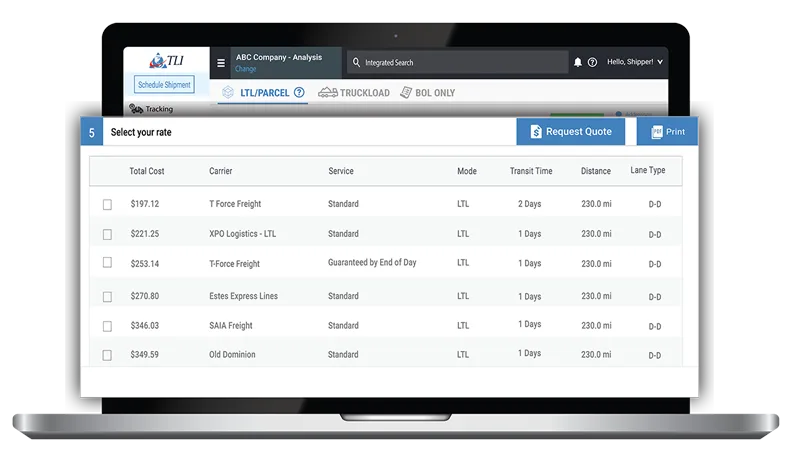
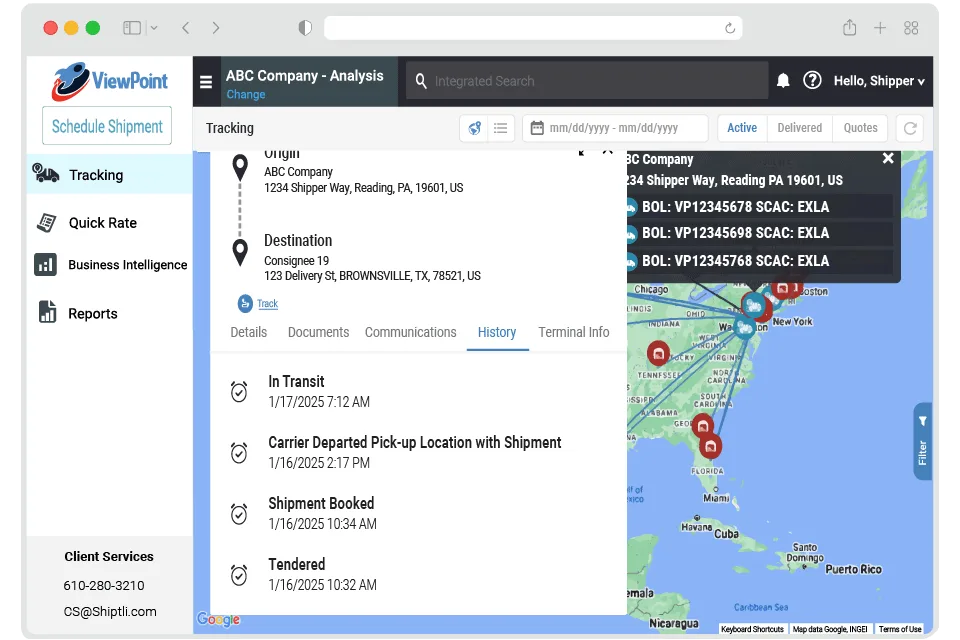
Contract rates established through a Less-than-Truckload RFP insulate your program from that volatility and give operations a stable foundation to plan against. TLI’s ViewPoint TMS supports both modalities, shippers access instant multi-carrier LTL rate quotes for transactional needs while drawing on their contracted program rates for recurring lanes. The platform makes it easy to see when a contracted LTL rate is the right call versus when a spot LTL rate quote makes sense, without creating manual process overhead.
TMS, Freight Audit & Claims: The Services That Protect Your LTL Program After the RFP
Winning an LTL RFP is where the savings potential is created. But the RFP itself does not negate the operational realities of routing freight. Motor carriers can bill incorrectly, and lose or damage shipments in-transit. So the ongoing services surrounding execution, transportation management technology, freight bill audit, and cargo claims management, are where that potential is either realized or eroded. TLI builds all three into every managed LTL program.
⚙️
ViewPoint TMS
Proprietary multi-modal Transportation Management System with ERP integration, auto-tendering, real-time tracking, and Power BI reporting. All your contracted LTL rates live inside it.
🔍
Freight Bill Audit
Automated invoice auditing flags every discrepancy between quoted and billed amounts before payment. TLI disputes reweighs, reclasses, and invalid accessorials on your behalf.
📋
Freight Claims
Managed claims handling for damaged or lost freight. TLI processes, tracks, and advocates on each claim so your team does not carry the administrative burden.
📊
Carrier Scorecards
Power BI dashboards track on-time performance, claims ratio, and billing accuracy by carrier and lane, feeding data back into the next RFP cycle. Dynamic dashboards are superior relative to static spreadsheets.
🔗
ERP Integration
ViewPoint TMS connects to ERPs so freight data flows alongside your financial and operational data in real time. This makes booking and tracking shipments quick and easy.
🛡️
TLI Advantage+
Enhanced freight insurance coverage that goes beyond carrier liability limits, protecting the full commercial value of your shipments. Purchase additional cargo liability on the fly directly in ViewPoint TMS.
Freight Bill Audit: The Financial Control Layer
Every LTL freight bill carries inherent billing risk. Carriers invoice based on their own weight inspections, class determinations, and accessorial interpretations, and they do not always align with what was quoted. TLI’s freight bill audit program generated well over $634,000 in collective savings across its shipper base in 2023 by catching billing variances before payment and disputing them directly with carriers.
The audit process works through three parallel tracks:
- Rate accuracy audit. ViewPoint TMS automatically compares each carrier invoice against the contracted LTL rate quote for that shipment. Any invoice that does not match the quoted amount is flagged immediately for the accounting team.
- Reweigh and reclass review. If a carrier applies a reweigh or reclassification charge, TLI’s experts evaluate whether the charge is valid, request carrier proof when it is, and formally dispute invalid charges on the shipper’s behalf.
- Accessorial verification. TLI reviews accessorial charges to confirm the service was actually required and applied correctly, disputing charges for services that were not rendered or were applied in error.
For shippers operating an LTL program without a freight bill audit layer, billing variances can quietly accumulate into significant, unrecovered costs. Even the most competitive LTL RFP cannot protect against these losses if contracted rates are not properly enforced at the invoice level. We have found that implementing an audit service alone can typically recover 2–3% of freight spend in the first year after an RFP. Over time, as root causes are corrected and carriers begin billing accurately, these savings naturally decrease. However, when future RFQs are launched or new carriers are added, billing discrepancies often reappear, creating the need for additional dispute resolution and ongoing billing mitigation.
Why TLI Delivers the Best LTL Sourcing Results
TLI, operating as Translogistics, Inc. under the brand Ship TLI has managed enterprise freight for more than +30 years. The company serves public and private companies across more than 50 industries including manufacturing, distribution, wholesale, retail, construction, automotive, building materials, and industrial machinery. The depth of that experience shows in how TLI executes an LTL RFP, manages the ongoing program, and protects the contracted LTL shipping rates through every layer of service.
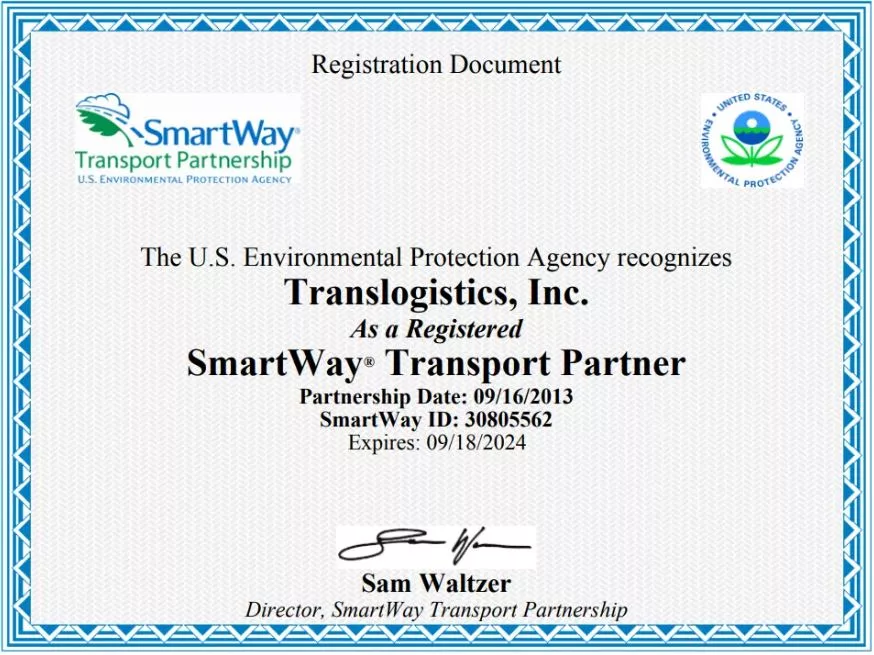
EPA SmartWay Certified Partner
TLI holds EPA SmartWay certification, recognizing a demonstrated commitment to measuring and reducing greenhouse gas emissions and air pollution across the freight supply chain. For shippers with sustainability reporting requirements or ESG commitments, TLI’s SmartWay status supports your emissions tracking and reporting goals.
| Ship TLI Capability | What It Means for Your LTL Program |
|---|---|
| 30+ Years of LTL Market Experience | Deep institutional knowledge of carrier pricing behavior, tariff structures, and market cycles, used to time and structure your LTL RFP for maximum competitive response |
| 30,000+ Vetted Carrier Network | Carrier qualification covers safety, financial stability, service history, and claims ratio before any carrier enters your LTL sourcing process |
| 20+ Active LTL Carrier Partnerships | Pre-negotiated fuel tables, FAK programs, and accessorial schedules that are available to TLI-managed shippers on day one |
| ViewPoint TMS | Proprietary TMS platform that stores all contracted LTL rates, auto-tenders shipments, tracks in real time, and feeds Power BI reporting, eliminating manual rate shopping and booking overhead |
| Automated Freight Bill Audit | Every LTL invoice audited against contracted rates; billing variances disputed before payment; $634K+ in annual client savings documented |
| Managed Cargo Claims Service | Full claims lifecycle management so your team focuses on the business while TLI advocates for every dollar of cargo liability recovery |
| EPA SmartWay Certification | Supports shipper ESG reporting |
| Rated #1 3PL on Google | 420+ five-star reviews from shippers and carriers reflect consistent execution and professional service across every mode and lane |
TLI operates as a true managed transportation partner, not a transactional freight broker. When you engage TLI to run your LTL RFP and manage your program, you get a team that takes ownership of your freight operation: from LTL sourcing strategy and carrier negotiations through daily execution, invoice audit, and claims resolution. The result is a freight program that runs better, costs less, and gives your leadership team the data visibility to make faster logistics decisions.

An LTL RFP (Request for Proposal) is a formal, competitive bidding process. A shipper provides lane data and a detailed freight profile to a 3PL. The 3PL then uses transportation technology to build the shipper profile and run key analytics, including density, accessorial, and CWT studies. Based on this analysis, the 3PL launches an RFQ to multiple LTL carriers to solicit contract pricing. The result is a set of negotiated, lane-level LTL rates, along with custom fuel surcharge tables and tailored accessorial schedules. By contrast, an LTL freight quote is a single, transactional rate for a specific shipment. It is typically based on a carrier’s published tariff with a standard discount applied. This approach does not benefit from competitive pressure or the volume leverage created through an RFP process.
TLI times LTL RFPs based on market capacity dynamics. Most mid-market shippers benefit from a full RFP cycle every 12 to 24 months. Between cycles, TLI conducts targeted lane-level re-sourcing for high-spend or underperforming lanes. TLI also staggers contracts as shipper profiles evolve throughout the year. Changes such as acquisitions, new product launches, or the addition of a distribution center often require adjustments to the carrier network and pricing strategy. Market conditions, shifts in carrier capacity, and significant volume changes can all trigger an out-of-cycle sourcing event. TLI continuously monitors carrier performance and market pricing across all managed clients and proactively recommends optimal re-bid timing.
You need 3-12 months of freight bill history including origin and destination zip codes, freight class, shipment weight, pallet count, and accessorial charges per shipment. The cleaner and more complete this data is, the more competitive the LTL rates you will receive in response. TLI’s RFP intake process guides you through exactly what to compile and can work with data exports from most ERPs and TMS platforms.
LTL shipping rates are contracted, lane-specific prices established through a formal sourcing process such as an LTL RFQ. These rates reflect your unique freight profile, volume commitments, and negotiated terms. By contrast, an LTL freight quote is a point-in-time price for a single shipment. Carriers typically generate these quotes from published tariffs with a standard discount applied.
Contracted LTL rates are almost always lower than transactional quotes. They benefit from competitive bidding, customized pricing structures, and volume leverage.
TLI aggregates freight volume across hundreds of enterprise shippers, giving LTL carriers a compelling business reason to offer pricing, on both base rates and fuel surcharge tables, that no single shipper could access on their own. As an award winning 3PL TLI built proprietary shipping technology, and closely tracks market forces. TLI also brings benchmark rate data, carrier qualification discipline, and a formal RFP process that forces genuine competition among carriers. The combination produces LTL shipping rates that are typically 4–15% below what shippers achieve through direct negotiations. Beyond the RFP itself TLI offers TMS technology, cargo claims management, audit services along with other critical support.
A FAK (Freight All Kinds) agreement allows a shipper to rate all freight at a single, negotiated class, regardless of the actual NMFC class of each commodity. This structure simplifies rating and reduces variability across shipments. For shippers moving higher-class commodities, negotiating an FAK down to Class 70 or 85 can significantly lower per-shipment LTL costs. Carriers typically offset this by increasing the linehaul rate for that class. However, the trade-off often proves worthwhile, as it reduces reclassification disputes, especially for shippers that frequently move mixed commodities.
FAK agreements require sufficient volume and strong negotiating leverage. TLI brings both techniques to the table and incorporates this FAQ strategy into your LTL RFP when it aligns with your shipping profile.
Yes. TLI manages the full freight claims lifecycle, from documentation through filing, follow-up, and settlement, for all managed LTL clients. On the billing side, TLI’s automated freight bill audit system flags every invoice variance and disputes reweighs, reclassifications, and invalid accessorial charges before payment.
TLI’s corporate HQ location is: 1 E Uwchlan Ave, S301, Exton PA 19341
Yes. TLI holds EPA SmartWay certification, which recognizes carriers and logistics companies that meet EPA standards for measuring and reducing freight transportation emissions. For shippers with ESG commitments shipping through a SmartWay-certified partner like TLI supports your sustainability documentation and reporting processes.
Ready to Run Your LTL RFP?
Footnotes:
- Motor carrier qualification parameters can vary. For example, some carriers may classify a shipment as LTL (Less-Than-Truckload) at 12 linear feet, while others may use thresholds of 14 or 16 feet. Weight thresholds and other criteria may also differ by carrier, so it is important to review each carrier’s specific guidelines when evaluating shipment classification. ↩︎
- TLI has the ability to negotiate a variety of LTL pricing structures depending on the shipment profile and carrier, including pallet-based pricing, linear footage pricing, density-based pricing, and other customized rating methodologies. These flexible structures allow for more tailored and often more cost-effective solutions compared to standard class-based pricing. ↩︎
- NMFC is a registered trademark of the National Motor Freight Traffic Association® (NMFTA). For more information on the National Motor Freight Classification (NMFC), please visit https://www.nmfta.org ↩︎
- When negotiating an FAK (Freight All Kinds), it is important to understand the trade-offs involved. For example, if your typical shipping profile ranges from class 100–250 and an FAK of class 100 is secured, the linehaul rate for class 100 will often increase to account for the blended risk to the carrier. In some cases, such as shipping mixed commodities, this can create overall savings and simplify rating. In other scenarios, however, an FAK may not be the most cost-effective approach. We are happy to evaluate your shipping profile and help determine whether an FAK strategy is optimal for your operation. ↩︎
- TLI’s fuel surcharge table is materially more competitive than standard motor carrier FSC tables and is considered proprietary. Access to this structure is reserved for shippers who engage TLI to launch and manage their LTL RFPs, ensuring alignment between pricing strategy, carrier selection, and overall cost optimization. ↩︎
