
Download a Transportation RFP Template
Instructions on Finding Data
Separate Tabs for LTL and Truckload
Free RFP Services and Data Rating Available
Download the Free template Run an RFP through TLI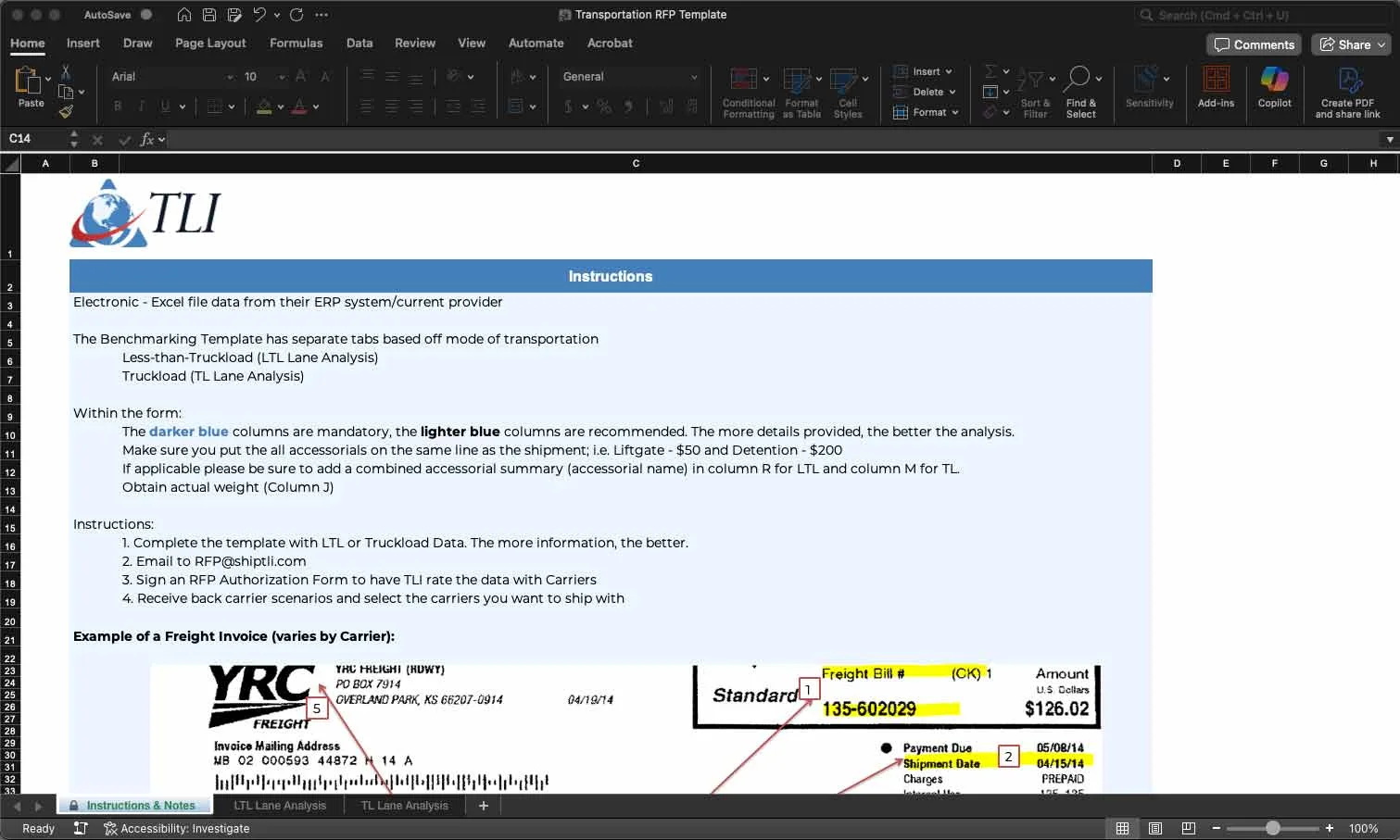
Everything procurement and logistics teams need to run a competitive freight bid. Download the free transportation RFP template to confidently utilize rating engines for your shipments.
A transportation RFP template is a structured data file that shippers fill out with their freight characteristics: lanes, volumes, weights, freight classes, and service requirements. Carriers price against that file and return rate submissions that feed directly into a freight rating engine for comparison.
When shippers complete the template correctly, they cut the back-and-forth that comes from vague RFP submissions and receive rate responses that compare on equal terms. This guide covers what data belongs in your transportation RFP template, why each field affects rating accuracy, and how the template fits into the LTL and truckload procurement process.
The free transportation RFP template is available for download at the top of this guide. It comes pre-formatted for direct import into a freight rating engine.
What is a Transportation RFP Template
A transportation RFP template is the data file at the center of a freight bid. It is a structured input file that captures your freight profile in enough detail for carriers to price it accurately. The file is then used to rate against built contracts in a rating engine to compare responses across multiple carriers.
The difference matters. Many shippers treat a transportation RFP as a document process. The most effective freight procurement teams treat it as a data preparation exercise. The goal is a clean, complete, standardized file that every carrier prices against in the same format.
The consequences of incomplete data show up after the RFP closes. When shippers submit inaccurate weights, dimensions, or freight classes, carriers re-rate the shipments after pickup. Two companies cited in an Old Dominion Freight Line white paper each found that approximately 25% of their shipments came back with a reweigh or re-classification, generating up to 30 invoice disputes per month for one logistics manager alone.1 Inaccurate data in the transportation RFP template produces the same problem at the bid stage: carriers price against a freight profile that does not match what they will actually pick up.
LTL vs Truckload: Why the Template Data is Different
A single transportation RFP template can cover both LTL and truckload freight, but the data fields for each mode differ. Mixing them in the same columns produces unreliable pricing. The template needs clearly separated tabs or sections for each mode.
LTL Template Data
Less-than-truckload pricing depends on freight density, classification, and terminal network proximity, not just lane distance. For a rating engine to model LTL rates accurately, the template must capture freight characteristics at the shipment level.
Industry pricing experts note that “the largest portion of an LTL carrier’s cost is represented in the linehaul segment” and that “occupied space in the trailer drives this cost, so having accurate cube and density data around each shipper’s freight is very important to properly model costs.”2 When that data is missing or estimated, carriers add pricing buffers that inflate your simulated total spend.
| LTL Data Field | Why It Matters | Notes |
|---|---|---|
| Origin Zip Code | Determines terminal proximity and linehaul distance | 5 digit ZIP, not city or state |
| Destination Zip Code | Determines delivery terminal and transit | 5 Digit ZIP, not city or state |
| Freight Class | Primary pricing variable in LTL rate structures | Class 50-500; carrier rates vary significantly by class |
| Actual Weight | Base of CWT (per hundredweight) rate calculation | Include total shipment weight and line item weight if possible |
| Pallet Count | Used to calculate cube/density and linear feet | |
| Dimensions | Used to compute linear feet and density | Per pallet or per shipment if same |
| Accessorial / Special Services | Helps carriers understand the special services for your account | Liftgates, Residential, Delivery Appointments, Limited Access |
Note: If you’re shipping a shipment with multiple ranging line items, it’s best to complete each differing pallet as a separate line item. Make sure to always reference the same shipment ID (typically using the PRO# on the historical shipment) for the data engine to reference.
Truckload Template Data
Truckload pricing uses a simpler structure: a rate per mile or flat lane rate from origin to destination. But the template data still requires ZIP-level precision and must account for current ELD-compliant operating conditions.
Carriers assume drive times of 500 to 550 miles per day for a driver. However, this assumption has been put to test recently due to ELD mandates. The actual miles per day varies based on the drivers hours of service available. Some factors include detention at last pickup, accidents/traffic, deadhead to pickup, and more.
MIT FreightLab research on truckload procurement found that “a significant portion of a TL carrier’s costs is due to the repositioning of empty vehicles (deadheading) from the destination of one load to the origin of the follow-on load.”3 When you group geographically logical lane pairs in your template, carriers can reduce deadhead miles, and that savings shows up in their rates.
| Truckload Data Field | Why It Matters | Notes |
|---|---|---|
| Origin Zip Code | Zip-Level Precision; state or city level is too vague for pricing | Never use State to State only |
| Destination Zip Code | Determines lane mileage and driver return options | Zip Level Required |
| Weight | Determines if their equipment can handle the load | |
| Monthly Load Count | Carriers price lanes based on volume | Call out any peak weeks or months |
| Equipment Type | Rates differ across dry van, reefer, flatbed, and more equipment | Specify per Lane |
| Accessorial / Special Services | Helps determine what special services are needed from either the driver or carrier | Driver load assist; Detention; Delivery Appt |
| Entry Notes | To include any special notes such as facility hours, live load / unload, Drop & Hook, or drop trailer | Helps carriers determine if they can help in the lane |
Why Data Quality Determines Rate Quality
The transportation RFP template produces useful results only when shippers fill it out completely and accurately. This is the most important principle in freight procurement, and the one teams most often skip.
MIT’s Center for Transportation & Logistics found that freight transportation is “subject to highly volatile demand and costs that are typically outside of a firm’s ability to control or even influence.”4 When shippers populate the RFP template thoroughly, they give carriers the information needed to price accurately rather than defensively.
The University of Tennessee’s Center for Freight Transportation for Efficient and Resilient Supply Chains (FERSC) projects that U.S. freight volumes will grow from approximately 19 billion tons in 2022 to over 29 billion tons by 2050.5 As freight volumes rise and supply chain demands increase, shippers who run disciplined, data-driven RFP processes hold a structural advantage over those who do not.
The Most Common Data Mistakes
- State-level lane data for truckload: Carriers price a New York to Springfield, IL lane differently than a New York to Chicago lane. State-to-state data pushes carriers toward worst-case pricing. Use 5-digit ZIP codes for every lane.
- Missing freight class for LTL: Without a freight class, carriers assign the highest-cost classification. A one-class error, such as Class 100 versus Class 85, shifts your effective rate on every shipment in that lane.
- Annual totals instead of monthly volumes: Seasonality affects how carriers price capacity. A lane that spikes in Q4 carries different risk than one with flat year-round demand. Break out volumes by month.
- Omitting accessorials: For LTL shipments to residential or limited-access locations, accessorial charges often exceed the linehaul cost. A template without accessorial data produces an incomplete cost model.
How the Transportation RFP Template Feeds the Rating Engine
After carriers submit their pricing against your template, that pricing loads into a freight rating engine. The engine runs your historical shipment data against each carrier’s rate structure and produces a projected total spend per carrier, per lane, and in aggregate.
This is why template format matters. A rating engine cannot process free-form proposals or inconsistent column structures. Every carrier response must map to the same fields in the same order. Standardizing the template before you send the RFP is what makes that possible.
Frequently Asked Questions
A freight quote request asks a carrier for a spot rate on a single shipment or a handful of lanes. A transportation RFP template covers your entire freight program: all lanes, all volumes, all service requirements, and compliance criteria. Carriers use the template to build a comprehensive bid that a rating engine can model against your actual shipment history. A quote request produces a price. The RFP template produces a procurement decision.
Our standard is at least 6 months. However, twelve months is the best if possible. You may miss seasonal swings that affect carrier pricing and capacity planning. If your freight patterns shifted significantly in the past year due to a new facility, a lost customer, or a product line change, include a note explaining the variance so carriers do not price the anomaly as a baseline.
You can, but keep them in separate tabs. LTL and truckload require different data fields and carriers price them through different rate structures. Mixing the two in the same columns forces whoever reviews the file to sort it out before pricing, which increases the chance of errors.
Six to ten pre-qualified carriers per mode is a practical range. For LTL, we recommend a mix of national and regional carriers to help best optimize your program.
Fill in the freight class fields with your best current information and flag the lanes where you are uncertain. Carriers will price conservatively against estimated class data, but that is better than leaving the field blank, which often results in the carrier assigning the highest available class.
- Old Dominion Freight Line. The Power of Data Accuracy in LTL Shipping (white paper). https://www.odfl.com/us/en/resources/OD-Outlook/Accurate-Freight-Data-in-LTL-Shipping.html ↩︎
- FreightWaves. What’s Involved in an RFP for an LTL Shipper? https://www.freightwaves.com/news/whats-involved-in-an-rfp-for-an-ltl-shipper ↩︎
- MIT FreightLab, MIT Center for Transportation & Logistics. Truckload Procurement Research. https://freightlab.mit.edu/ ↩︎
- Caplice, C. MIT Center for Transportation & Logistics. Research on freight transportation procurement and uncertainty reduction. https://caplice.mit.edu/research-publications/ ↩︎
- University of Tennessee, Center for Freight Transportation for Efficient and Resilient Supply Chains (FERSC). Freight Mobility and Supply Chain Resilience Research. https://fersc.utk.edu/ ↩︎