
Freight is one of the largest controllable costs on a manufacturer’s or distributor’s balance sheet. Yet most mid-market companies manage it the same way they did a decade ago, a mix of spreadsheets, personal carrier relationships, and reactive decisions whenever a lane breaks down. As freight markets grow more volatile and carrier capacity becomes less predictable, that approach leaves real money on the table and creates avoidable operational risk.
Key Takeaway: Managed transportation services give mid-market and enterprise shippers a dedicated team that owns the freight program end-to-end, from carrier procurement and daily load execution to supply chain data reporting and continuous operations process improvement.
Managed transportation services offer shippers the ideal model. Instead of managing freight in-house or relying on transactional brokers, shippers partner with a 3PL provider who takes ownership of the entire freight program including: strategy, procurement, execution, and reporting. This logistics service guide explains exactly what managed transportation services are, who they are built for, and how to evaluate whether outsourcing your freight program is the right move for your company.
What Are Managed Transportation Services?
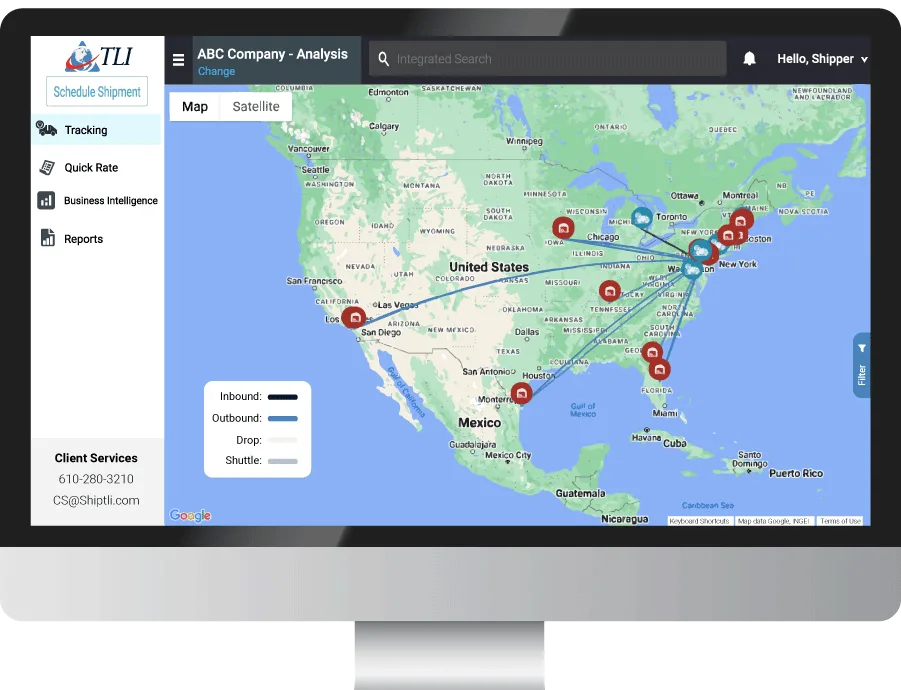
Managed transportation services is a form of logistics outsourcing where a third-party provider assumes operational ownership of a shipper’s freight program. This goes well beyond booking loads. A true managed transportation partner handles carrier sourcing, RFP management, daily shipment execution, freight audit and payment, carrier performance monitoring, and supply chain reporting, all supported by a dedicated team and a proprietary TMS technology platform. TLI’s tech platform is called ViewPoint TMS.
The distinction from a traditional transactional freight broker is meaningful. A broker connects a load to a carrier and earns a margin on the transaction on a one-off basis. A managed transportation provider, by contrast, is accountable to the shipper’s freight program as a whole, including cost performance over time, carrier relationships, and the quality of data the shipper uses to make business decisions. Think of it as the difference between hiring a staffing agency to fill a role versus bringing on a full-time manager who owns the function.
According to the Bureau of Transportation Statistics, transportation services contributed $1.7 trillion, or 6.7%, to U.S. GDP in 2022, with trucking representing the dominant mode for domestic freight movement.1 For manufacturers and distributors, managing that spend effectively is not a logistics problem, it is a financial one.
Table 1: Freight Management Model Comparison
| Model | Freight Management | Carrier Relationship | Data Reporting | Accountability |
|---|---|---|---|---|
| In-House Team | Your staff | You build them | Manual | Internal with limited analytic tools |
| Transactional Broker | Broker (Per Load) | Broker’s network | Minimal | Per transaction |
| Managed Transportation | Dedicated 3PL Team | Provider’s network + yours | Full Program Analytics | Ongoing Enterprise Program-level |
| Asset-Based Carrier | Carrier handles execution only | Single Carrier Capacity | Carrier-level only | Service failure performance only |
The Real Cost of Unmanaged Freight
Before evaluating managed transportation services, shippers should understand the full cost of the status quo. Transportation and logistics costs typically range from 6% to 14% of a company’s revenue, depending on industry sector, according to research on logistics cost benchmarking across manufacturing and distribution companies. For a company generating $100 million in annual revenue, that represents $6 to $14 million in freight spend, much of which goes largely unexamined.2
Companies with inefficient networks can lower their distribution and transportation costs by as much as 25%. (Bain & Company, 2018)
The costs compound in ways that don’t always show up on a freight invoice. Mid-market shippers frequently report an inability to secure reliable capacity on their core lanes, premium spot rates during tight markets, limited tracking and visibility, and no leverage in annual carrier negotiations.3 These are structural problems, not temporary ones, that stem from managing freight without the volume, relationships, or technology that larger shippers take for granted.
Standing alone, a smaller shipper’s chances of satisfying the retailer’s ever-changing requirements are slim. But some are raising the odds through participation in load-consolidation programs, often through the participation of a third-party logistics provider. (Supply Chain Brain, 2018)
Meanwhile, the Federal Highway Administration confirms that freight transportation efficiency improvements translate directly into lower total logistics costs for shippers, not just direct transportation savings, but downstream reductions in inventory carry, warehousing needs, and service failures.4 Managed transportation services unlock these second-order gains by applying systematic program management to a shipper’s network rather than optimizing one load at a time.
Table 2: Hidden Costs of Unmanaged Freight Programs
| Hidden Cost | What it Looks Like | Business Impact |
|---|---|---|
| Uncompetitive lane pricing | Accepting incumbent carrier rates without benchmarking | Overpaying 5–20% on core lanes |
| Spot market dependence | Routing guide failures filled with broker spot loads | Rate unpredictability; poor budget performance |
| Limited carrier visibility | No real-time tracking; manual status calls | Customer service failures; detention costs |
| Reactive procurement | Annual RFP with insufficient data or carrier coverage | Weak award outcomes; capacity gaps, carrier sourcing not optimized |
| Unbilled freight errors | Invoices paid without audit vs. contracted rates | Industry estimates: 2–3% of freight spend in errors |
| Staff bandwidth | In-house team managing exceptions instead of strategy | No time for network optimization or cost reduction |
Who Are Managed Transportation Services Built For?
Managed transportation services are not the right fit for every shipper. They deliver the highest value for mid-market and enterprise companies that ship frequently across multiple lanes, modes, and origins, but lack the internal headcount, technology, or carrier leverage to optimize the program themselves.
The typical managed transportation candidate ships at least $1 to $15 million in annual freight across truckload, LTL, or intermodal lanes. They often operate from multiple distribution points, serve national accounts or retail partners with compliance requirements, and are growing in ways that outpace their current transportation infrastructure. They may have strong operations teams, but those teams are consumed by daily execution rather than strategic program management.
Industries that consistently benefit from managed transportation services include manufacturing, distribution, wholesale, retail, construction, automotive, building materials, industrial machinery, and paper and packaging. What these sectors share is a need for predictable carrier capacity, consistent pricing, and meaningful freight data and an inability to get all three without a dedicated program.
Table 3: Industries Best Served by Managed Transportation Services
| Industry | Primary Freight Modes | Key Driver for Managed Transportation |
|---|---|---|
| Manufacturing | TL, LTL, intermodal | Inbound raw materials + outbound finished goods across multiple plants |
| Distribution & Wholesale | TL, LTL | High shipment volume; retailer compliance requirements; routing guide management |
| Building Materials | Flatbed, TL, LTL | Seasonal demand; oversize/specialized freight; project-based scheduling |
| Automotive & Industrial | TL, LTL, expedite | JIT delivery requirements; supplier coordination; compliance-heavy lanes |
| Retail & Consumer Goods | TL, LTL, parcel | Vendor-managed inbound; retailer chargebacks; multi-location distribution |
| Construction & Infrastructure | Flatbed, heavy haul | Project-specific freight; permit routing; time-sensitive delivery windows |
Core Components of a Managed Transportation Program
Not all managed transportation services are structured the same way. So when evaluating 3PL providers, shippers should understand the specific functions included in a program, and hold providers accountable to clear deliverables in each area. The following components represent the full scope of a well-designed managed transportation engagement
Freight RFP Management and Carrier Procurement
A managed transportation provider conducts formal carrier procurement on behalf of the shipper building the lane data package, running the bid event, evaluating proposals, and making award recommendations based on cost, service history, and network fit. Carrier compliance rates, which measure how often primary carriers actually accept awarded freight, should target a range of 80% to 100% according to freight procurement best practices. Too low, and a routing guide fails. Too high, and a shipper may be under-diversified when markets tighten.
Effective RFP management requires clean historical shipment data, a clear lane segmentation strategy, and the ability to evaluate bids on total cost, not just linehaul rate. A managed transportation provider brings the market intelligence, carrier relationships, and technology tools to run this process more effectively than most in-house teams can on their own.
Daily Shipment Execution and Routing Guide Management
Once motor carriers are awarded lanes, the managed transportation team handles daily tendering, exception management, and escalation recovery when primary carriers decline freight. This includes maintaining and enforcing a routing guide that reflects contracted commitments, and filling capacity gaps with qualified backup carriers rather than defaulting to expensive spot loads. This is where dedicated program management creates durable savings, not in the RFP itself, but in day-to-day execution discipline over twelve months.
Freight Audit and Payment
Freight billing errors are a persistent drain on shipper budgets that rarely get the attention they deserve. A managed transportation program includes systematic audit of freight invoices against contracted rates, with disputes filed on behalf of the shipper and cost recoveries returned to the freight budget. Research on logistics technology ROI consistently identifies freight audit as one of the highest-return components of any managed transportation engagement.5
Reporting, Analytics, and Continuous Improvement
A managed transportation provider should deliver regular freight program reporting, carrier scorecards, spend analytics by lane and mode, on-time performance trends, and exception summaries. This data enables quarterly reviews, contract benchmarking, and strategic decisions about network changes. Shippers that lacked visibility into their freight program before outsourcing consistently identify reporting as one of the most valuable outcomes of a managed transportation engagement. Likewise, tools like a rating engine need to be deployed so shippers historical data can be run against carrier proposals so they know what the actual price impact will be based off each proposal when accounting for all the variables including accessorial use, fsc, cwt, pcf density breaks along with many other moving parts.
The TMS Advantage
Technology is what makes modern managed transportation services scalable. A Transportation Management System (TMS) serves as the operational platform for booking, tendering, tracking, auditing, and reporting, connecting the shipper, the managed transportation team, and the carrier network in a single environment. Shippers who access a TMS through a managed transportation provider gain enterprise-grade technology without the cost or complexity of owning and maintaining the system themselves.
By choosing the right transportation management system (TMS), shippers and third-party logistics providers (3PLs) can often reduce annual transportation spend by 2- 5% and limit cost elsewhere across their supply chain networks. Importantly, TMS users can also adapt when conditions change to reduce risk and protect service.
Research, as quoted above, on TMS adoption consistently shows that organizations using transportation management technology reduce annual freight spend by 2% to 10% compared to manual or fragmented approaches6. Optimization of carrier selection, load consolidation, and mode decisions all contribute to this outcome, none of which is achievable without accurate data flowing through a centralized platform.
For shippers evaluating managed transportation providers, the TMS platform is a differentiator worth probing. Key questions include: Does the TMS connect to your ERP? Can you access real-time shipment visibility? Does it produce the reporting your finance team needs? So, a proprietary TMS built specifically for the managed transportation model, like ViewPoint TMS, rather than a generic off-the-shelf tool typically delivers more consistent outcomes because the workflow is designed around the managed service, not adapted to it.
Table 4: TMS Capabilities and Business Impact for Managed Transportation Shippers
| TMS Capability | Operational Benefit | Financial Impact |
|---|---|---|
| Automated load tendering | Faster carrier response; reduced manual work | Lower internal labor cost; fewer missed pickups |
| Rate shopping across multi-modal carrier networks | Best price/service balance on every load | 4–16% reduction in freight spend |
| Real-time shipment tracking | Proactive exception management | Reduced detention; fewer customer service failures |
| Freight audit integration | Invoice errors caught before payment | Recovery of 2–3% of freight spend in overbillings |
| Carrier performance scoring | Data-driven award decisions at next RFP | Improved routing guide compliance; better service |
| ERP integration | Unified data for finance and operations, automated GL coding | Reduced administrative cost; faster reporting cycles |
Citations:
- Source: U.S. Bureau of Transportation Statistics, Transportation Satellite Accounts, 2022. https://www.bts.gov/newsroom/transportation-services-contributed-67-us-gdp-2022-rising-above-63-2019 ↩︎
- Source: Bain & Company, “Are Your Distribution and Transportation Costs Out of Control?” https://www.bain.com/insights/are-your-distribution-and-transportation-costs-out-of-control/ ↩︎
- Source: Supply Chain Brain, “Understanding the Freight Transportation Challenges of Mid-Market Shippers.” https://www.supplychainbrain.com/articles/27551-understanding-the-freight-transportation-challenges-of-mid-market-shippers-1 ↩︎
- Source: U.S. Federal Highway Administration, “Economic Effects of Transportation: The Freight Story.” https://ops.fhwa.dot.gov/freight/documents/freightstory_12902.pdf ↩︎
- Source: Infios (formerly MercuryGate), “How a Transportation Management System Supports Supply Chain Cost Reduction.” https://www.infios.com/en/knowledge-center/blog/how-a-tms-supports-supply-chain-cost-reduction ↩︎
- Source: Infios, “How a TMS Supports Supply Chain Cost Reduction.” https://www.infios.com/en/knowledge-center/blog/how-a-tms-supports-supply-chain-cost-reduction ↩︎