

Freight costs keep rising across less-than-truckload (LTL), truckload, parcel, and intermodal shipments. Fuel prices, tighter capacity, accessorial fees, and inefficient processes increase transportation spend month after month. While the actual cost for transportation is set in rate agreements and market conditions, there are other ways to reduce freight shipping costs. Companies that make a proactive approach to freight management regularly uncover savings inside their routing decisions, carrier contracts, invoice data, and more.
This guide explains seven strategies to reduce freight shipping costs outside of shopping for rates.
Article Contents:
01
Mode Optimization
CHOOSE THE RIGHT MODE FOR EVERY SHIPMENT
Transportation mode selection is one of the most important cost and service decisions in freight management. Choosing the wrong mode, whether out of habit, speed, or limited carrier visibility, can significantly increase transportation spend and reduce network efficiency.
The most effective shipping strategies match the shipment’s size, distance, urgency, freight characteristics, and delivery requirements to the appropriate mode. Smaller shipments often move more economically through LTL networks, while heavier or high-volume freight may justify truckload or partial capacity. Longer-haul freight with flexible transit requirements may benefit from intermodal carriers to reduce cost and fuel consumption.
Instead of defaulting to one mode for every shipment, companies should build a mode-selection framework that evaluates shipment weight, cube, density, lane distance, service expectations, and handling requirements before tendering freight.
| Mode | Best Used When | Shipment Profile | Key Advantages | Tradeoffs |
|---|---|---|---|---|
| LTL (less-than-Truckload | Shipping smaller freight that does not require a full trailer | Typically 150–10,000 lbs, 1-6 pallets | Pay for space, flexible services, available capacity | More handling, longer transit times, higher damage risk |
| Truckload (FTL) | Freight fills most or all of a trailer, or requires direct service | Large shipments, high value or dedicated loads | Fast transit, minimal handling, improved security and reliability | Higher cost if trailer space is underutilized |
| Partial / Volume LTL | Freight is too large for standard LTL but does not justify a full trailer | High-Cube or 6 – 15 Pallets | Lower cost than FTL, reduced handling versus standard LTL | Capacity can vary by market and lane |
| Intermodal | Long-haul freight with flexible delivery windows | Heavier shipments moving long distances (typically 700+ miles) | Lower transportation cost, fuel efficiency, sustainability benefits | Longer transit times and additional drayage coordination |
A formal mode optimization strategy should also evaluate opportunities for shipment consolidation, regional carrier utilization on short-haul lanes, pool distribution, and cross-docking to reduce handling and improve trailer utilization. The goal is to create a data-driven mode matrix that aligns freight characteristics with the most cost-effective and operationally efficient transportation solution for every shipment.
02
Freight invoice auditing
Find What You Are Overpaying
Freight invoice auditing is one of the most effective ways to reduce freight shipping costs because transportation billing is inherently complex. A single invoice may include linehaul charges, fuel surcharges tied to Department of Energy diesel indexes, dimensional weight pricing, NMFC® freight classifications, and multiple accessorial fees. With so many moving parts, billing errors are common and often go unnoticed.
According to Cass, due to contract complexity and the many charges typically presented on a freight invoice, error rates are high.1 Incorrect freight class assignments, duplicate charges, invalid accessorial fees, and non-contracted carrier rates can quietly increase transportation spend over time. For shippers managing millions in annual freight spend, even small discrepancies can result in substantial unnecessary costs.
A structured freight audit process helps companies identify and prevent these overcharges before they impact the bottom line. Pre-payment audits verify invoice accuracy before payment is issued, while post-payment audits help recover hidden overcharges and identify recurring billing patterns that can be corrected during carrier negotiations.
Beyond immediate cost recovery, freight invoice auditing improves visibility into transportation spend and helps businesses better understand where excess costs are occurring. It also creates stronger carrier accountability by ensuring invoices align with contracted pricing and shipment details.
1-2%
Average Freight Budget Recovery
Our freight audit services recover an average of 1% to 2% in transportation spend for managed customers by identifying billing discrepancies, duplicate charges, and non-contracted carrier fees before they become permanent freight costs.
For companies focused on long-term freight savings, invoice auditing is often one of the highest-return operational improvements available because it uncovers hidden costs that would otherwise continue reducing profit margins year after year.
03
process audit
Turn invoice data into operational insight
Freight invoices do more than show shipping charges. They often reveal operational issues that increase transportation costs over time. Recurring redelivery fees may point to address errors, detention charges can indicate warehouse scheduling problems, and frequent reweigh fees often come from inaccurate shipment measurements or packaging issues.
A freight process audit reviews invoices alongside shipping procedures, carrier contracts, warehouse operations, and performance data to identify the root causes of unnecessary freight costs. The objective is not just to correct billing errors, but to improve the processes creating those charges.
By reviewing invoice trends, companies can identify recurring cost drivers such as detention fees, accessorial charges, reweighs, and fuel surcharge discrepancies. Auditing these patterns is one way companies can reduce freight shipping costs and improve transportation operations efficiency.
04
Contract negotiation
renegotiate carrier contracts
Carrier contracts establish the foundation for your freight costs, often for a year or longer. Companies that enter carrier negotiations without accurate lane data, carrier performance metrics, or current market benchmarks often pay higher transportation rates than necessary.
Successful contract negotiations start with clean freight spend data by lane, mode, and carrier. Freight invoice auditing helps identify actual shipping patterns, recurring accessorial charges, and rate inconsistencies that strengthen negotiating leverage during carrier reviews and RFPs.
Many shippers focus only on base linehaul pricing, but fuel surcharge programs, minimum charges, and accessorial fees can account for a significant portion of total freight spend. Reviewing these areas during negotiations can create substantial long-term savings.
Market benchmarking is also critical when looking to reduce freight shipping costs. Comparing rates against current market conditions and carrier performance data helps companies understand where pricing is above market and where renegotiation opportunities exist.
Download an RFP Template!
Instructions on Finding Data
Separate Tabs for LTL and Truckload
Free RFP Services and Data Rating Available
Download the Free template Run an RFP through TLI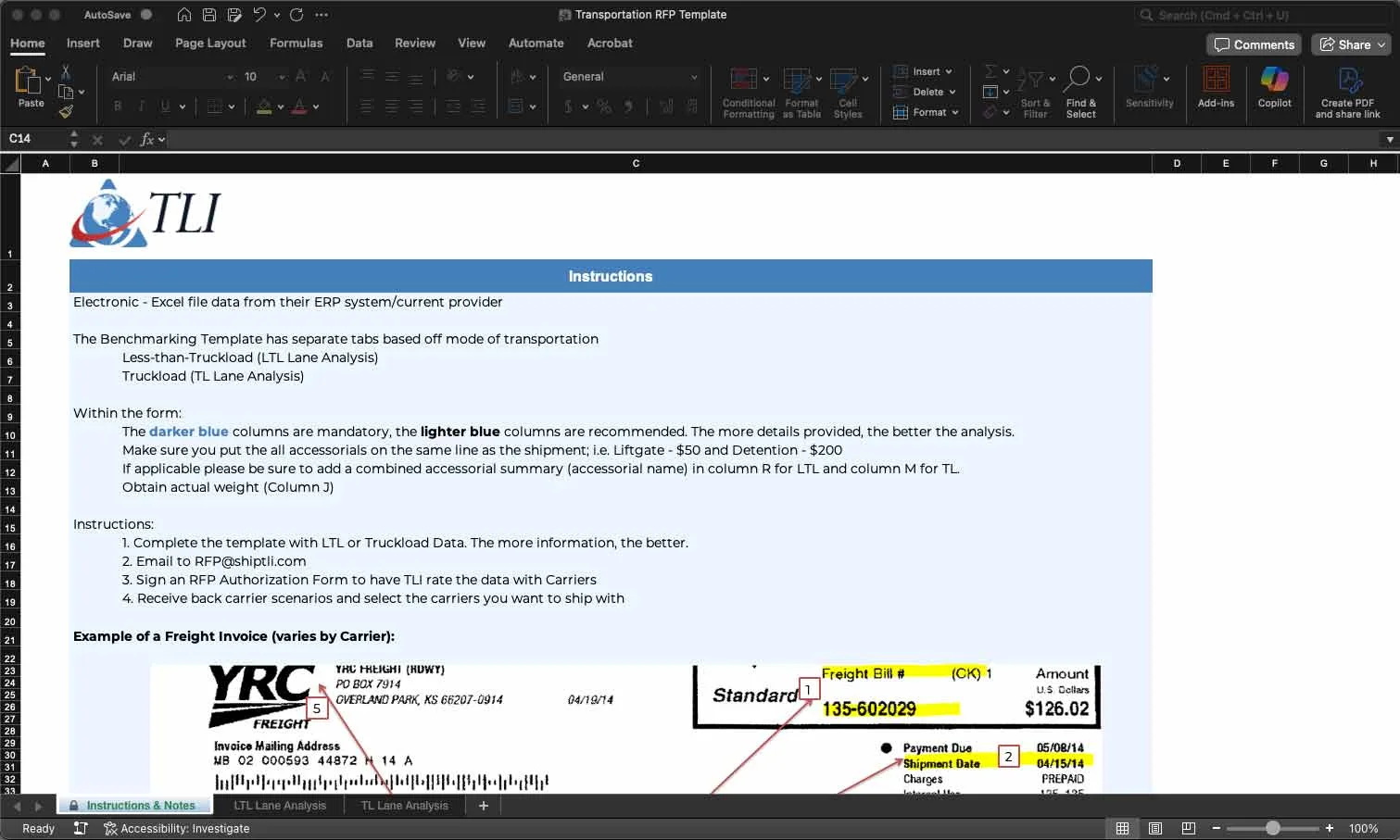
A well-prepared carrier negotiation strategy improves pricing, increases carrier accountability, and helps create more stable long-term transportation costs.
05
Accessorial management
negotiate accesorial waivers
Accessorial charges — liftgate fees, residential delivery surcharges, detention charges, redelivery fees, fuel surcharges — can add 20 to 35% to a base linehaul rate if left unmanaged. Most shippers negotiate linehaul discounts during contract season and accept carrier accessorial tariffs without pushback.
An accessorial audit reviews which charges appear on invoices most frequently and cross-references them against contracted rates and carrier tariff schedules. High-volume accessorials become negotiation targets: waiver thresholds, caps, or reduced per-occurrence rates in exchange for freight volume commitments.
Detention charges in particular reflect a mutual cost. Carriers charge shippers for trucks sitting idle at docks. The American Transportation Research Institute (ATRI) estimates that driver detention costs the trucking industry over $1 billion annually in lost productivity (ATRI, atri-online.org). Shippers who reduce dock wait times through appointment scheduling improve carrier relationships and lower their own detention exposure simultaneously.
06
SPOT Truckload strategy
Don’t Saturate Rates Through Multiple Brokers
Posting the same truckload shipment to multiple freight brokers at the same time can unintentionally increase spot market pricing. When several brokers send the same load to carriers through load boards and carrier networks, the shipment quickly appears oversaturated in the market.
Carriers often interpret repeated postings as a sign of urgency or low coverage availability, which can lead to higher rate quotes and reduced negotiating leverage for the shipper.
Instead of creating competition, excessive broker overlap can drive spot truckload costs higher by exposing the shipment too broadly. A more controlled spot freight strategy helps maintain pricing stability, improve carrier relationships, and reduce unnecessary transportation costs.
07
TMS technology
Deploy a Cloud-Based Transportation Management System
A Transportation Management System (TMS) helps companies manage freight operations from a single platform by improving carrier selection, shipment visibility, routing, and rate management.
Transportation often represents a large portion of total supply chain costs, and many companies use a TMS to help reduce freight shipping costs through better routing decisions, load optimization, and stronger carrier management.
TLI’s cloud-based TMS, ViewPoint, allows shippers to rate, book, and track shipments across multiple transportation modes in one system. It also centralizes carrier management, freight reporting, and shipment visibility without relying on spreadsheets, emails, or manual processes. Because ViewPoint connects directly to TLI’s carrier network and contracted pricing, shippers can review accurate transportation costs before booking shipments.
15%
TMS Platforms reduce transportation spending by an average of 15%2
Cloud-based TMS platforms are typically more cost-effective and easier to implement than traditional on-premise systems, making them accessible for mid-sized shippers looking to improve transportation efficiency and control freight spend.
Reduce Freight Shipping Costs through Translogistics, Inc (TLI)
Reducing freight shipping costs requires more than negotiating lower rates. Companies that improve mode selection, audit freight invoices, strengthen carrier agreements, and gain better visibility into transportation data often uncover significant long-term savings. TLI helps shippers manage these strategies through freight audit services, carrier procurement support, and our cloud-based TMS, ViewPoint. Contact TLI to identify cost-saving opportunities across your transportation network.
Frequently Asked Questions
Yes. Companies can reduce shipping costs by improving transportation planning, auditing freight invoices, optimizing packaging, consolidating shipments, and selecting the right transportation mode for each shipment. Reviewing carrier contracts and reducing unnecessary accessorial charges can also lower overall freight spend.
Cheaper freight shipping often starts with comparing carrier options, optimizing shipment sizes, and improving freight classification accuracy. Businesses can also reduce freight shipping costs by using a Transportation Management System (TMS), negotiating carrier contracts, and by partnering with a proven transportation partner.
Companies can decrease shipping costs by reducing detention time, consolidating freight, and identifying billing errors through freight invoice audits. Better routing decisions and stronger carrier management also help lower long-term transportation expenses.
Delivery fees can often be reduced by minimizing residential surcharges, liftgate requirements, reweigh charges, and other accessorial fees. Accurate shipment information, better packaging practices, and improved delivery planning help reduce unnecessary delivery costs.
Footnotes
- Cass Information Systems. “The Cass Freight Index: A Measure of North American Freight Activity.” Accessed May 21, 2026. https://www.cassinfo.com/freight-audit-payment/cass-transportation-indexes/cass-freight-index ↩︎
- Nucleus Research. “How to Maximize the ROI of a TMS in 2024.” 2024. https://nucleusresearch.com/research/single/how-to-maximize-the-roi-of-a-tms-in-2024/. ↩︎
Acknowledgment of NMFTA’s Trademark
Whenever our educational content refers to the National Motor Freight Classification, we want readers to understand that the term NMFC is a registered trademark of the National Motor Freight Traffic Association (NMFTA). Our goal is to provide helpful industry education while also respecting the intellectual property rights of the NMFTA. Whenever we discuss topics related to freight classification, density, or commodity groupings, we recognize that NMFC identifies the official classification standard maintained and licensed by the NMFTA.
NMFTA is the owner of the National Motor Freight Classification®, more commonly known as the NMFC® (“NMFC”).
