

The Transportation Update for April 2026 covers key areas affecting freight operations. In Mexico, truckers and farmers staged a nationwide blockade on April 7 to protest rising cargo theft, high diesel costs, and lack of government support. On the fuel side, diesel prices remain elevated at $5.643 per gallon for the week of April 6, up $0.24 from the prior week and $2.00 higher than this time last year. On the market side, the domestic spot market is tightening with load-to-truck ratios topping 10 and van rates climbing to $2.73 per mile, while international import demand growth continues to soften heading into Q2 and ocean rates are rising due to Suez Canal disruptions.
Jump to Topic:
Mexico Transportation Update: Nationwide Trucker Blockade Disrupt Key Freight Corridors
On April 7, 2026, truckers and farmers across Mexico blocked major highways and freight corridors in a nationwide strike. The action was organized by two industry groups: the National Association of Transporters (ANTAC) and the National Front for the Rescue of the Mexican Countryside (FNRCM). The groups cited cargo theft, high diesel costs, and a lack of government support for the transportation sector as the driving reasons behind the protest.
Cargo theft is a key concern behind the strike. According to government data cited by FreightWaves, 6,263 cargo theft investigations were opened in 2025. Industry sources, however, estimate the real number exceeded 16,000 incidents when unreported cases are included.1 Transporters argue that law enforcement has not kept pace with the problem, leaving carriers to absorb the losses.
Protesters also pointed to rising diesel prices, higher operating costs, and poor road infrastructure as additional factors behind the action. Shippers with Mexico-originated freight should monitor for potential delays and rerouting. TLI will continue to monitor these shipments for our clients to provide solutions to any affected shipments.
Fuel Update: Diesel Prices Remain Elevated Despite Oil Price Dip
Crude oil prices pulled back sharply in early trading on April 8, 2026, following news of a diplomatic agreement reached overnight between the U.S. and Iran. While the development eased some tension in global energy markets, the relief has not yet translated to meaningful savings at the pump for motor carriers.
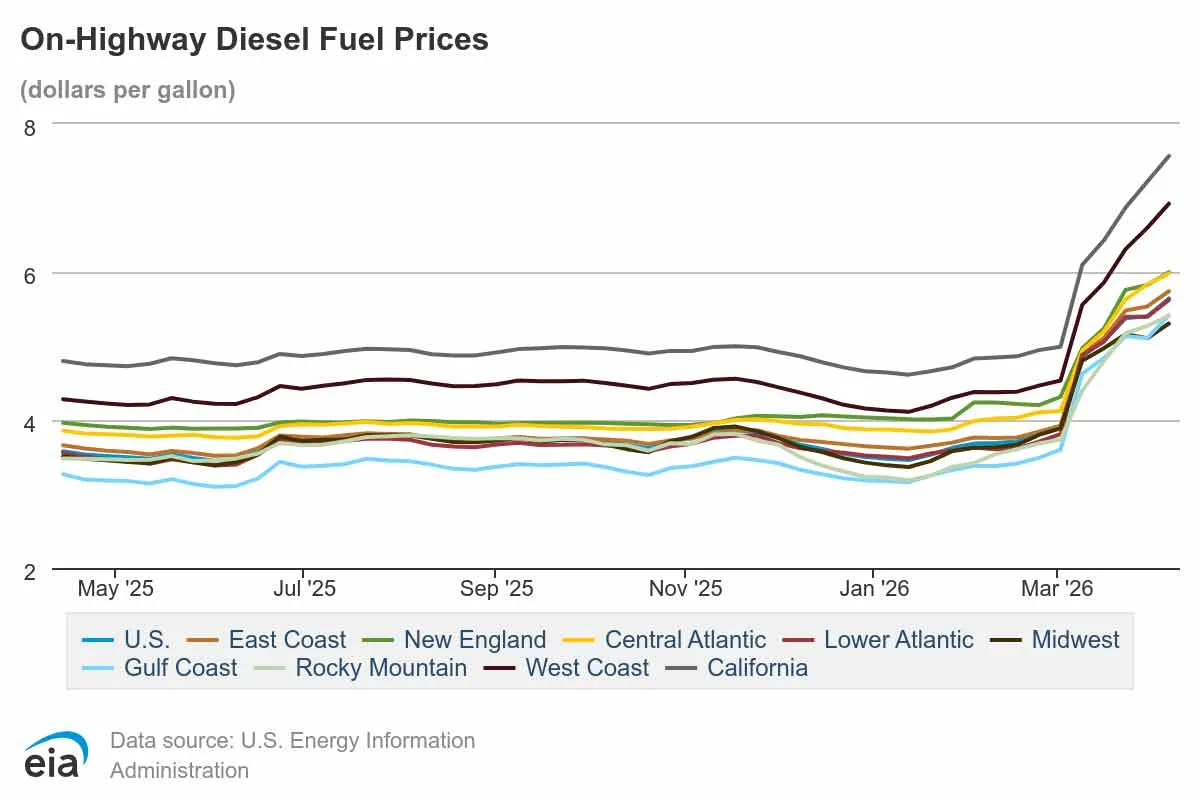
The national weekly average diesel price for the week of April 6, 2026 came in at $5.643 per gallon, up $0.24 from the prior week and $2.00 higher than the same period last year.2 Fuel remains one of the top cost pressures facing fleets, and carriers should expect continued price swings as geopolitical developments affect crude pricing.
How Has TLI Helped Shippers with Fuel Surcharges?
Find out how with this article >
Domestic Freight Update: Spot Market Tightens as Load-to-Truck Ratios Surge
The domestic spot market showed solid strength in March 2026. Spot load postings jumped 68.4% compared to March 2025, while available truck posts fell 10.1% over the same period. This points to a tightening capacity environment. The load-to-truck ratio peaked above 10 during the week of March 28, reflecting strong demand relative to available capacity.
Dry van spot rates averaged $2.73 per mile in March, continuing the month-over-month upward trend. Shippers using spot capacity should expect continued rate pressure heading into Q2 as seasonal freight volumes pick up.
International Freight Update: Import Demand Softens as Ocean Rates Climb
U.S. import volumes were strong at the start of 2025, as shippers moved to bring in inventory ahead of anticipated tariff increases. That demand has pulled back through the latter part of 2025 into February 2026 entering an expansion phase in March 2026. Now in Q2 2026, experts expect import demand growth to stay muted as the market works through that earlier surge.
On the ocean rate side, new vessel capacity coming into service pushed rates lower at the start of 2026. However, rising tensions in the Middle East have changed the picture. The closure of the Suez Canal to commercial shipping has forced carriers to reroute around the Cape of Good Hope, adding transit time and cost. Blank sailings and operational disruptions have tightened effective capacity and pushed rates higher in the short term, even with overall vessel supply still available. Importers and exporters with time-sensitive cargo should monitor routing options and plan for further disruptions.
Current International Increases by Lane
- Asia–US West Coast rates (FBX01 Weekly) rose 4%
- Asia–US East Coast rates (FBX03 Weekly) increased 3%
- Asia to Northern Europe (FBX11 Weekly) remained steady
- Asia–Mediterranean pricing (FBX13 Weekly) declined by 8%.
Rising oil prices and fuel supply challenges are driving up carrier costs estimated by Hapag-Lloyd at $40–$50 million per week, and have prompted a surge in emergency fuel surcharges, Peak Season Surcharges (PSS), and General Rate Increase (GRI) announcements.3 While many of these increases are slated to take effect in April, some fuel surcharges, ranging from $300 to $500 per FEU, were already implemented by several carriers beginning mid-month and continuing through last week, alongside select GRIs.
The Transportation Update April 2026 was compiled through various industry sources and data. For more information, feel free to reach out to marketing@shiptli.com for any questions or concerns.
Footnotes:
- FreightWaves. Mexico Truckers Block Key Freight Routes in Nationwide Strike (Article). https://www.freightwaves.com/news/mexico-truckers-block-key-freight-routes-in-nationwide-strike ↩︎
- U.S. Energy Information Administration. Weekly Retail Diesel Prices (Government Data). https://www.eia.gov/petroleum/gasdiesel/gov/petroleum/gasdiesel/ ↩︎
- Hapag Lloyd. Implementation of Emergency Fuel Surcharge (EFS) (Article). https://www.hapag-lloyd.com/en/services-information/news/2026/03/emergency-fuel-surcharge–efs–implementation.html ↩︎