
If you ship freight, you already know the market doesn’t sit still. Rates move. Carriers come and go. Capacity tightens or floods without warning. A well-built RFP for transportation services is one of the most powerful tools you have to bring order to that chaos and to lock in competitive pricing before conditions shift.
This guide walks you through what a transportation RFP is, why it matters right now, how to structure one that works, and what mistakes consistently trip up shippers. Whether you’re preparing a trucking RFP, running a freight RFP, or issuing a shipping RFQ, the fundamentals are the same.
Why the Transportation Market Makes a Strong RFP Non-Negotiable
The U.S. trucking market remains massive, but highly fragmented. According to the American Trucking Associations, the industry generated roughly $906 billion in freight revenue in 2024, with nearly 580,000 active carriers as of mid-2025. The majority of those carriers are small operations, with over 90% running 10 or fewer trucks and more than 99% operating fleets under 100 trucks.1 For shippers, that level of fragmentation makes a structured RFP for Transportation Services essential to identify reliable, scalable carrier partners.
At the same time, the market is tightening and demand is beginning to recover. According to FleetOwner, the Federal Motor Carrier Safety Administration’s count of property carriers with operating authority fell by 11.4% from December 2022 to December 2025, reducing available capacity and increasing competition for dependable carriers.2 Even today, carrier exits continue as regulatory enforcement intensifies.
As demand returns and capacity continues to exit the market, shippers that rely on outdated or unstructured procurement processes risk higher costs and service instability, making a well-executed Freight RFP more critical than ever.
What Is an RFP for Transportation Services?
A request for proposal (RFP) for transportation services is a structured document a shipper sends to a pool of carriers, inviting them to submit competitive bids for specific freight lanes, modes, and service requirements. It differs from a shipping RFQ (request for quotation), which typically asks only for pricing on a specific shipment. An RFP goes deeper: it asks carriers to describe their capabilities, technology, safety record, and how they would solve your logistics challenges.
A Routing Guide or Transportation Management System (TMS)-based tender is a related but separate tool: it issues freight to pre-qualified carriers at pre-negotiated rates. The RFP is what builds that pre-qualified list and those rates in the first place.
A freight RFP can cover:
- Full truckload (FTL) lanes
- Less-than-truckload (LTL) lanes
- Intermodal services
- Specialized freight (hazmat, temperature-controlled, oversized)
- Last mile or final mile delivery
The Core Elements of a Transportation RFP
Define your Strategy Before Conducting
The single biggest mistake shippers make is conducting the RFP before they know what they actually want. Do you want the lowest possible rate right now? Do you want service reliability above all else? Do you want to reduce your carrier base or diversify it?
Your strategy should sync with your budget cycle. Most shippers run procurement events in Q4 and Q1, but if your budget gets set before your RFP results come back, you’re guessing at your transportation spend.
Working with a 3PL helps ensure your timeline is sequenced correctly so the numbers you bring to finance are grounded in real market data. Build a steering committee that includes procurement, operations, finance, and any business unit that touches freight. Define your KPIs before the bid opens, not after.
Gather and Clean your Shipping Data
Carriers price from your data. If your data is incomplete, inconsistent, or stale, you get inaccurate bids, and you end up with a contract that doesn’t reflect your actual freight profile. A 3PL has the tools and experience to help you compile, clean, and structure your data correctly before it ever goes to market.
At a minimum, compile 12 months of historical shipment records that include:
- Origin and destination ZIP codes (Don’t just use generic city / state)
- Freight class (for LTL RFPs)
- Weight per Shipment or Line Item
- Shipment Dimensions (length, width, height)
- Pickup and delivery dates
- Accessorial charges incurred (liftgate, residential, hazmat, etc.)
- Current Carrier / Rate Paid (for internal comparison)
Dimensions matter enormously in LTL. Many shippers underestimate this. Freight classes have recently been shifting toward density-based pricing, so if you don’t know your freight’s pounds per cubic foot, you can’t negotiate intelligently. A 3PL ensures your data is complete and structured the way carriers need to see it to price competitively. Even including additional resources like pictures of your freight and facility help a carrier to understand what is needed.
Download an RFP Data Template today!
Instructions on Finding Data
Separate Tabs for LTL and Truckload
Free RFP Services and Data Rating Available
Download the Free template Run an RFP through TLI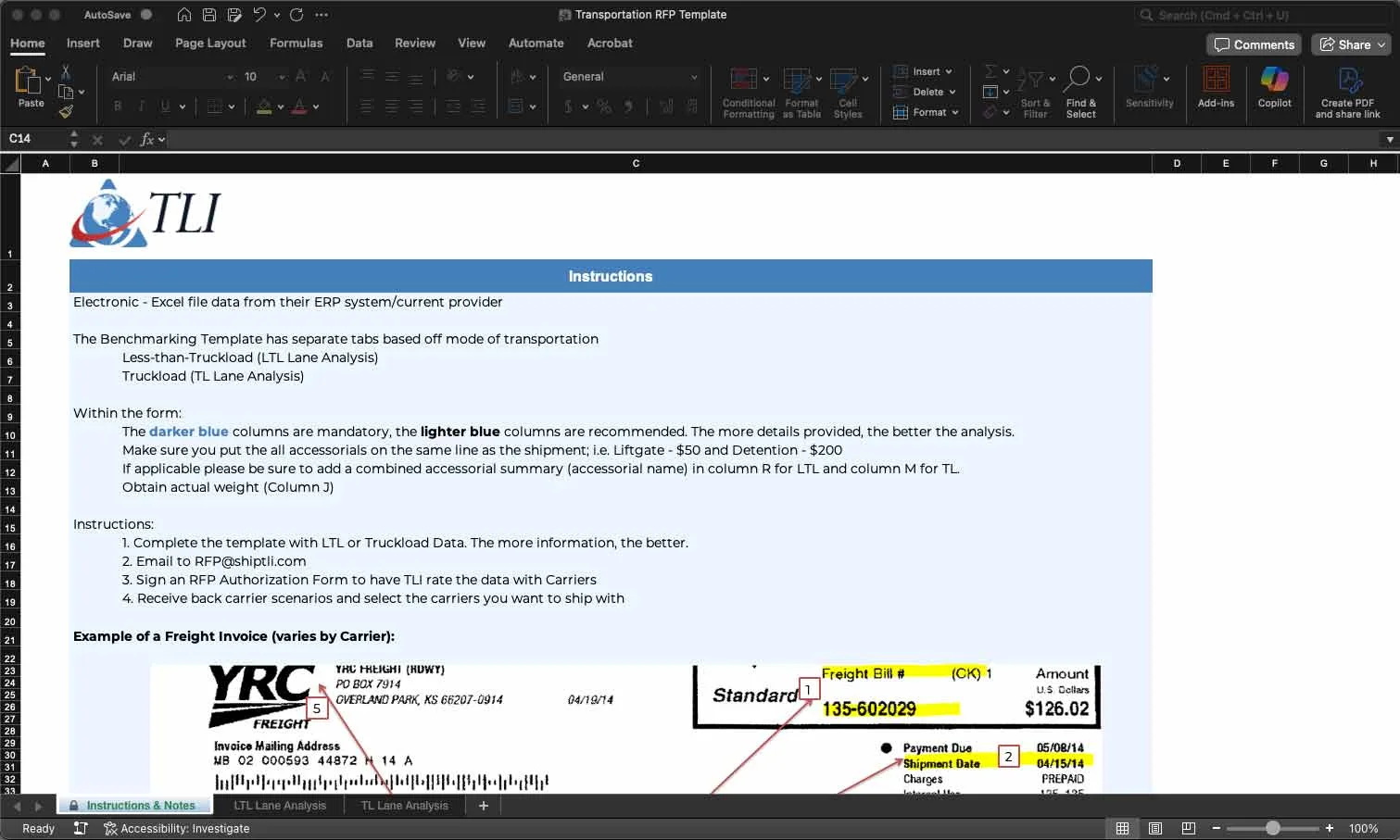
Build the Quantitative and Qualitative Sections
An effective RFP for transportation services has two parts:
Quantitative: Lane-level volume commitments, rate structure (base rate + accessorials), service days, and any minimum performance thresholds. Be specific. Provide Origin-Destination pairs at the ZIP code level. Specify average weight, frequency of shipments per week, and seasonal peaks.
Qualitative: Carrier background, safety performance, technology capabilities (TMS integration, EDI, API connections, real-time tracking), insurance limits, financial stability, sustainability certifications (SmartWay, for example), and customer references.
Asking for both gives you a complete picture. A 3PL has the rating tools and carrier relationships to evaluate both sides objectively. For example, a carrier with an attractive rate but poor on-time delivery or weak technology integration will cost you more in operational friction than the rate savings are worth.
Set Fair Accessorial Terms
Accessorials (fuel surcharges, liftgate fees, residential delivery, inside delivery, hazmat handling) often add 10–30% or more to a base rate. A trucking RFP that focuses only on base rates and ignores accessorials is like negotiating a car price and ignoring the financing terms.
Map the accessorials you actually incur from your historical data and require carriers to price each one explicitly. A 3PL’s rating engine can model your true accessorial exposure so carriers are pricing against real usage data rather than guessing. This will lead to more competitive, accurate bids.
Define the Award Structure
Decide before you launch how you will award lanes. Common structures include:
- Primary carrier + backup carrier per lane: Provides service continuity if the primary declines a tender.
- Volume thresholds: Award 70–80% of a lane to a primary carrier with a secondary taking the rest.
A 3PL can run simulations through a rating engine to compare total landed cost across scenarios, not just per-lane rates. A carrier with a slightly higher line-haul rate but lower accessorials and better fuel surcharge tables may actually save money in aggregate. The right tools make that analysis clear before any award decision is made.
Communicate Clearly and Protect Your Timeline
When you send a freight RFP out, be explicit: tell them how many bid rounds to expect, when responses are due, when you will make awards, and when new rates take effect. Changing parameters mid-bid tells carriers you’re disorganized and gives them reason to hedge on pricing or service commitments.
Give carriers enough time to analyze your lanes and respond thoughtfully. Two to three weeks for initial pricing is reasonable. Another two weeks after contracts are published to begin tendering under new rates is a typical timeline.
Utilizing a 3PL helps manage all carrier communication, follow-up, and negotiation throughout this process. Once lanes are awarded, the 3PL continues to track carrier performance against the commitments made during the RFP, keeping them accountable in ways that are difficult to do without dedicated tools and established carrier relationships.
The RFP vs. the Shipping RFQ: Know the Difference
A shipping RFQ (request for quotation) is narrower in scope. You use it when you have a defined, specific requirement (a single lane, a spot shipment, or a short-term project) and you want apples-to-apples price quotes from multiple carriers. The RFQ doesn’t ask carriers to propose a solution; it asks them to price a singular shipment.
Use a shipping RFQ when:
- You need spot market pricing for a specific load
- You’re testing a carrier’s pricing on a lane before adding them to your formal RFP pool
- You’re benchmarking your current contract rates against market
Use a full RFP for transportation services when:
- You’re running your annual carrier bid cycle
- You’re expanding into new regions or modes
- You’re building a new routing guide from scratch
- Your current carrier performance has deteriorated and you need fresh competition
Common Mistakes That Kill a Transportation RFP
Annualizing Seasonal Volume
If your freight peaks heavily in Q4, don’t spread that volume evenly across 52 weeks in your bid data. Carriers who see a realistic seasonality profile will plan capacity accordingly. Carriers who get surprised by peak volumes will reject tenders when it matters most.
Chasing the Lowest Rate without Context
Different discount ratios mean nothing if carriers use different base rates. You need a rating engine that runs your actual historical shipments through each carrier’s proposed contract to get a true total-cost comparison.
Inviting too many or too Few Carriers.
A freight RFP with 30 carriers generates noise and administrative burden with diminishing returns. Most shippers operate best with a core group of four to six asset-based carriers who can cover the majority of their network, supplemented by brokerage for overflow and spot freight.
Not Monitoring Your Carriers
The number of motor carriers with operating authority dropped by about 13,000 (3.7%) in 2024 according to FMCSA data.3 Awarding lanes to a financially stressed carrier is a service risk. Pull CSA safety scores and check insurance certificates for valid coverage.
Skipping Operations Input
The people who actually execute freight (dock managers, operations supervisors, distribution center staff) often know which carriers reliably show up on time and which ones don’t. Procurement teams that write an RFP without input from operations frequently award to carriers who look good on paper but underperform in the field.
Timing Your Freight RFP to the Market Cycle
Market timing matters. Running a trucking RFP during a freight recession, when carrier capacity exceeds demand, gives shippers significant pricing leverage. Running the same bid in a tight market, when carriers have abundant freight alternatives, produces a very different result.
The freight market as of early 2026 sits at an interesting inflection point. Carrier capacity has contracted significantly over the past three years. As mentioned earlier, FMCSA data shows that property carriers with operating authority fell 11.4% from December 2022 to December 2025.2 At the same, demand for shipments is rising, with the dry van load-to-truck ratio reaching 10.6 at the end of March 2026, according to DAT Freight & Analytics.5
Shippers who ran RFPs and locked in contracts during the softer 2023–2024 freight environment positioned themselves well. Those who delayed procurement face renegotiating in a market that increasingly favors carriers.
What Carriers Actually Want to See
Carriers are businesses. They price based on risk. The more certainty and predictability you offer, the better pricing you attract.
Carriers want to know:
- Volume consistency (will you actually tender the loads you committed to?)
- Lane density (does your freight build a driver’s trip back home, or does it strand them?)
- Operational complexity (how difficult are your pickup and delivery locations?)
- Payment terms (net-15 beats net-45 in a carrier’s pricing model)
- Relationship and growth potential
The best RFP for transportation services treats carriers as partners, not vendors. Shippers who build a reputation for fair dealing, accurate data, and consistent tendering attract better capacity and better rates over time. Shippers who constantly chase the market rate and switch carriers on price alone find themselves at the back of the line when capacity gets tight.
A Simple RFP Checklist to Get Started
Before you send your next transportation RFP, work through this list:
- Pull 12 months of clean shipment history with weights, dimensions, and accessorials
- Define your procurement goals (cost reduction, service improvement, carrier consolidation)
- Build a steering committee with procurement and operations
- Identify your target carrier pool (4–8 carriers minimum)
- Decide your award structure (primary/backup, volume splits, mode segmentation)
- Write clear, complete qualitative questions covering safety, technology, and financial stability
- Set a firm timeline with no mid-process changes
- Use a rating engine to simulate total cost not just per-lane rates
- Plan for seasonal volume accurately
- Communicate award decisions to all participating carriers, including those not selected
Ready to Run Your Next Transportation RFP? Let TLI Do the Heavy Lifting.
A well-executed RFP for transportation services shapes your carrier network, controls your freight spend, and protects your service levels for the next 12 to 24 months. But building one correctly takes clean data, market expertise, carrier relationships, and a rating engine that runs real simulations on your actual freight. Most procurement teams don’t have all of that in-house, and that’s exactly where Translogistics, Inc. (TLI) comes in.
TLI manages the entire freight RFP process on your behalf, from data cleansing and lane analysis to carrier outreach, bid management, and final award simulations. Their team knows when to launch a trucking RFP based on market conditions, how to structure accessorials so carriers price competitively, and how to use their proprietary ViewPoint TMS to model total landed cost across every carrier scenario, not just the headline rate.
If you’re ready to stop guessing at your transportation spend and start negotiating from a position of strength, contact TLI to get your freight RFP started today.
Run an RFP through TLIFrequently Asked Questions
An RFP in transportation is a formal request for proposals from service providers. It outlines requirements, expectations, and timelines to help businesses select the best transportation partner.
Yes, ChatGPT can draft an RFP response by organizing content and creating professional language. You must review and customize it with your service details and pricing.
The seven RFP steps are: define requirements, develop the RFP, identify vendors, issue the RFP, review proposals, conduct interviews or presentations, and select a vendor.
An RFP seeks the best solution and evaluates proposals on quality and approach, while an RFQ focuses on pricing for a clearly defined service. Use RFPs for complex needs and RFQs for straightforward purchases.
Footnotes
- American Trucking Associations. “Economics and Industry Data.” https://trucking.org/economics-and-industry-data. Accessed April 2026. ↩︎
- FleetOwner. “Trucking Capacity reached a Bottom; 2026 Just Needs Better Freight Demand”. (Article). https://www.fleetowner.com/news/article/55352178/trucking-capacity-reached-a-bottom-2026-just-needs-better-freight-rates. Accessed April 2026. ↩︎
- FleetOwner. “Trucking Capacity reached a Bottom; 2026 Just Needs Better Freight Demand”. (Article). https://www.fleetowner.com/news/article/55352178/trucking-capacity-reached-a-bottom-2026-just-needs-better-freight-rates. Accessed April 2026. ↩︎
- FleetOwner. “Trucking Capacity reached a Bottom; 2026 Just Needs Better Freight Demand”. (Article). https://www.fleetowner.com/news/article/55352178/trucking-capacity-reached-a-bottom-2026-just-needs-better-freight-rates. Accessed April 2026. ↩︎
- DAT Freight & Analytics. “Price pressures build as available capacity tightens.” (The Trucker). https://www.thetrucker.com/trucking-news/business/dat-price-pressures-build-as-available-capacity-tightens. Accessed April 9, 2026. ↩︎
