

Outsourcing freight management to a 3PL like TLI typically reduces transportation costs by 10–25% while removing the overhead of managing an internal logistics team. Carriers change capacity, regulations shift, and freight rates fluctuate constantly. Businesses that try to manage all of this in-house often spend more time reacting to problems than running their operations.
Working with a dedicated freight management partner gives you access to an established carrier network, a Transportation Management System (TMS), and logistics professionals who handle carrier selection, rate negotiation, shipment tracking, freight audit, and claims on your behalf. The result is lower costs, better visibility, and a logistics operation that scales with your business.
The need to outsource freight management continues to rise as supply chains expand. Businesses move products faster and across wider regions. A skilled partner keeps you competitive while eliminating wasted effort.
Benefits of Outsourcing Freight Management
Cost Savings and Improved Efficiency
Every business looks for ways to cut costs, and freight bills often hide extra fees or errors. When you outsource freight management, experts audit invoices and recover overcharges. This keeps carriers accountable and saves money over time.
Outsourcing also drives efficiency. Freight partners use transportation management systems (TMS) to automate booking, tracking, and reporting. These systems minimize delays, improve visibility, and keep shipments on schedule. Happy customers follow consistent delivery performance.
Outsourced partners increase buying power, too. They leverage volume across many clients to negotiate stronger carrier rates. Those savings flow directly to your business.
Managing carriers manually drains staff resources. Employees waste hours chasing updates or resolving disputes. By outsourcing, you free your team to focus on growth initiatives instead of paperwork.
Scalability and Access to Technology
As your business grows, outsourcing scales with you. Freight partners expand resources without requiring you to hire more staff or build new systems. They bring flexible solutions that match your growth curve.
You also gain access to advanced tools. A strong TMS, real-time shipment tracking, IoT-enabled sensors, and data dashboards become available when you outsource freight management. Smaller companies often cannot afford these systems independently, but outsourcing makes them accessible.1 Large enterprises also benefit since the technology comes with expert services that maximize results.
With the right partner, outsourcing delivers not only cost savings but also strategic advantages. Better tracking, stronger visibility, and faster deliveries lead to improved customer satisfaction and loyalty.
Risk Reduction and Peace of Mind
Shipping always carries risk. Damaged goods, delayed deliveries, and compliance issues can hurt your bottom line. When you outsource freight management, logistics providers absorb much of that risk. They handle cargo claims, disputes, and resolutions quickly.
Experienced partners maintain strong carrier relationships, which helps resolve problems faster. Their risk management tools also protect freight before issues arise. At TLI, for example, we use Highway to carefully vet carriers, verify Certificates of Insurance, and prevent double brokering. This screening protects shippers from unethical practices like freight theft or hostage situations.
With safeguards in place, outsourcing provides peace of mind. You know shipments are protected, disruptions are minimized, and your supply chain runs smoothly. This stability gives you confidence to expand into new markets.
Why Businesses Choose Outsourcing Freight Management
Choosing to outsource freight management gives businesses a competitive edge. It reduces costs, improves efficiency, and frees teams to focus on strategic growth. Providers deliver technology, expertise, and risk management that most businesses cannot build on their own.
When Should You Outsource Freight Management?
Outsourcing is not the right move for every business at every stage. These five triggers are reliable signs that your freight program has outgrown what an internal team can manage effectively.
- You are shipping 50 or more loads per month
At this volume, managing carrier relationships, rate negotiations, and shipment tracking manually becomes a full-time job. A 3PL brings the systems and staff to handle that volume without adding headcount on your end. - You do not have a Transportation Management System
Without a TMS, your team is likely relying on email, spreadsheets, or individual carrier portals to manage freight. This creates gaps in visibility, makes auditing invoices difficult, and leaves you without the data needed to negotiate better rates. - Your carrier invoice dispute rate is high
If your team regularly finds billing errors, unexpected accessorial charges, or overcharges on freight invoices, that is a sign your current process lacks the audit controls a 3PL provides. Freight audit alone often recovers enough to offset the cost of outsourcing. - Your internal team is spending more time on logistics than on core work
When operations, sales, or finance staff are regularly pulled into freight issues, it signals that logistics has grown beyond a background function. Outsourcing returns that time to the work that drives your business forward. - You are expanding into new lanes, regions, or freight modes
Entering new markets or adding modes like flatbed, temperature-controlled, or international freight requires carrier relationships and compliance knowledge your team may not have. A 3PL with national coverage and multi-mode expertise removes that barrier immediately.
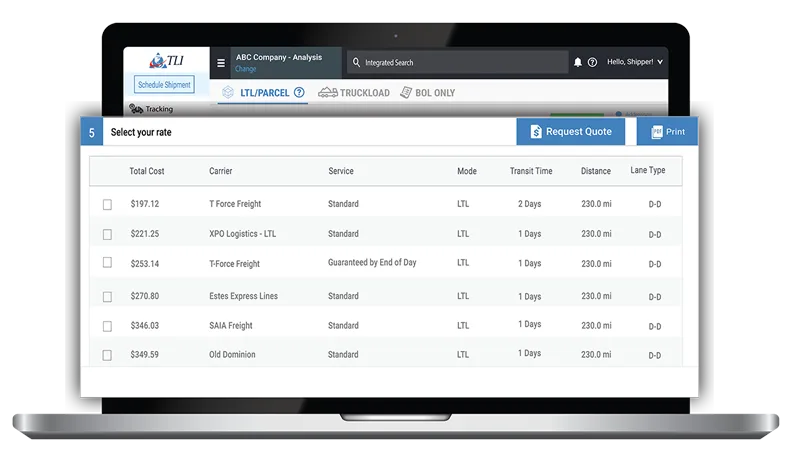
In-House Logistics vs. Outsourcing Freight Management to a 3PL
Deciding whether to manage freight internally or partner with a 3PL comes down to cost, capability, and capacity. The table below breaks down how the two approaches compare across the factors that matter most to growing businesses.
| Factor | In-House Logistics | Outsourced 3PL (TLI) |
|---|---|---|
| Cost Structure | Fixed Overhead; staff salaries, benefits, training, and software licenses regardless of shipment volume | Variable costs tied to freight spend |
| Technology Access | TMS and tracking tools require significant upfront investment and ongoing IT support | One web-based TMS with tracking tools and data reporting for all shipments |
| Scalability | Adding volume means hiring staff, expanding systems, and increasing fixed costs | Scales up or down with your business without adding internal resources |
| Visibility | Limited to the carriers and portals your team manages directly | Single dashboard visibility across all carriers, modes, and lanes through ViewPoint TMS |
| Expertise | Dependent on the knowledge and availability of your internal team | Dedicated logistics professionals with established carrier relationships |
Frequently Asked Questions
Outsourcing freight management means partnering with a third-party logistics provider (3PL) to handle carrier selection, rate negotiation, shipment booking, tracking, freight audit, and claims on your behalf. Instead of managing these tasks internally, your 3PL takes ownership of the process and the technology required to run it.
While some 3PLs charge a flat management fee on-top of rates, TLI structures our costs as all in rates. Companies that outsource freight management typically save 10–25% on transportation costs through better carrier contracts, smarter routing, and reduced billing errors.
Managed transportation is when a shipper hands off all or most of their freight operations to a third-party logistics provider (3PL). The Bureau of Transportation Statistics defines 3PL as the outsourcing of a company’s logistics operations to a specialized company, allowing shippers to focus on their core business while transportation, carrier management, and related functions are handled by experts.2 At TLI, managed transportation covers carrier procurement, routing, shipment tracking, freight audit, claims management, and reporting through our ViewPoint TMS platform.
Onboarding for managed transportation with a 3PL typically takes 30 days depending on the complexity of your freight program. A straightforward LTL program with existing carrier relationships can be set up faster, while programs involving multiple modes, custom routing guides, ERP integrations, or large carrier networks take longer. At TLI, we work through a structured onboarding process that covers carrier setup, TMS access, routing rules, and team training before your first shipment moves.
Footnotes
- University of Tennessee Supply Chain Institute, “Third-Party Logistics Provider White Paper,” Supply Chain Management Research, https://supplychainmanagement.utk.edu/research/white-papers/third-party-logistics-provider-white-paper/ ↩︎
- Bureau of Transportation Statistics, “Third-Party Logistics,” Freight Transportation, https://www.bts.gov ↩︎
