
What’s Right for Your Freight Program?
Every growing company reaches a crossroads in its freight operations: keep building the logistics team internally, or delegate freight management over to a third-party logistics provider (3PL)? It’s a decision that affects costs, service levels, and internal resources, and the answer isn’t the same for every business.
This guide breaks down the real trade-offs between managing freight in-house and partnering with a 3PL, so you can make the right call for where your company is today and where it’s heading.
Neither model is universally better. In-house control works well for companies with stable, low-volume freight in a single mode. A 3PL or managed transportation provider delivers more value when freight complexity, carrier management burden, and technology gaps are limiting your team. If you’re managing freight RFPs, shipment reclassification issues, billing discrepancies, and cargo claims, selecting the right supply chain partner becomes a straightforward decision.

What does “In-House Logistics” actually mean?
An in-house logistics team means your company directly employs the people responsible for managing freight and transportation operations every single day. On paper, it sounds straightforward. In reality, it adds another complex operational layer to teams that are already stretched thin running production, managing inventory, and fulfilling customer orders.
These internal teams typically handle:
- Production schedules and manufacturing deadlines
- Inventory planning and warehouse capacity
- Picking, packing, and order fulfillment workflows
- Customer service escalations and delivery expectations
- Procurement coordination and supplier timelines
- Filing and managing freight claims
- Handling billing disputes, reclassifications, and accessorial charges
- Booking freight shipments and scheduling pickups
- Finance requests, cost tracking, and budget accountability
It becomes a constant whirlwind of decisions, emails, approvals, and data requests. Freight data management alone can overwhelm internal teams. Rates, accessorials, transit times, contract terms, and invoice line items all live in different systems, or worse, spreadsheets! Without the right transportation management system (TMS) and automation tools, teams spend more time chasing information than making strategic supply chain decisions.

What Is a 3PL (and What Is Managed Transportation)?
A 3PL, third-party logistics provider, takes over some or all of your freight operations. The level of involvement varies significantly:
- Transactional brokers find capacity for individual loads. You still manage the program.
- Managed transportation providers act as an outsourced logistics department: running your RFPs, managing day-to-day load execution, providing TMS technology, handling freight audit and claims, and delivering reporting.
TLI operates as a managed transportation provider. That distinction matters because it changes the scope of what’s being outsourced: not just individual loads, but the entire freight program.
Side-by-Side Comparison
Here’s how the two supply chain models stack up across the factors that matter most to shippers:
| Factor | In-House Team | 3PL / Managed Transportation |
|---|---|---|
| Carrier network | Built over time; limited by headcount and relationships | Instant access to vetted carrier network (TLI: 30,000+ carriers) |
| Technology | Requires TMS investment, integration, and ongoing IT support | TMS included; ERP integrations handled by provider |
| Cost visibility | Manual invoice reconciliation; errors common | Automated freight audit; billing exceptions caught before payment |
| Scalability | Adding volume means adding headcount | Scales with your freight without proportional cost increase |
| Expertise | Dependent on individual staff knowledge | Deep modal and market expertise across your provider’s team |
| RFP capability | Time-intensive; have to pay for licensing and rating engine RFP comparison tools | Dedicated RFP management; data-driven lane optimization |
| Flexibility | Full control over every decision | Shared decisions; provider executes within agreed framework |
| Speed to value | Months to build processes and carrier base | Operational quickly; carrier relationships already in place |
| Cost structure | Fixed: salaries, benefits, overhead | Variable: tied to freight volume and program scope |
When In-House Logistics Makes Sense
There are real scenarios where building and maintaining an internal team is the right call:
You ship in one mode at very high volume
If 95% of your freight is full truckload on a handful of dedicated lanes, and you have the consistent volume to negotiate direct carrier contracts, an in-house team can manage that efficiently. Complexity is low; execution is repetitive.
You have a highly specialized product requiring unique handling
Some commodities: oversized industrial equipment, hazmat waste, dangerous goods, or freight requiring unique specialized equipment, may be better managed by a team with deep institutional knowledge of your specific product and its quirks.
Freight is a genuine competitive advantage
In a small number of industries, logistics speed and precision is part of the value proposition. Industry giants like Amazon, Walmart, and large grocery chains invest heavily in proprietary logistics infrastructure because the capability IS the product. For most manufacturers and distributors, this doesn’t apply.

When does a 3PL or Managed Transportation Provider Partnership Makes Sense?
For most mid-market and enterprise shippers, the ideal strategy favors outsourcing at least part of the freight program. Here’s why:
You’re shipping across multiple modes
Managing LTL, truckload, intermodal, expedite, and parcel simultaneously requires different carrier relationships, different pricing structures, and different tracking capabilities. A 3PL with a multi-modal TMS handles this under one roof.
Carrier management is consuming your team
Effective carrier management requires more than booking loads, it demands thorough carrier vetting, performance monitoring, compliance checks, and the right transportation management software to keep everything organized. As shipment volume increases, teams must evaluate carrier safety scores, insurance coverage, service history, on-time performance, and rate competitiveness while managing capacity in real time. Without a modern TMS, carrier portals, inbound vendor portals and automated freight audit tools, these processes quickly become manual, fragmented, and error-prone.
You’re not running a formal carrier RFP
Shippers don’t just face market volatility, they also absorb annual general rate increases that quietly push transportation costs higher even when volumes stay flat. Running a competitive RFP is the most effective way to reset those costs, but doing it right takes more than internal personnel and spreadsheets.
If your team hasn’t run a structured carrier bid in the past 18–24 months, you’re likely overpaying. Markets shift, rates change, and capacity tightens, so yesterday’s pricing rarely holds up. By contrast, a 3PL can run a data-driven RFP on your behalf, create real competition among carriers, and typically unlock 8–15% in transportation cost savings.
TLI uses advanced rating engines to model multiple pricing scenarios, run true tariff discount comparisons, and quantify savings with precision. This TLI dream team conducts detailed accessorial analyses to uncover hidden cost drivers, performs hundredweight (CWT) and weight-break studies to optimize pricing tiers, and engineers programs around how your freight actually moves, not generic assumptions. The result is a transportation program tailored to your real-world shipping profile, built with data, validated by technology, and structured to deliver measurable savings.
Your technology is holding you back
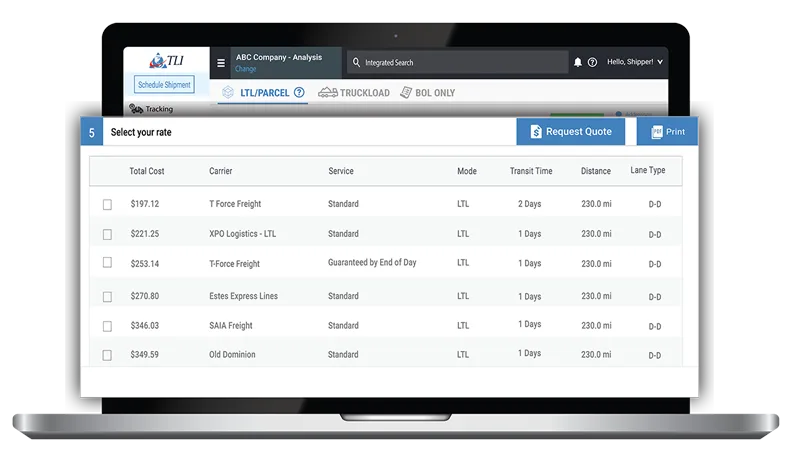
Many shippers simply don’t have the technology stack required to truly optimize their transportation programs. Optimization goes far beyond the basics like mode selection, linear-foot utilization, or contract rate reviews. With the right tools, you can analyze lanes for contract opportunities, model network flows, and even run distribution center location studies to reduce total landed costs.
Serious optimization requires a rating engine to test pricing scenarios, a robust TMS to manage execution and data visibility, and proven logistics RFP templates and processes to drive competitive bids. Likewise, the tools to audit the freight bills, and submit cargo claims. Just as important, it takes an experienced team, like the specialists at Translogistics, who know how to bring all these tools together, structure the event properly, and turn complex data into a transportation program that actually performs.
Freight is growing faster than your team can scale
Hiring, onboarding, and retaining experienced logistics professionals takes time, time most supply chains don’t have. A strong 3PL scales with your freight program immediately, giving you instant access to people, processes, and carrier capacity without the lag of building an internal team. Need to add a new mode of transportation? Just win a customer that ships on unfamiliar lanes? Bringing on a key vendor and want to ensure they’re consolidating freight properly and selecting the lowest-cost provider every time? These shifts happen fast, and internal teams often struggle to keep pace. That’s why shippers partner with 3PLs, so their transportation strategy can adapt as quickly as their business grows.
Quick Self-Assessment:
Not sure which model fits your situation? Use these signal lists as a starting point:
Signs you might benefit from a 3PL
- Freight invoices frequently have errors or surprises
- Your team books freight manually or via carrier portals
- You haven’t run a carrier RFP in 2+ years
- You ship multiple modes with different carrier sets
- Freight exceptions are handled reactively, not proactively
- You lack real-time shipment visibility
- Freight spend is growing but staffing can’t keep up
Signs in-house may be working well
- Freight is primarily full truckload on stable lanes
- Your team regularly benchmarks carrier rates
- You have a functioning TMS with ERP integration
- OTIF performance consistently meets targets
- Claims and audit are handled systematically and automatically
- Carrier RFPs happen on a defined cycle, with multi-modal focus
- Not sure where to gather data for supply chain analysis, nor what to interpret
The Hybrid Model: More Common Than You’d Think
Many shippers don’t fully outsource, they use a managed transportation provider to fill specific gaps. Common hybrid approaches include:
- Using a 3PL for multi-modal execution while keeping a single internal logistics manager as the strategic owner
- Outsourcing the annual carrier RFP process while handling day-to-day load execution and carrier selection in-house
- Using a 3PL’s TMS and carrier network while retaining freight audit and reporting internally
- Transitioning overflow or secondary-mode freight to a 3PL while keeping core lanes direct
The right split depends on where your team’s time is best spent and where outside expertise creates the most leverage. There’s no universal answer to the 3PL vs. in-house debate, but there is a practical framework. If your freight is simple, stable, and your team is performing, in-house management may be the right choice. If you’re dealing with multi-modal complexity, technology gaps, carrier management burden, or a team that’s stretched thin, a managed transportation provider can deliver measurable cost savings and free your team to focus on the work that actually grows the business.
The best 3PLs don’t just move freight, they take ownership of the program, bring supply chain technology you’d otherwise have to build, and deliver the data visibility that turns freight from a cost center into a strategic advantage.
Ready to see what a managed transportation program looks like in practice? Call TLI at 610-280-3210 or visit shiptli.com/transportation-rfp/ to request a freight program assessment. We’ll analyze your current spend, carrier mix, and operations, and show you exactly where the opportunities are.
About TLI

Translogistics Inc. (TLI) is a managed transportation services provider headquartered in Exton, PA. With 30+ years of experience, 30,000+ vetted carriers, and a proprietary TMS platform (ViewPoint), TLI manages freight programs for mid-market and enterprise shippers across the U.S. EPA SmartWay Certified. Rated #1 3PL on Google.
