
The Hidden Cost of Inefficient Transportation Procurement
Transportation costs represent up to 58% of total logistics expenses for many companies, making freight procurement one of the most impactful areas for cost reduction. Yet many shippers with annual transportation spends between $100,000 and $15 million continue using outdated RFP processes that leave substantial savings on the table.
Traditional annual RFP cycles render contract rates obsolete within six months, forcing shippers to overpay during soft markets and face service failures during tight markets. Research from MIT Freight Labs explains that “The output of the annual RFP stage consists of an allocation of specific carriers to specific lanes, sometimes with forecasted volumes or maximum capacity levels. These assignments are then fed into the routing guide which is at the centre of a shipper’s transportation management system (TMS).”1 The solution isn’t more frequent RFPs, it’s smarter, data-driven procurement managed by logistics experts who understand both shipper needs and carrier economics. It also entails embracing supply chain technology to empower dynamic routing guides to ensure the proper mode, and least cost carrier are automatically utilized.
Understanding the True Value of Professional RFP Management
What is a Transportation RFP?
A transportation Request for Proposal (RFP) is a structured process through which shippers solicit bids from carriers to move a forecasted portion of freight volume. As Maria Lucchi of Pennsylvania State University explains, “An RFP is initiated by a shipper or a third party acting on behalf of a shipper. A shipper forecasts its freight needs and invites carriers to bid on a portion of that volume. Even if a shipper contracts all its forecasted volume through an RFP, there is no promise that all this volume will be executed according to the RFP strategy. Contracts between shippers and carriers do not guarantee load coverage, since carriers are neither required to accept a load tendered to them nor are shippers responsible when their forecasted volumes awarded to carriers do not materialize as expected. For these reasons, it is the execution of these contracts that poses the greatest challenge for shippers and carriers alike” (Lucchi, 2019).2
In practice, managing an RFP is especially complex for Less‑Than‑Truckload (LTL) shipments. LTL operations involve multiple stops, diverse shipment sizes, variable service levels, and intricate routing requirements, creating far more parameters to manage than a standard truckload shipment. This complexity makes technology like a Transportation Management System (TMS) essential. Just as you cannot build a house without a hammer, you cannot successfully launch and execute an RFP without a TMS. Modern freight pricing is dynamic and sophisticated, and relying on static spreadsheets is no longer viable. There are many contract types that all should play a role in enterprise specific needs, such as tariff based, linear feet based, density based, point-to-point pricing amongst others. A TMS provides visibility, automation in rating against multiple contract types, and analytical tools that allow shippers to forecast accurately, evaluate bids effectively, and optimize execution across carriers and lanes, turning the RFP from a manual administrative process into a strategic lever for cost savings and operational efficiency.
The Data Quality Problem
Most shippers fail to realize that incomplete or poorly structured data is the single biggest obstacle to achieving optimal freight rates. Carriers operate on a simple principle: “If I have to guess, I have to hedge.” When shippers provide incomplete shipment data, carriers build risk premiums into their pricing, often 10-20% above what they would quote with complete information.
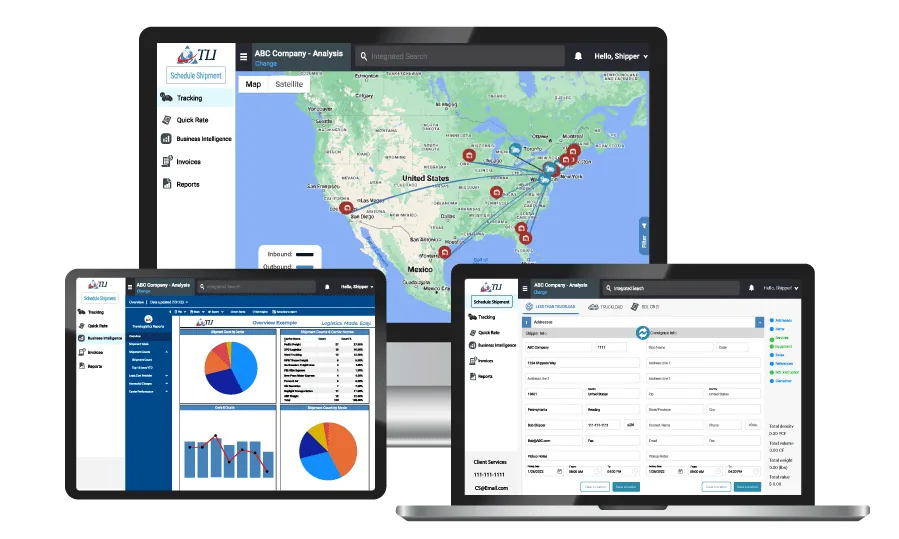
For Full Truckload (FTL) procurement, optimal RFP results require:
- Pro numbers
- Pickup date
- Carrier identification
- Origin and destination details (city, state, ZIP, country)
- Precise weight, piece count, and pallet counts
- Complete charge breakdowns (linehaul, fuel, accessorials)
For Less-Than-Truckload (LTL) procurement, the data requirements are more extensive:
- BOL numbers with actual dates
- Carrier SCAC
- Origin-destination pairs with ZIP codes
- Line-item weights by freight class
- Dimensional data (length, width, height) for density calculations
- Actual and FAK (Freight-All-Kinds) class applications
- NMFC™ codes or commodity descriptions
- Detailed accessorial charges (liftgate, residential delivery, limited access, etc.)
The cost of missing data: Missing data directly increases shipping costs. When dimensional data is not captured, shippers lose access to density based pricing programs that can be more competitive than traditional class based contracts. Undefined accessorial patterns force carriers to price in uncertainty, which drives up base rates. Cargo liability is another common gap. When coverage needs are unclear, shippers either over insure, limiting rate flexibility, or under insure, creating risk exposure. While TLI can add cargo insurance during bill of lading creation, proactive and accurate data management leads to better pricing, lower risk, and more predictable outcomes.
Why Professional RFP Management Outperforms DIY Approaches
Competitive bidding through properly managed RFPs reduces freight rates by 8-15% compared to non-competitive renewal processes. However, achieving these results requires expertise that most internal teams lack:
Market Timing Expertise
Launching an RFP during peak season versus soft market conditions can impact final rates by 15-25%. Professional logistics providers monitor capacity trends, seasonal patterns, and regional market conditions to time bid events optimally.
Carrier Relationship Management
The average annual RFP takes 14 weeks from preparation to implementation. During this time, managing carrier questions, addressing concerns, and negotiating terms requires dedicated resources and industry relationships that internal teams often cannot maintain.
Data Normalization and Analysis
Raw shipment data requires extensive cleansing, normalization, and enrichment before carriers can price accurately. Professional RFP managers use sophisticated rating engines to:
- Identify pricing anomalies and outliers
- Create carrier-specific lane packages that optimize their network economics
- Benchmark proposed rates against market intelligence
- Run what-if scenarios comparing different carrier combinations
Real Data-Driven FTL/LTL Contract Optimization
Research indicates that selecting carriers whose network structures align with a shipper’s traffic patterns can significantly reduce overall transportation costs. When carriers are well matched to a shipper’s lanes, they are more likely to accept freight and operate efficiently, resulting in improved service reliability and lower costs. This perspective is supported by Angela Acocella and Chris Caplice of the Massachusetts Institute of Technology Center for Transportation & Logistics, who observe the limitations of traditional coverage-based contracting strategies:
“Due to TL supply and demand uncertainty, shippers often adopt a coverage strategy to ensure contracted capacity is secured on combinations of lanes on which demand is expected. However, this strategy leads to unnecessary costs and inefficiencies. We find that a large percentage of shippers’ lanes never end up being utilized. We refer to contracted lanes on which no business materializes as ghost lanes. In this study, we characterize ghost lanes to help shippers identify which lanes need not be contracted in the first place to reduce existing startup costs.
When none of the expected business on ghost lanes materializes, this disrupts carriers’ network balance and operating efficiencies and impacts service levels to other customers. We empirically demonstrate how the disruptions from ghost lanes from a shipper in one year factor into carriers’ performance and pricing decisions the following year.”3
These findings highlight the importance of evaluating the data integrity to ensure the lanes are actually active and predictable. Expecting a carrier to offer capacity and deliver reliable performance takes collaborative efforts on the front end with the data, while many shippers are using criteria of price alone. Metrics such as primary carrier acceptance rates, on-time delivery performance, and other service indicators more accurately reflect real-world execution. Academic research further demonstrates that consistent lanes with predictable volumes tend to yield higher carrier acceptance rates and lower transportation costs than volatile or irregular lanes, which often experience higher rejection rates and increased exposure to the spot market. The spot market certainly has its place in many supply chains, and TLI excels at operating within it, but pricing is more volatile and the carriers must be thoroughly vetted.
Carrier Load Assignment Optimization
Accordingly, carrier assignment optimization should consider lane characteristics, geographic alignment, and demand patterns to ensure that service quality and operational performance are incorporated into procurement decisions, rather than relying solely on bid price. Maria Lucchi of Pennsylvania State University reinforces this view in her paper titled “Truckload Procurement: From State-of-the-Practice to State-of-the-Art”:
“Even if a shipper contracts all its forecasted volume through an RFP, there is no promise that all this volume will be executed according to the RFP strategy. Contracts between shippers and carriers do not guarantee load coverage, since carriers are neither required to accept a load tendered to them nor are shippers responsible when their forecasted volumes awarded to carriers do not materialize as expected. For these reasons, it is the execution of these contracts that poses the greatest challenge for shippers and carriers alike.
Because agreements between shippers and carriers do not require 100% load acceptance, it is critical for shippers to strategically source transportation on a lane-level basis, often through segmentation. Segmentation is the process in which lanes are identified by certain characteristics, such as service level needs, capacity needs, or volatility measures. These characteristics offer a means of further classification so that transportation can be procured strategically.”4
This insight underscores the necessity of lane-level segmentation and data-driven procurement strategies. Transportation Management Systems (TMS) provide tools that enable shippers to analyze and present this information in a structured and carrier-friendly format. The importance of such analysis becomes even more pronounced in less-than-truckload (LTL) freight environments, where pricing and service parameters are more complex. Variables such as hundredweight (CWT),5 pounds per cubic foot (PCF),6 accessorial charges, and mileage breaks introduce additional layers of variability, making strategic segmentation and performance-based carrier selection even more critical. Likewise, the utility of a TMS to deliver this visibility is a critical component for a data-driven transportation RFP initiative.
The 8-15% Cost Reduction: How It’s Achieved
Base Rate Improvements
Well-executed RFPs consistently deliver 8-15% improvements in base transportation rates through several mechanisms:
Competitive Pressure: When carriers know they’re competing against qualified alternatives, pricing sharpens dramatically. Competitive procurement events reduce truckload rates by 2-3% even in tight markets, and ensure a healthy blend of regional players in LTL sourcing events.
Eliminates Information Asymmetry: Carriers use sophisticated analytics to price freight. When shippers provide equally detailed data, carriers can price more accurately and competitively. In our historical experience, detailed RFP data reduces carrier rates by 4-12%.
Network Optimization: Professional RFP managers package lanes to create balanced freight flows that reduce carrier empty miles. This network optimization can reduce per-mile costs by 10-18% on balanced lanes. Likewise, shippers need a TMS tool to automatically determine the proper mode of transportation to use. The consequences, which are amplified on inbound shipments, of making assumptions and guesses on mode optimization can entail being victim to routing a partial or volume load in a dedicated network, or being subject to the cubic capacity rule. Carrier policies regarding cubic capacity are not uniform across the industry, and in some cases, individual carriers apply different cubic capacity rules to different customers based on specific contract structures. At TLI, the most commonly observed cubic capacity threshold is defined as follows:
A shipment is subject to cubic capacity pricing when it exceeds 750 cubic feet and has a density of less than six pounds per cubic foot.
Amplified Savings Through Multi-Location Consolidation
The savings multiply significantly when companies leverage multiple shipping locations together:
Volume Aggregation: Consolidating freight across locations provides carriers with larger volumes that justify lower per-unit rates. Research shows volume consolidation delivers an additional 6-10% in rate improvements beyond competitive bidding alone. At TLI when the ship date and address details are populated we can run consolidation studies on the historical data to provide the opportunity savings figure through consolidation.
Corporate Control and Visibility: Subsidiaries operating independently often pay 15-30% more than they would under a consolidated corporate program. Central procurement provides leverage and standardization that individual locations cannot achieve. There are other benefits that come with data consolidation in the TMS such as the ability of tracking and tracing using your own internal reference numbers, and increased visibility of freight for purchasing and procurement teams. Similarly, perhaps your accounting team needs to run a reconciliation and needs invoice or historically archived PODs, this all takes only seconds if you utilize a TMS system like ViewPoint.
Custom General Ledger Coding: Professional managed transportation providers like TLI offer sophisticated cost allocation:
- By location for P&L accuracy
- By direction type (inbound vs. outbound) for activity-based costing
- By shipment for customer billing accuracy
- By cost center for departmental budgeting
Beyond RFP: Comprehensive Managed Transportation Services
Freight Audit and Payment Services
Transportation invoice errors occur in 2-6% of freight bills, with overcharges averaging $150-$300 per error. Professional freight audit services:
- Validate carrier invoices against contracted rates
- Identify accessorial charge errors and duplications
- Recover overcharges through systematic claims processes
- Provide audit trails for financial compliance
Claims Management
Freight claims management requires specialized expertise, consistent follow-up, and carrier relationship management. Professional providers like those of us at shipTLI:
- Enable claims submission for shippers right in the TMS system
- Document and file claims according to carrier-specific requirements
- Pursue claims through resolution with higher success rates (60-77% vs. 22-37% for shippers)
- Maintain claim history databases to identify problematic lanes or carriers
- Establish exclusionary lanes
- Integrate claim data into carrier performance scorecards
Rating Engine Intelligence
Rather than relying on static bid cycles and historical averages, these rating systems dynamically evaluate carrier pricing, capacity availability, and service performance in real time. This enables shippers to make lane-level and shipment-level decisions that reflect current market conditions, improve carrier alignment, and reduce reliance on spot market coverage. Modern transportation management systems with integrated rating engines transform procurement from periodic events to continuous optimization:
Historical Data Analysis: Rating engines process historical shipment data against new RFP results, quantifying:
- Projected annual savings by carrier and lane
- Service level trade-offs between lowest-cost and best-performing carriers
- Sensitivity analysis showing how volume changes affect total costs
Real-Time Decision Support: As a result of these data driven efforts, procurement becomes an ongoing, data-driven function that balances cost, service, and execution risk instead of a one-time pricing exercise During daily operations, rating engines enable:
- Multi-carrier rate shopping for every shipment
- Automated carrier selection based on cost, service, and preference hierarchies
- Dynamic routing guide updates as market conditions change
- Exception management when primary carriers reject tenders
Market-Responsive Procurement
Transportation markets are cyclical, with power shifting between shippers and carriers on roughly four-year business cycle. This pattern seems to correlate closely with the manufacturing ISM data. Professional managed transportation providers:
- Monitor Market Indicators: Track spot rates, contract rates, tender rejection rates, and capacity metrics to identify market inflections
- Execute Mini-Bids Strategically: Launch targeted procurement events on problematic lanes without disrupting the entire carrier network. Research shows that strategic mini-bids that are project related deliver 2-3% additional savings annually. The repeated use of a carrier also results in better service levels and less risk of fraud.
- Adjust Procurement Tactics: Modify contracting strategies (volume commitments, index-based pricing, tiered rate structures) based on market conditions
Distribution Center Simulations
When a company uses more than one shipping facility in its network, it gains real advantages in both freight cost and customer service. Strategic placement of distribution centers closer to demand hubs lowers overall transportation costs, because products travel shorter distances and carriers can offer better pricing and service on those lanes. Adding facilities also reduces the reliance on long haul shipments, which tends to improve delivery speed and reliability.
Academic research in supply chain network design shows that optimizing the number and location of facilities can reduce total logistics costs and enhance responsiveness to customer needs, as reduced travel distances and better alignment with demand patterns help control transportation spend and service outcomes.7 TLI can take historical data and run simulations based off a new distribution center as point of origin, so you know as a shipper the exact freight savings and transit time impact, such a change would make.
The Risk-Free Value Proposition
Unlike traditional consulting arrangements, TLI’s professional freight RFP and managed transportation services operate on a risk-free model:
- No Forced Commitments: RFP results are recommendations, not binding obligations. If the proposed savings don’t materialize through the analysis, shippers can maintain their status quo without penalty
- Performance-Based Success: The value proposition is straightforward, if the managed transportation provider doesn’t deliver measurable savings and improved service, there’s no reason to proceed with implementation.
- Scalable Solutions: Services scale from basic RFP management for smaller shippers to comprehensive managed transportation for companies with complex, multi-location networks:
$100,000-$500,000 annual spend: RFP management and freight audit
$500,000-$2,000,000 annual spend: Add TMS access and claims management
$2,000,000-$15,000,000 annual spend: Full managed transportation with dedicated account management
$15,000,000+ annual spend: Enterprise solutions with custom ERP integrations
Frequently Asked Questions
Q1: How long does the RFP process typically take?
A: From data collection to final contract implementation, expect 6-10 weeks:
- Weeks 1-2: Data collection, cleansing, and preparation
- Weeks 3-4: Bid distribution and carrier pricing period
- Weeks 5-6: Bid analysis, scenario modeling, and motor carrier recommendations
- Weeks 7-8: Contract finalization and TMS implementation
- Weeks 9-10: Carrier onboarding and transition management
Some carriers inevitably respond late or require clarification, but we maintain momentum and address questions efficiently.
Q2: What if we don’t have complete shipment data?
A: While complete data produces the best results, experienced RFP managers can work with partial data sets:
- Missing dimensions: Can still run class-based pricing, though density-based savings won’t be accessible
- Missing freight classes: Can calculate approximate classes using weight and density, though accuracy decreases
- Missing accessorials: Historical averages can substitute, but specific lane optimization becomes less precise on the front end
- Incomplete origin-destination data: Basic ZIP-to-ZIP modeling works but loses granularity
Best practice: Start with available data to achieve 3-5% savings, then enhance data collection through ViewPoint TMS and proper processes to unlock the full 8-15% savings potential in year two.
Q3: Won’t frequent RFPs damage carrier relationships?
A: This is a common misconception. Strategic procurement actually strengthens carrier relationships:
- Annual RFPs are standard industry practice: Carriers expect annual bid events and build them into their business cycles.
- Professional management maintains relationships: Expert RFP managers communicate clearly, respect carrier timelines, and provide quality data, factors carriers appreciate. An effective TMS system is also integrated into the carriers tech stack empowering automated load tendering.
- Long-term contracts are optional: You can structure two or three-year agreements with annual rate reviews, giving carriers stability while maintaining market-competitive pricing.
- Transparency builds trust: Carriers prefer working with shippers who provide clear expectations, complete data, and professional management over those who threaten to “shop around” but never do.
- Payment Processing: TLI consistently pays the carrier within 30 days and has the technology to come equipped with billing disputes so resolution is swifter.
Q4: How do managed transportation services differ from using a traditional freight broker?
A: The distinction is crucial:
Traditional Freight Brokers:
- Transaction-focused: earn margin on each shipment
- Typically handle spot market and overflow freight
- Not incentivized to reduce your costs (lower rates = lower margins)
- Reactive approach to capacity issues
- Reps change constantly
- Hides their rating in Google reviews and similar resources
- Built for short term service
Managed Transportation Providers:
- Program-focused: earn fees for managing your entire transportation program
- Proactive procurement, mode optimization, and continuous improvement
- Success measured by reducing your total transportation costs
- Strategic approach combining contracted carriers, backup capacity, and spot market
- Provide technology (TMS), reporting, audit, and claims management
- Built for long term relationships and ERP integration
Incentive alignment: Managed transportation providers succeed when you achieve measurable savings and improved service, creating true partnership versus transactional relationships.
Q5: What about our existing carrier relationships?
A: Professional RFP managers respect and preserve valuable carrier relationships:
- Incumbent advantage: Your current carriers can participate in the RFP, often with preferential consideration given their proven performance and understanding of your business. We also give them a chance to counter a lower submission to ensure they have every opportunity to remain competitive.
- Relationship-based carrier selection: Cost isn’t the only factor. Performance history, service levels, capacity reliability, and relationship quality all factor into final recommendations.
- Gradual transitions: New carrier onboarding can be phased, testing performance on small lane sets before shifting significant volumes.
- Win-back opportunities: Incumbents that lose lanes can be given opportunities to match competitive rates before final transitions occur.
- Shippers are in control: TLI provides shippers with scenarios but the shipper is the one who selects each motor carrier they want to be in their program.
Q6: How do you handle specialized shipping requirements?
A: Accessorial requirements and specialty equipment needs are captured at the front end of the procurement process through structured bid questions and clearly defined shipment attributes within the RFP. Shippers explicitly document handling requirements, regulatory constraints, and service expectations so that only appropriately qualified carriers participate and price the freight accurately. Specialized freight requires specialized expertise:
- Hazmat: Carriers with proper certifications and insurance are pre-qualified. RFP documents include specific hazmat requirements (class, UN numbers, placarding) so carriers price accurately.
- Temperature-controlled: Reefer equipment requirements, temperature ranges, and monitoring capabilities are explicitly defined. Carriers quote specific equipment and service level commitments.
- Oversized/heavy haul: Dimensional data and weight specifications ensure carriers with appropriate equipment bid. Permitting requirements and route surveys are factored into lane awards.
- White glove/final mile: Inside delivery, assembly, debris removal, and scheduling windows are detailed. Only carriers with demonstrated capabilities in these services participate.
Q7: What metrics should we track to measure success?
A: Comprehensive performance measurement includes:
Cost Metrics:
- Average cost per shipment (trending over time)
- Cost per mile or hundredweight (normalized for distance/weight)
- Accessorial costs as percentage of total (target: 12-15%)
- Fuel surcharge percentage vs. DOE diesel index (variance should be <2%)
- Year-over-year savings by carrier and lane
Service Metrics:
- On-time pickup percentage (target: >95%)
- On-time delivery percentage (target: >95%)
- Tender acceptance rate by carrier (target: >90% for primary carriers)
- Claims ratio (dollar value of claims / total freight spend, target: <0.5%)
- Average transit time vs. committed transit time
Program Health Metrics:
- Percentage of shipments moving at contracted rates vs. spot (target: >85%)
- Carrier concentration (percentage moving with top 5 carriers, target: 60-75%)
- Invoice accuracy rate (target: >95%)
- Exception handling time (hours from tender rejection to coverage)
Q8: What happens after the first year?
A: Year two and beyond is where compounding value emerges:
Continuous improvement cycle:
- Quarterly business reviews analyzing performance trends
- Mini-bids on projects and underperforming or changing lanes
- Annual contract renewals or extensions based on market conditions
- Progressive data quality improvements unlocking additional savings
- Same-day load consolidation
- Focus on savings related to the inbound program
Enhanced capabilities:
- Integration of TMS data with other business systems like your ERP
- Advanced analytics identifying optimization opportunities
- Proactive capacity planning for seasonal peaks
- Carrier scorecarding driving performance improvements
Organizational benefits:
- Internal staff shifts from tactical execution to strategic focus
- Reduced staffing needs for freight payment and claims processing
- Elimination of crisis management as program matures
- Executive visibility into transportation performance and opportunities
Typical trajectory: Year one achieves 8-15% savings through procurement optimization. Years 2-3 deliver an additional 3-7% through operational improvements, technology leverage, and continuous refinement.
Footnotes:
- Chris Caplice, “Reducing Uncertainty in Freight Transportation Procurement,” Journal of Supply Chain Management, Logistics and Procurement 4, no. 1 (Summer 2021): 1–18, https://bpb-us-e1.wpmucdn.com/sites.mit.edu/dist/5/2080/files/2021/11/jscm_reducing_uncertainty_in_transportation_procurement_aug_2021.pdf. ↩︎
- Maria Lucchi, 2019, “Truckload Procurement: From State-of-the-Practice to State-of-the-Art” https://ctl.mit.edu/sites/ctl.mit.edu/files/theses/Truckload%20Procurement-%20From%20State-of-the-Practice%20to%20State-of-the-Art.pdf ↩︎
- Angela Acocella and Chris Caplice, 2022. “The hidden costs of not-so-friendly ghost lanes” https://dspace.mit.edu/bitstream/handle/1721.1/143780/2022-mitscale-ctl-03.pdf ↩︎
- Maria Lucchi, 2019, “Truckload Procurement: From State-of-the-Practice to State-of-the-Art” https://ctl.mit.edu/sites/ctl.mit.edu/files/theses/Truckload%20Procurement-%20From%20State-of-the-Practice%20to%20State-of-the-Art.pdf ↩︎
- Hundredweight (CWT) is a freight pricing unit equal to 100 pounds, widely used in LTL transportation to calculate shipment charges. ↩︎
- Pounds per cubic foot (PCF) is a freight density metric defined as shipment weight divided by cubic feet of occupied space. In LTL environments, PCF plays a critical role in determining freight Classification, pricing tiers, and carrier capacity efficiency. ↩︎
- Mark S. Daskin, Lawrence V. Snyder, and Rosemary T. Berger. Facility Location in Supply Chain Design https://daskin.engin.umich.edu/wp-content/uploads/sites/133/2014/07/daskinsnyderandberger_geradbook_.pdf ↩︎
